
Dangerous mistake
Field mushroom or death cap? How to tell them apart
Field mushroom is an edible mushroom, while the death cap is a deadly poisonous mushroom. Compare the two mushrooms point by point.
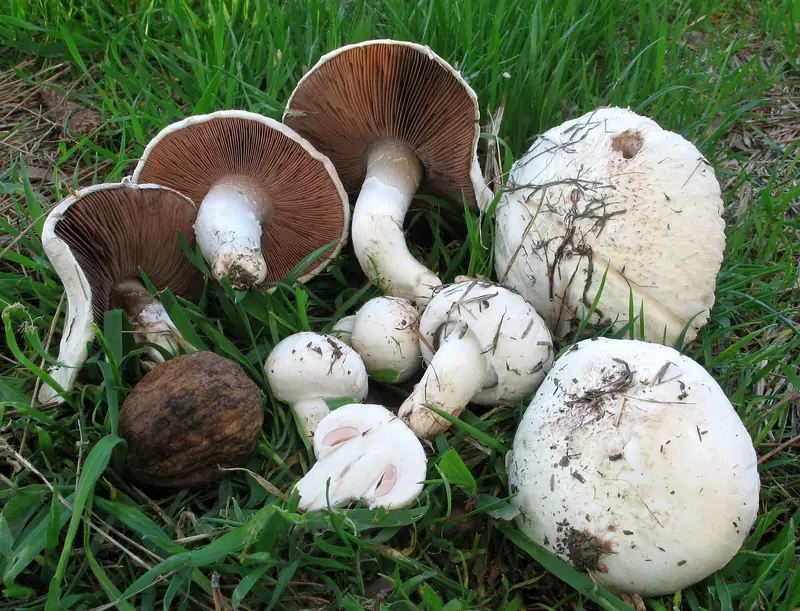
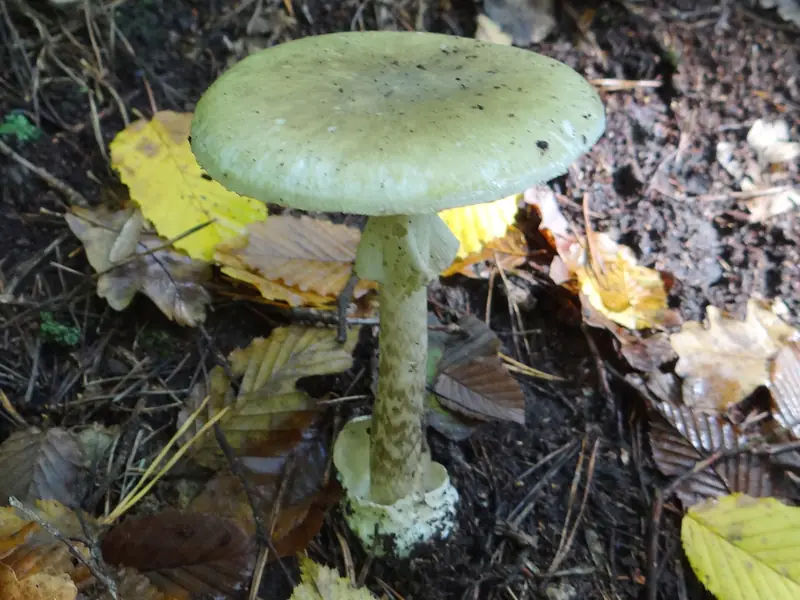
Young, poorly coloured death caps (and the white form) are sometimes taken for field mushrooms. Agaricus mushrooms have gills that are pink, then chocolate-brown, and a dark spore print; they never have a volva. Do not pick “field mushrooms” with white gills.
Young and white (var. alba) death caps have white gills, a hanging ring and a sac-like volva. Never pick “field mushrooms” with white gills.
Feature by feature
| Feature | Field mushroom | Death cap |
|---|---|---|
| Edibility | Edible | Deadly poisonous |
| Cap | 5–12 cm, hemispherical when young, then flat; white, grey-ochre with age, smooth, silky or finely scaly; does not turn yellow when pressed, or only slightly. | 5–15 cm, hemispherical, then expanded; greenish, olive, yellowish-green to white (white form), with darker, radially innate fibrils; smooth, usually without patches, margin not striate. |
| Under the cap | Gills free, crowded; pink in young specimens, then chocolate-brown to blackish-brown. Spore print chocolate-brown. | Gills always white (slightly cream-greenish in old specimens), crowded, free; in young specimens covered by a white veil. |
| Stem | 4–8 cm, white, short, solid, easily broken off; a delicate, quickly vanishing ring; no bulb and no volva. | 8–15 cm, whitish with a yellowish-greenish zigzag pattern; a distinct, hanging white ring; base bulbous, surrounded by a tall, free-standing, white, sac-like volva (often hidden in the soil). |
| Flesh | White, turning slightly pink in places when cut; does not turn yellow. | White, slightly yellow-green under the cap cuticle; does not change colour when broken. |
| Smell and taste | Smell lightly mushroomy, without a note of carbolic or aniseed; taste pleasant. | Mature fruit bodies smell sweetish and sickly (like artificial honey), young ones mild. Never taste. |
| Habitat | Saprotrophic; meadows, pastures (especially those fertilised with manure, e.g. horse manure), fields, roadside ditches; less often parks and forest edges. | Common in broadleaf and mixed forests, especially oak and beech woods, less often in coniferous forests; also in parks and grassy areas near trees. Likes fertile soils, neutral to alkaline. |
| Season | May, June, July, August, September, October | June, July, August, September, October, November |
How to recognise it: field mushroom
- Gills pink in young specimens, then chocolate-brown – never permanently white
- Dark brown spore print
- Grows in meadows and pastures, not deep in the forest
- Does not turn yellow when rubbed or cut, does not smell of carbolic
- No volva at the stem base
How to recognise it: death cap
- Gills white throughout the life of the fruit body (field mushrooms have pink, then brown gills)
- Sac-like volva at the bulbous stem base – dig up the whole mushroom to see it
- Hanging ring below the cap
- Greenish cap with radial fibrils (can also be white)
- White spore print; sweetish, sickly smell of older fruit bodies
Safety rule
Never eat a mushroom identified only from a website, a photo or an app. Show any doubtful specimen to a certified mushroom inspector at the sanepid (state sanitary inspection); in season the advice points are free. Do not give wild-picked mushrooms to children.
The golden rules of foraging →Frequently asked questions
Field mushroom or death cap: how can you tell them apart?
Young, poorly coloured death caps (and the white form) are sometimes taken for field mushrooms. Agaricus mushrooms have gills that are pink, then chocolate-brown, and a dark spore print; they never have a volva. Do not pick “field mushrooms” with white gills. Young and white (var. alba) death caps have white gills, a hanging ring and a sac-like volva. Never pick “field mushrooms” with white gills.
Death cap: what to do if you have eaten it?
Call 112 at once or go to A&E (SOR), and take any leftover mushrooms with you. Amatoxins (mainly α-amanitin) and phallotoxins – phalloides (cytotoxic) syndrome. First symptoms (vomiting, diarrhoea, abdominal pain) only after approx. 8–16 h (on average approx. 12 h), earlier in children; then a deceptive improvement, and after 2–6 days damage to the liver and kidneys; death usually after several days. Hospital treatment, sometimes a liver transplant. At any suspicion go to hospital immediately and keep the mushroom remains.
Sources
- Wikipedia (pl): Pieczarka łąkowa
- grzyby.pl (M. Snowarski): Agaricus campestris
- First Nature: Agaricus campestris, Field Mushroom
- Wikipedia (pl): Muchomor zielonawy
- grzyby.pl (M. Snowarski): Amanita phalloides
- First Nature: Amanita phalloides, Deathcap
Last checked: 9 November 2026. Spotted a mistake? Write to us.