Gilled mushrooms
Field mushroom
Agaricus campestris · also known as: Meadow mushroom
EdibleApproved for sale
A good edible mushroom. Pick only fruit bodies whose gills are already pink or brown – young, closed specimens with white gills can be confused with deadly poisonous white amanitas. Do not pick next to busy roads (pollution). The name “pieczarka łąkowa” is recommended in newer mycological literature (Wojewoda 1987); in legislation and everyday speech – “pieczarka polna”.
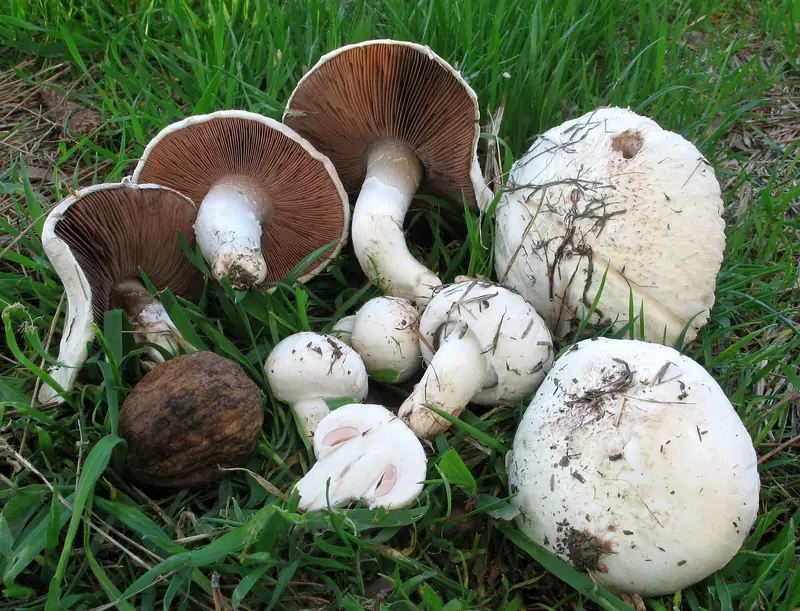
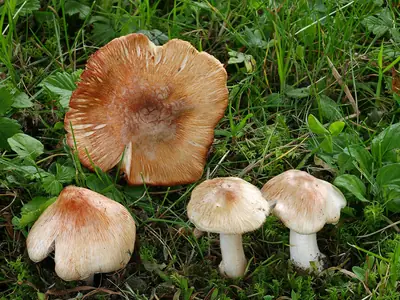
How to recognise it: field mushroom
- 1
Gills pink in young specimens, then chocolate-brown – never permanently white
- 2
Dark brown spore print
- 3
Grows in meadows and pastures, not deep in the forest
- 4
Does not turn yellow when rubbed or cut, does not smell of carbolic
- 5
No volva at the stem base
Description
- Cap
- 5–12 cm, hemispherical when young, then flat; white, grey-ochre with age, smooth, silky or finely scaly; does not turn yellow when pressed, or only slightly.
- Gills
- Gills free, crowded; pink in young specimens, then chocolate-brown to blackish-brown. Spore print chocolate-brown.
- Stem
- 4–8 cm, white, short, solid, easily broken off; a delicate, quickly vanishing ring; no bulb and no volva.
- Flesh
- White, turning slightly pink in places when cut; does not turn yellow.
- Smell and taste
- Smell lightly mushroomy, without a note of carbolic or aniseed; taste pleasant.
Where and when it grows
Saprotrophic; meadows, pastures (especially those fertilised with manure, e.g. horse manure), fields, roadside ditches; less often parks and forest edges.
Look-alikes: what it can be mistaken for
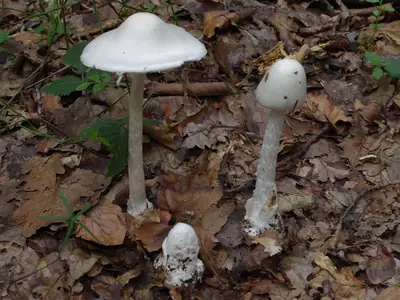
Destroying angel Deadly poisonous high risk of confusion
A deadly poisonous white amanita. It has gills that are always white, a white spore print and a volva at the bulbous stem base. The risk concerns mainly closed, young fruit bodies.
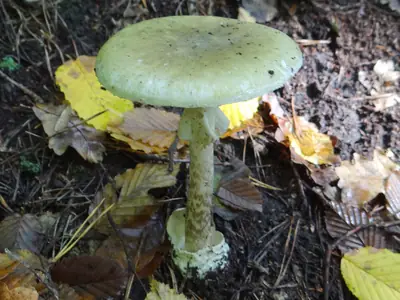
Step-by-step comparison: Field mushroom or destroying angel →Death cap Deadly poisonous high risk of confusion
Young and white (var. alba) death caps have white gills, a hanging ring and a sac-like volva. Never pick “field mushrooms” with white gills.
Step-by-step comparison: Field mushroom or death cap →Yellow stainer Poisonous medium risk
The yellow stainer, when rubbed (especially at the stem base), immediately turns chrome-yellow and smells of carbolic/ink, more strongly when cooked.
Step-by-step comparison: Field mushroom or yellow stainer →Deadly fibrecap Deadly poisonous low risk
White young fruit bodies growing along roads and in parks may resemble young field mushrooms; the field mushroom has pink, then chocolate-brown gills, a ring, and does not turn red along its fibres.
Step-by-step comparison: Field mushroom or deadly fibrecap →
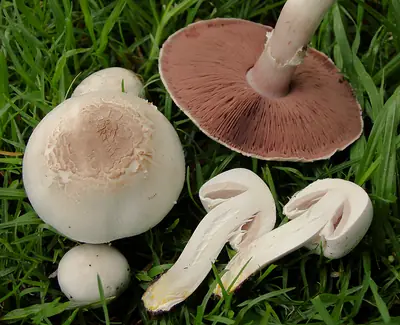
Foragers’ finds
All photosPhotos and identifications are added by users; we do not check them. Add your own find →
In the kitchen
Like cultivated mushrooms: fried, stewed, in soups, sauces, omelettes and as an accompaniment to meat dishes. It matures quickly and keeps only briefly – cook it straight away.
Protection and sale
- Species protection: the species is not protected.
- Sale: the species is on the list of mushrooms approved for sale (it may be sold only with a mushroom inspector’s certificate). Permitted for sale, except for wild specimens that are too young, whose gills have not yet turned pink (Dz.U. 2026 poz. 258, Annex 1).
Field mushroom: common questions
Is the field mushroom edible?
Edible. A good edible mushroom. Pick only fruit bodies whose gills are already pink or brown – young, closed specimens with white gills can be confused with deadly poisonous white amanitas. Do not pick next to busy roads (pollution). The name “pieczarka łąkowa” is recommended in newer mycological literature (Wojewoda 1987); in legislation and everyday speech – “pieczarka polna”.
When does the field mushroom grow?
In Poland the fruiting bodies usually appear in: May, June, July, August, September, October. Habitat: Saprotrophic; meadows, pastures (especially those fertilised with manure, e.g. horse manure), fields, roadside ditches; less often parks and forest edges.
What can the field mushroom be mistaken for?
Destroying angel (deadly poisonous): A deadly poisonous white amanita. It has gills that are always white, a white spore print and a volva at the bulbous stem base. The risk concerns mainly closed, young fruit bodies. Death cap (deadly poisonous): Young and white (var. alba) death caps have white gills, a hanging ring and a sac-like volva. Never pick “field mushrooms” with white gills. Yellow stainer (poisonous): The yellow stainer, when rubbed (especially at the stem base), immediately turns chrome-yellow and smells of carbolic/ink, more strongly when cooked. Deadly fibrecap (deadly poisonous): White young fruit bodies growing along roads and in parks may resemble young field mushrooms; the field mushroom has pink, then chocolate-brown gills, a ring, and does not turn red along its fibres.
Sources
- Wikipedia (pl): Pieczarka łąkowa
- grzyby.pl (M. Snowarski): Agaricus campestris
- First Nature: Agaricus campestris, Field Mushroom
- Medycyna Praktyczna (mp.pl): Zatrucie grzybami
Last checked: 9 November 2026. Spotted a mistake? Write to us.