
How it works
Methodology: the forecast and the atlas
We explain exactly how the flush index is calculated and where our facts about each species come from. The numbers on this page are taken straight from the code that computes the forecast.
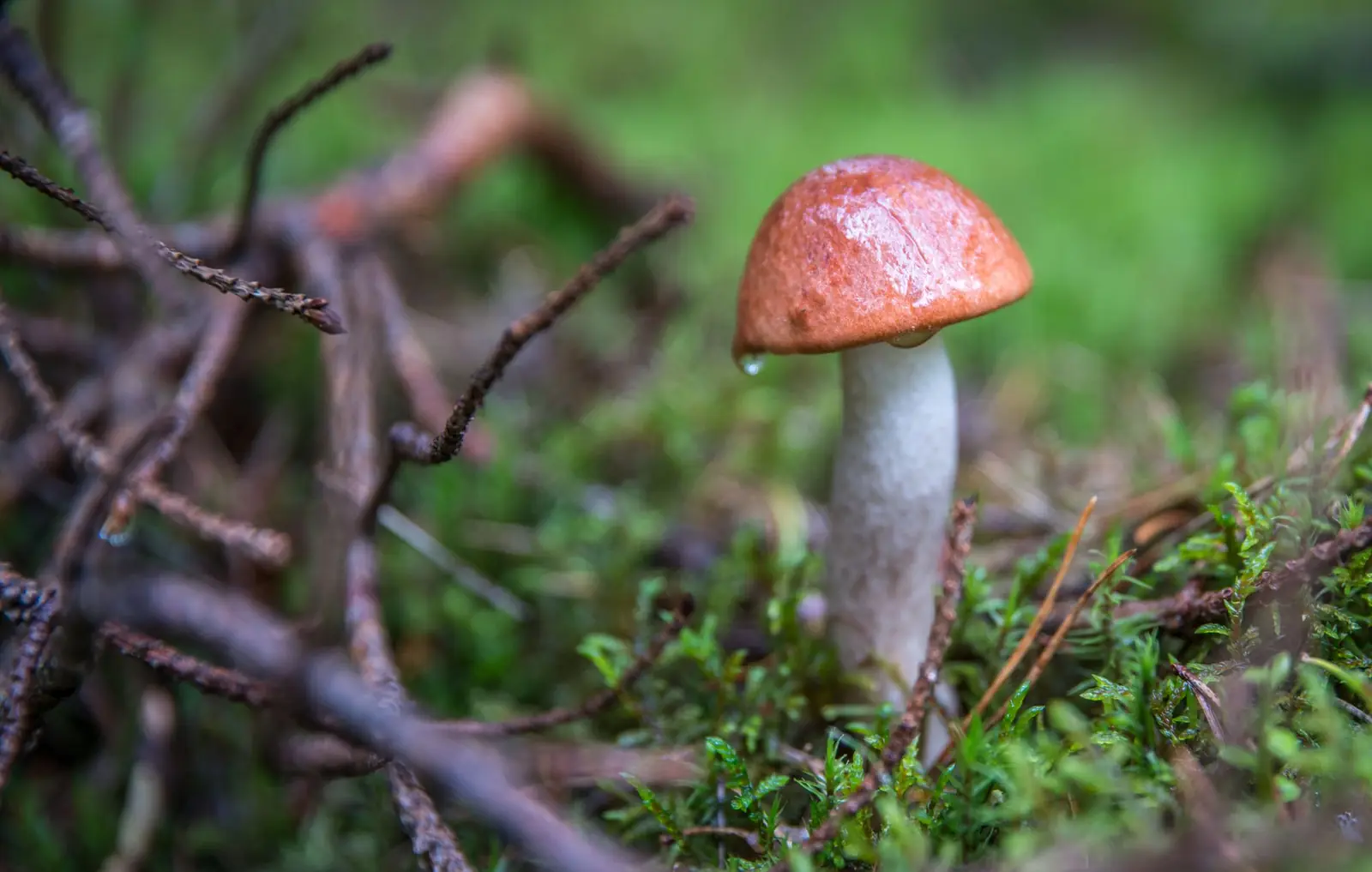
The mushroom forecast
For each of Poland’s 380 districts (powiaty) we take a point inside its boundary (from the National Register of Boundaries, PRG, kept by GUGiK) and twice a day download daily weather data from Open-Meteo: rainfall, mean, minimum and maximum temperature, and the moisture of the top soil layer (0–10 cm). We use 35 days of history and 7 days of forecast. From these we calculate a fruiting conditions index on a 0–100 scale for today and the next 6 days.
The score tells you whether the weather favours mushrooms appearing. It does not take into account the type of woodland, the soil, or the fact that someone may have been in the forest before you. A local storm can bring mushrooms to a place the model cannot see.
The formula
index = (A × Bgate + C × Bgate + B − D) × S
- A. Long-term moisture (0–45 pts)
- Half of it: the mean daily rainfall over the last 26 days, from 1 mm/day (0 pts) to 3.5 mm/day (the full amount). The other half: soil moisture at 0–10 cm, from 0.14 to 0.32 m³/m³. The window of about a month and the linear effect of rainfall come from ten years of observations of porcini (Boletus edulis) fruiting; there, a mean rainfall of 2–4 mm a day coincided with flushes.
- B. Temperature (0–30 pts)
- The mean temperature over the last 20 days. In autumn the full amount is given at 10–15 °C, and zero below 5 °C and from 21 °C. In summer (June–August) we move the range to 12–18 °C, because chanterelles and summer boletes fruit in warmer weather (an editorial assumption). When it is cold, the moisture points (A and C) are multiplied by a gate from 0.3 to 1, because a wet but cold forest does not fruit.
- C. Rain pulse (0–25 pts)
- Days since the last heavy rain (at least 15 mm within 3 days): 0–1 days: 5 pts; 2–5 days: 15 pts; 6–14 days: 25 pts; 15–21 days: 15 pts; 0 pts after that. Slippery jacks, birch boletes and chanterelles usually appear a few days after rain, porcini after 6–10 days, and foresters speak of 10–14 days after heavy rainfall.
- D. Penalties
- Ground frost in the last 3 days: −10 pts (down to 0 °C) or −25 pts (down to -3 °C). Heat in the last 5 days: −10 pts (from 27 °C) or −15 pts (from 30 °C). Drought: −10 pts after 7 days without rain with dry soil.
- S. Time of year (multiplier)
- January 0.08, February 0.08, March 0.15, April 0.3, May 0.35, June 0.7, July 0.75, August 1, September 1, October 1, November 0.7, December 0.2. The values change smoothly between months.
The scale
Limitations
- The most precise numbers (windows of 20 and 26 days, an optimum of about 13 °C) come from a single study of a single species in a beech forest in Germany (a preprint, not peer reviewed). Other studies come from Spain, Japan and Canada, so we treat them as indicating direction only.
- The penalty thresholds, the rain pulse and the seasonal multiplier are editorial rules, not research results. We will tune them by comparing the index with reports from mushroom pickers.
- One weather point stands for a whole district; in the mountains and in large districts conditions can differ a great deal.
- The model needs 27 days of history; the historical data are weather-model analyses, not station measurements.
The mushroom atlas
The atlas covers 67 species. Every description is based on at least two sources (244 references in total): Polish atlases and studies (including grzyby.pl, with Wikipedia as a starting point), First Nature, material from sanepid (the state sanitary inspection) and the Chief Sanitary Inspectorate (GIS), the medical portal Medycyna Praktyczna and the texts of the legislation. You will find the list of sources at the bottom of each species page.
- Edibility: Where sources disagree, the safer class has been chosen. The data is for educational purposes; the edibility of collected mushrooms is decided by a mushroom classifier / certified mushroom inspector (grzyboznawca) at a sanitary-epidemiological station (sanepid, the state sanitary inspection).
- Species protection: according to the regulation of the Minister of the Environment of 9 October 2014 (Dz.U. 2014 poz. 1408).
- Sale: according to the list of mushrooms approved for sale in the regulation of the Minister of Health of 17 May 2011 (consolidated text Dz.U. 2026 poz. 258). Being on that list does not mean that a mushroom is safe for everyone.
- Species photos come from Wikimedia Commons (the main photos of the articles about each species), with the author and licence shown with every photo. A photo is never a substitute for an inspection by a certified mushroom inspector.
Sources for the model and data
- Brejon Lamartinière & Hoffman, 'Predicting porcini: a decade of sporocarp monitoring reveals the meteorological triggers of Boletus edulis fruiting in central European beech forests' (bioRxiv preprint, not peer reviewed)
- Karavani A. et al. (2018), the effect of climatic conditions on fruiting in pine stands (Agric. For. Meteorol. 248)
- Alday J.G. et al. (2017), Mushroom biomass and diversity are driven by different spatio-temporal scales, Scientific Reports 7:45824
- Sato H., Morimoto S., Hattori T. (2012), A Thirty-Year Survey… Phenology of Mushroom Fruiting, PLoS ONE
- Salerni E., Paoli L., Perini C. (2023), Boletus edulis productivity and climate extremes, Italian Journal of Mycology 52(1)
- Radio Kielce (Daleszyce Forest District): the mycelium needs 10–14 days after heavy rain (17.07.2022, in Polish)
- PSSE Golub-Dobrzyń (sanepid): Kalendarz grzybiarza – when it is best to pick mushrooms (in Polish)
- Open-Meteo: Weather Forecast API (data CC BY 4.0)
- National Register of Boundaries (PRG, GUGiK), simplified boundaries: github.com/ppatrzyk/polska-geojson (MIT)
Last checked: 9 November 2026. Spotted a mistake? Write to us.