Gilled mushrooms
Death cap
Amanita phalloides · also known as: Deathcap, Death cup
Deadly poisonous
The most dangerous mushroom in Poland – it is responsible for almost all fatal and severe mushroom poisonings. Just 30–50 g (one medium fruit body) can be a lethal dose. The toxins are not destroyed by boiling, frying, pickling or drying. It has a mild taste, so taste gives no warning. A white form (var. alba) also occurs. Scientifically recommended Polish name: “muchomor zielonawy” (Wojewoda 1992); in everyday speech and in sanepid (state sanitary inspection) announcements “muchomor sromotnikowy” prevails.
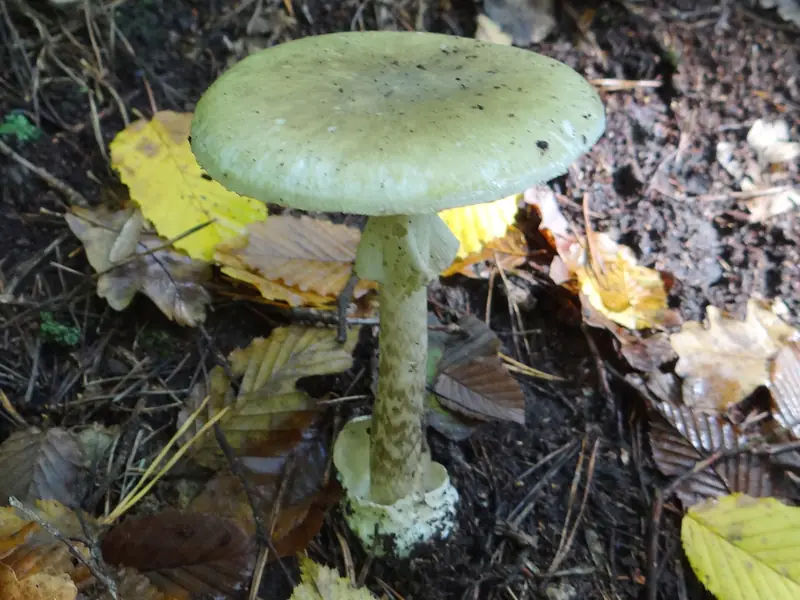
How to recognise it: death cap
- 1
Gills white throughout the life of the fruit body (field mushrooms have pink, then brown gills)
- 2
Sac-like volva at the bulbous stem base – dig up the whole mushroom to see it
- 3
Hanging ring below the cap
- 4
Greenish cap with radial fibrils (can also be white)
- 5
White spore print; sweetish, sickly smell of older fruit bodies
Description
- Cap
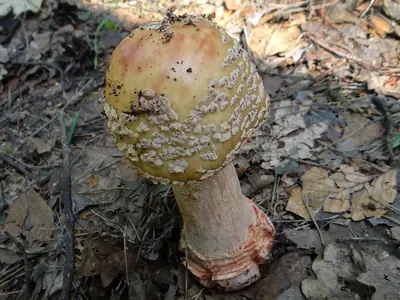
- 5–15 cm, hemispherical, then expanded; greenish, olive, yellowish-green to white (white form), with darker, radially innate fibrils; smooth, usually without patches, margin not striate.
- Gills
- Gills always white (slightly cream-greenish in old specimens), crowded, free; in young specimens covered by a white veil.
- Stem
- 8–15 cm, whitish with a yellowish-greenish zigzag pattern; a distinct, hanging white ring; base bulbous, surrounded by a tall, free-standing, white, sac-like volva (often hidden in the soil).
- Flesh
- White, slightly yellow-green under the cap cuticle; does not change colour when broken.
- Smell and taste
- Mature fruit bodies smell sweetish and sickly (like artificial honey), young ones mild. Never taste.
Where and when it grows
Common in broadleaf and mixed forests, especially oak and beech woods, less often in coniferous forests; also in parks and grassy areas near trees. Likes fertile soils, neutral to alkaline.
Most often with: oak, beech, birch, hornbeam, hazel, horse chestnut, pine, spruce
Look-alikes: what it can be mistaken for
Yellow knight Poisonous high risk of confusion
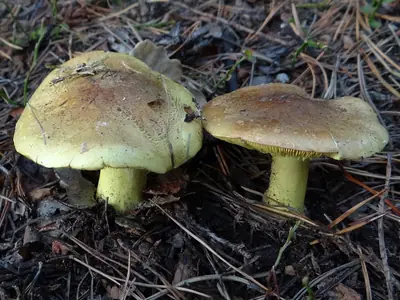
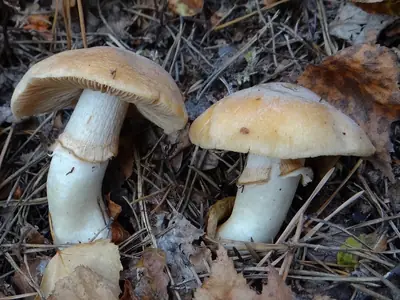
The yellow knight has yellow (not white) gills notched at the stem, a stout stem buried in sand, with no ring and no volva; it grows in late autumn in pine forests.
Green brittlegill Edible high risk of confusion
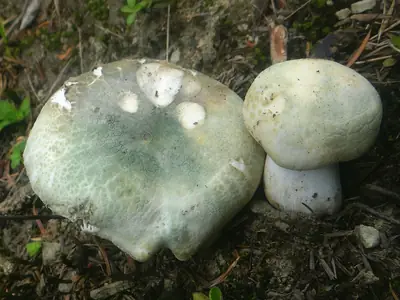
The green brittlegill has a matt cap cracked into small patches, a brittle white stem without a ring and without a bulb with a volva. Young brittlegills must be checked especially carefully.
Step-by-step comparison: Green brittlegill or death cap →Parasol mushroom Edible high risk of confusion
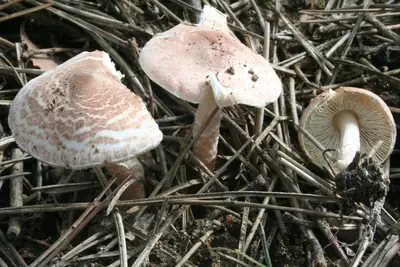
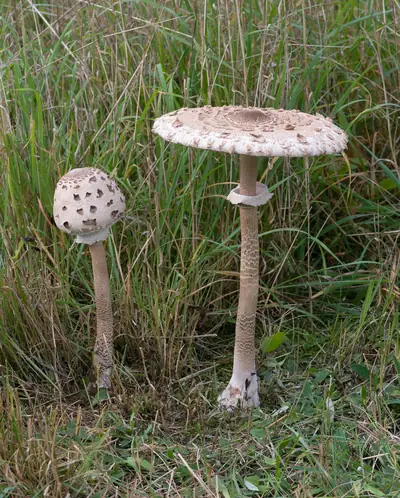
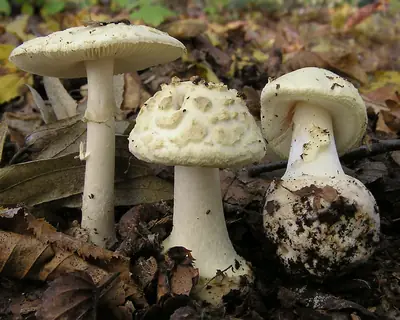
The parasol has a scaly cap, a stem with a snakeskin pattern and a movable ring, and no volva. Pale/white death caps in particular are mistaken for the parasol.
Step-by-step comparison: Parasol mushroom or death cap →Field mushroom Edible high risk of confusion
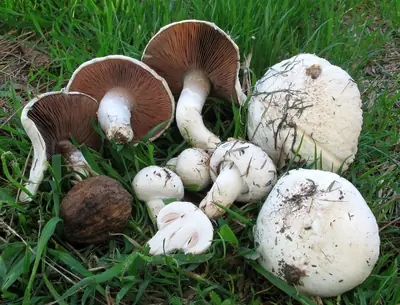
Young, poorly coloured death caps (and the white form) are sometimes taken for field mushrooms. Agaricus mushrooms have gills that are pink, then chocolate-brown, and a dark spore print; they never have a volva. Do not pick “field mushrooms” with white gills.
Step-by-step comparison: Field mushroom or death cap →False death cap Poisonous medium risk
The false death cap has a lemon-yellow cap, usually with patches, a smell of raw potatoes and a large globose bulb with a rim instead of a sac-like volva. Both are inedible.
Destroying angel Deadly poisonous low risk
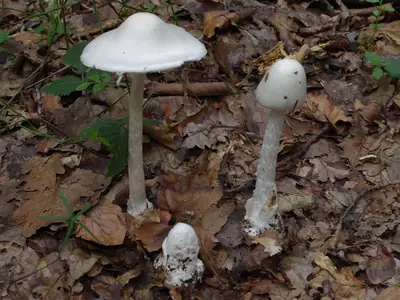
The white form of the death cap (var. alba) is equally deadly poisonous; telling the two apart makes no difference to safety.
Gypsy mushroom Edible low risk
Amanitas have WHITE gills and a white spore print and a bulb with a volva at the base; the gypsy mushroom has rusty-brown gills and no volva.
Step-by-step comparison: Gypsy mushroom or death cap →Common puffball Edible high risk of confusion
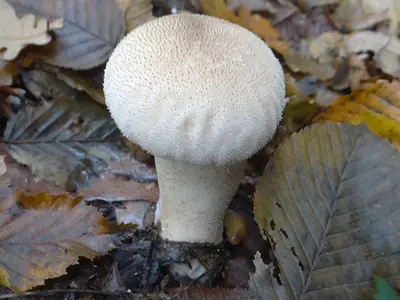
Young amanitas still in their veil (“eggs”) look like white balls. A vertical cross-section of an amanita shows the outline of the cap, gills and stem; a puffball is uniformly white inside. Never pick without cutting in half.
Step-by-step comparison: Common puffball or death cap →Giant puffball Edible low risk
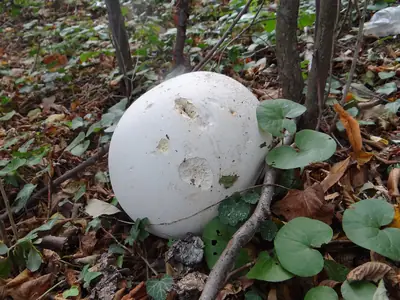
Applies only to small, young fruit bodies: an amanita “egg” cut in half shows the outline of the cap and gills. An adult giant puffball cannot be confused because of its size.
Step-by-step comparison: Giant puffball or death cap →
Foragers’ finds
All photosPhotos and identifications are added by users; we do not check them. Add your own find →
Protection and sale
- Species protection: the species is not protected.
- Sale: the species is not on the list of mushrooms approved for sale.
Death cap: common questions
Is the death cap edible?
Deadly poisonous. The most dangerous mushroom in Poland – it is responsible for almost all fatal and severe mushroom poisonings. Just 30–50 g (one medium fruit body) can be a lethal dose. The toxins are not destroyed by boiling, frying, pickling or drying. It has a mild taste, so taste gives no warning. A white form (var. alba) also occurs. Scientifically recommended Polish name: “muchomor zielonawy” (Wojewoda 1992); in everyday speech and in sanepid (state sanitary inspection) announcements “muchomor sromotnikowy” prevails.
When does the death cap grow?
In Poland the fruiting bodies usually appear in: June, July, August, September, October, November. Habitat: Common in broadleaf and mixed forests, especially oak and beech woods, less often in coniferous forests; also in parks and grassy areas near trees. Likes fertile soils, neutral to alkaline.
What can the death cap be mistaken for?
Yellow knight (poisonous): The yellow knight has yellow (not white) gills notched at the stem, a stout stem buried in sand, with no ring and no volva; it grows in late autumn in pine forests. Green brittlegill (edible): The green brittlegill has a matt cap cracked into small patches, a brittle white stem without a ring and without a bulb with a volva. Young brittlegills must be checked especially carefully. Parasol mushroom (edible): The parasol has a scaly cap, a stem with a snakeskin pattern and a movable ring, and no volva. Pale/white death caps in particular are mistaken for the parasol. Field mushroom (edible): Young, poorly coloured death caps (and the white form) are sometimes taken for field mushrooms. Agaricus mushrooms have gills that are pink, then chocolate-brown, and a dark spore print; they never have a volva. Do not pick “field mushrooms” with white gills. False death cap (poisonous): The false death cap has a lemon-yellow cap, usually with patches, a smell of raw potatoes and a large globose bulb with a rim instead of a sac-like volva. Both are inedible. Destroying angel (deadly poisonous): The white form of the death cap (var. alba) is equally deadly poisonous; telling the two apart makes no difference to safety. Gypsy mushroom (edible): Amanitas have WHITE gills and a white spore print and a bulb with a volva at the base; the gypsy mushroom has rusty-brown gills and no volva. Common puffball (edible): Young amanitas still in their veil (“eggs”) look like white balls. A vertical cross-section of an amanita shows the outline of the cap, gills and stem; a puffball is uniformly white inside. Never pick without cutting in half. Giant puffball (edible): Applies only to small, young fruit bodies: an amanita “egg” cut in half shows the outline of the cap and gills. An adult giant puffball cannot be confused because of its size.
Sources
- Wikipedia (pl): Muchomor zielonawy
- grzyby.pl (M. Snowarski): Amanita phalloides
- First Nature: Amanita phalloides, Deathcap
- Medycyna Praktyczna (mp.pl): Zatrucie grzybami
Last checked: 9 November 2026. Spotted a mistake? Write to us.