Other (brackets, puffballs)
Giant puffball
Calvatia gigantea
Edible
Only immature fruit bodies with a completely white interior are edible; once the interior turns yellow or olive, it is inedible. Rarely collected in Poland (popular in the Czech Republic). Always cut small, young specimens in half – see the note about young amanitas under the common puffball.
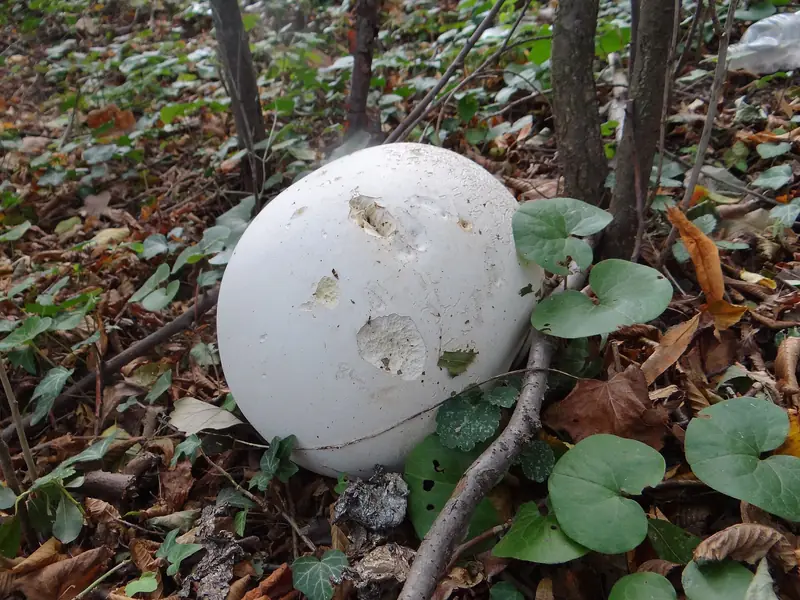
How to recognise it: giant puffball
- 1
A white ball from the size of a football to a large pumpkin in a meadow or park
- 2
Smooth surface without spines
- 3
Interior of a young specimen uniformly white
- 4
No stem and no gills
Description
- Cap
- Fruit body globose or slightly flattened, huge – 10–60 cm across; white, smooth, with a floury bloom, ochre to brown with age; the skin cracks when mature.
- Underside
- No gills – spores are produced inside (the gleba): white when young, then yellow and olive-brown, finally powdery.
- Stem
- No stem; a thin cord of white mycelium at the base.
- Flesh
- White, firm, cottony in young specimens; turns yellow and olive with age.
- Smell and taste
- Smell and taste mushroomy, mild. Spore mass olive-brown.
Where and when it grows
In meadows, pastures, lawns, parks, gardens, scrub and among nettles, on fertile, nitrogen-rich soils; rarely in forests. More common in northern Poland.
Look-alikes: what it can be mistaken for
Common puffball Edible low risk
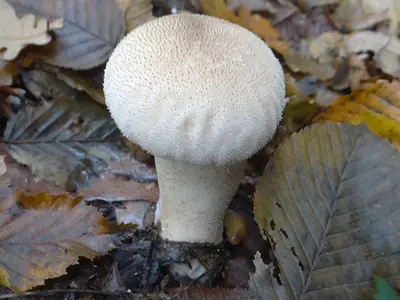
The common puffball is small (up to 8 cm), pear-shaped and covered with spines; both species are edible when white inside.
Death cap Deadly poisonous low risk
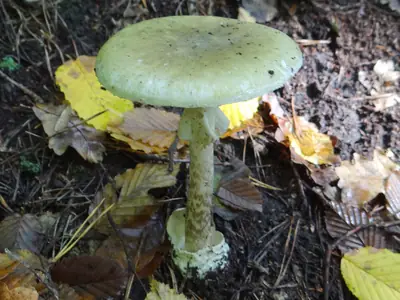
Applies only to small, young fruit bodies: an amanita “egg” cut in half shows the outline of the cap and gills. An adult giant puffball cannot be confused because of its size.
Step-by-step comparison: Giant puffball or death cap →Common earthball Poisonous low risk
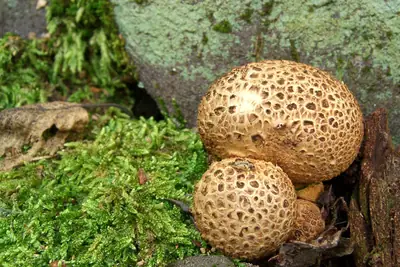
The giant puffball is much larger, smooth and white, with a white interior; the earthball is small, yellowish, cracked, dark inside.
Step-by-step comparison: Giant puffball or common earthball →
Foragers’ finds
All photosPhotos and identifications are added by users; we do not check them. Add your own find →
In the kitchen
Only fresh specimens, white throughout when cut. Cut into slices, bread and fry.
Protection and sale
- Species protection: the species is not protected. Protected until 9 October 2014 (according to Wikipedia strictly protected; according to grzyby.pl protected since 1983); now not protected.
- Sale: the species is not on the list of mushrooms approved for sale.
Giant puffball: common questions
Is the giant puffball edible?
Edible. Only immature fruit bodies with a completely white interior are edible; once the interior turns yellow or olive, it is inedible. Rarely collected in Poland (popular in the Czech Republic). Always cut small, young specimens in half – see the note about young amanitas under the common puffball.
When does the giant puffball grow?
In Poland the fruiting bodies usually appear in: July, August, September, October. Habitat: In meadows, pastures, lawns, parks, gardens, scrub and among nettles, on fertile, nitrogen-rich soils; rarely in forests. More common in northern Poland.
What can the giant puffball be mistaken for?
Common puffball (edible): The common puffball is small (up to 8 cm), pear-shaped and covered with spines; both species are edible when white inside. Death cap (deadly poisonous): Applies only to small, young fruit bodies: an amanita “egg” cut in half shows the outline of the cap and gills. An adult giant puffball cannot be confused because of its size. Common earthball (poisonous): The giant puffball is much larger, smooth and white, with a white interior; the earthball is small, yellowish, cracked, dark inside.
Sources
- Wikipedia (pl): Czasznica olbrzymia
- grzyby.pl (atlas M. Snowarskiego): Langermannia gigantea
- First Nature: Calvatia gigantea
Last checked: 9 November 2026. Spotted a mistake? Write to us.