Other (brackets, puffballs)
Cauliflower fungus
Sparassis crispa · also known as: Wood cauliflower, Cauliflower mushroom
EdibleApproved for sale
A very tasty edible mushroom; pick young, cream-coloured fruit bodies – do not eat them once they start turning brown. The main problem is sand and pine needles in the crevices of the fruit body.
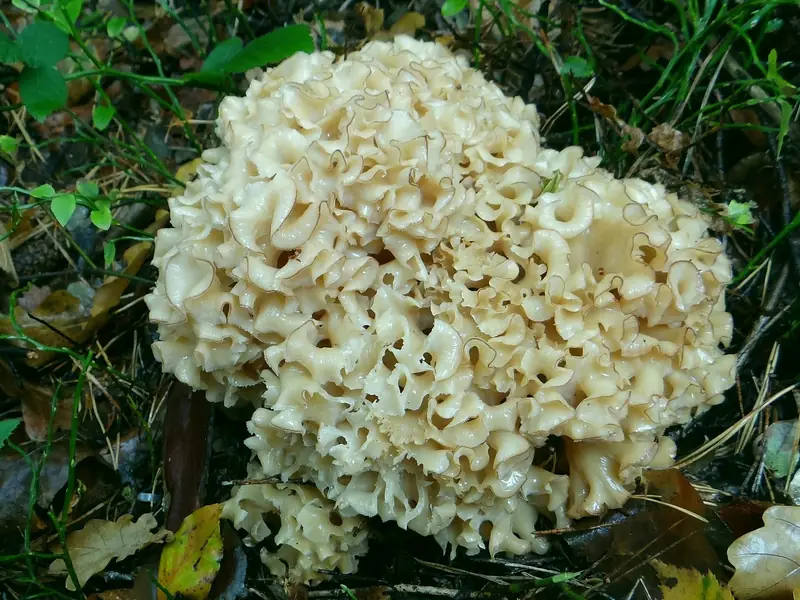
How to recognise it: cauliflower fungus
- 1
A cream “cauliflower” or “sponge” at the base of a pine
- 2
Curly, flat lobes instead of a cap
- 3
Thick, dark base rooted into the roots
- 4
By oaks grows the similar, protected Sparassis brevipes
Description
- Cap
- Fruit body without a cap: globose, cauliflower-like, 10–40 cm across, made up of numerous curly, flat, wavy lobes (branches); cream, then yellowish to ochre, the tips turning brown.
- Underside
- No gills or tubes – spores are produced on the smooth surface of the lobes.
- Stem
- A short, thick, blackish base (stem) rooted into the tree's roots.
- Flesh
- White, waxy, elastic; does not change colour.
- Smell and taste
- Smell pleasant, taste nutty. Spore print white to ochre.
Where and when it grows
At the base of trunks and on the roots of pines (rarely spruces, also Douglas firs), in coniferous and mixed forests; a parasite or saprotroph causing brown rot. It reappears on the same tree every few years.
Most often with: pine, spruce, Douglas fir
Foragers’ finds
All photosPhotos and identifications are added by users; we do not check them. Add your own find →
In the kitchen
Cut into slices or florets and rinse thoroughly of sand under running water. Soups, frying, roasting, drying. Breaks easily in transport.
Protection and sale
- Species protection: the species is not protected. Protected until 9 October 2014 (according to Wikipedia strictly protected from 1990, according to grzyby.pl from 1983); now not protected. The similar Sparassis brevipes, growing by oaks, remains partially protected – do not pick it.
- Sale: the species is on the list of mushrooms approved for sale (it may be sold only with a mushroom inspector’s certificate).
Cauliflower fungus: common questions
Is the cauliflower fungus edible?
Edible. A very tasty edible mushroom; pick young, cream-coloured fruit bodies – do not eat them once they start turning brown. The main problem is sand and pine needles in the crevices of the fruit body.
When does the cauliflower fungus grow?
In Poland the fruiting bodies usually appear in: July, August, September, October. Habitat: At the base of trunks and on the roots of pines (rarely spruces, also Douglas firs), in coniferous and mixed forests; a parasite or saprotroph causing brown rot. It reappears on the same tree every few years.
Sources
- Wikipedia (pl): Siedzuń sosnowy
- grzyby.pl (atlas M. Snowarskiego): Sparassis crispa
- First Nature: Sparassis crispa
- Rozporządzenie Ministra Środowiska z dnia 9 października 2014 r. w sprawie ochrony gatunkowej grzybów (Dz.U. 2014 poz. 1408)
- Rozporządzenie Ministra Zdrowia w sprawie grzybów dopuszczonych do obrotu… – tekst jednolity Dz.U. 2026 poz. 258
Last checked: 9 November 2026. Spotted a mistake? Write to us.