Other (brackets, puffballs)
Common puffball
Lycoperdon perlatum · also known as: Gem-studded puffball, Warted puffball
Edible
Only young fruit bodies with a completely white, uniform and elastic interior are edible. Cut every fruit body vertically: an outline of a cap and gills means a young amanita (deadly risk), a purple-black interior – the poisonous earthball, yellow/olive – an old puffball. Strong, distinctive taste.
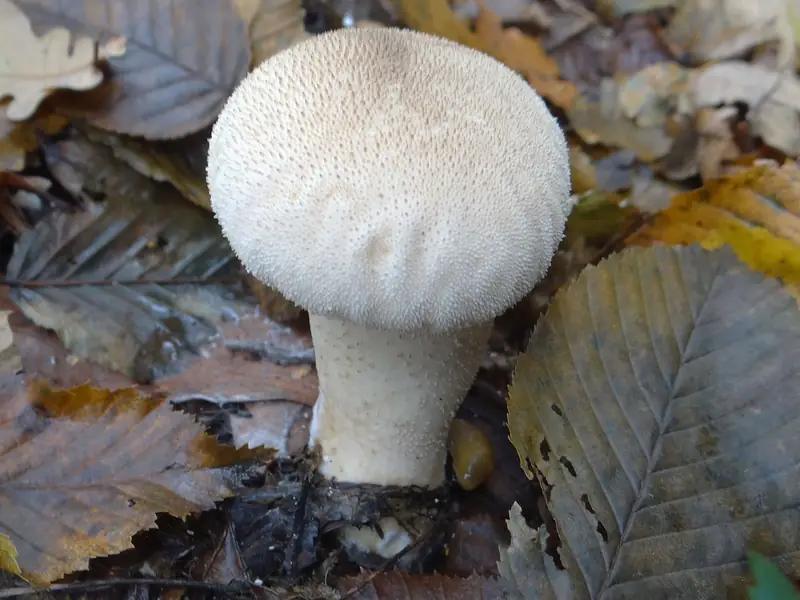
How to recognise it: common puffball
- 1
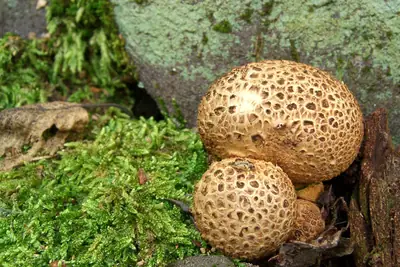
White, pear-shaped fruit body covered with spines that fall off
- 2
No cap and no gills
- 3
Cut in half when young: uniformly white flesh
- 4
When mature, puffs out brown spores from a pore at the top
Description
- Cap
- Fruit body pear- to club-shaped, 3–8 cm tall, 2–6 cm wide; white when young, then ochre to brown; covered with blunt spines that fall off easily, leaving a net-like pattern; when mature it opens with a pore at the top.
- Underside
- No gills – spores are produced inside the fruit body (the gleba): white when young, then yellow, olive and brown, finally powdery.
- Stem
- A pseudostem (subgleba) – the narrowed, sterile lower part of the fruit body.
- Flesh
- White, uniform and elastic in young specimens; with age turns yellow, olive and becomes a powder of spores.
- Smell and taste
- Smell and taste distinct, mushroomy. Spore mass olive-brown.
Where and when it grows
Very common; on the ground in broadleaf and coniferous forests, in scrub, on heaths, rarely on lawns and rotten wood; singly or in groups.
Look-alikes: what it can be mistaken for
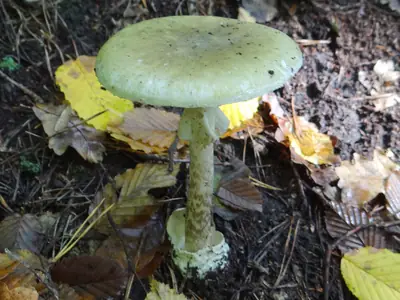
Death cap Deadly poisonous high risk of confusion
Young amanitas still in their veil (“eggs”) look like white balls. A vertical cross-section of an amanita shows the outline of the cap, gills and stem; a puffball is uniformly white inside. Never pick without cutting in half.
Step-by-step comparison: Common puffball or death cap →Common earthball Poisonous medium risk
The earthball (poisonous) is hard, with a thick, yellowish, cracked skin, and its interior soon becomes purple-black (like ground poppy seed); the puffball is soft, spongy, with a white interior.
Step-by-step comparison: Common puffball or common earthball →Giant puffball Edible low risk
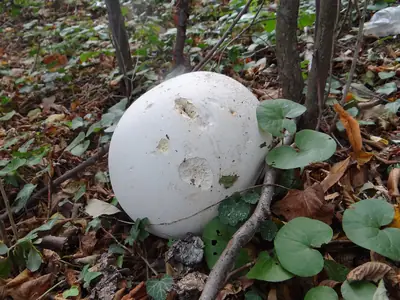
The giant puffball is much larger (10–60 cm), smooth, without spines; both are edible when white inside.
Foragers’ finds
All photosPhotos and identifications are added by users; we do not check them. Add your own find →
In the kitchen
Only young fruit bodies that are white inside; remove the tougher skin. Best cut into slices and fried; can be dried. Strong aroma – better not mixed with other mushrooms.
Protection and sale
- Species protection: the species is not protected.
- Sale: the species is not on the list of mushrooms approved for sale.
Common puffball: common questions
Is the common puffball edible?
Edible. Only young fruit bodies with a completely white, uniform and elastic interior are edible. Cut every fruit body vertically: an outline of a cap and gills means a young amanita (deadly risk), a purple-black interior – the poisonous earthball, yellow/olive – an old puffball. Strong, distinctive taste.
When does the common puffball grow?
In Poland the fruiting bodies usually appear in: June, July, August, September, October, November, December. Habitat: Very common; on the ground in broadleaf and coniferous forests, in scrub, on heaths, rarely on lawns and rotten wood; singly or in groups.
What can the common puffball be mistaken for?
Death cap (deadly poisonous): Young amanitas still in their veil (“eggs”) look like white balls. A vertical cross-section of an amanita shows the outline of the cap, gills and stem; a puffball is uniformly white inside. Never pick without cutting in half. Common earthball (poisonous): The earthball (poisonous) is hard, with a thick, yellowish, cracked skin, and its interior soon becomes purple-black (like ground poppy seed); the puffball is soft, spongy, with a white interior. Giant puffball (edible): The giant puffball is much larger (10–60 cm), smooth, without spines; both are edible when white inside.
Sources
- Wikipedia (pl): Purchawka chropowata
- grzyby.pl (atlas M. Snowarskiego): Lycoperdon perlatum
- First Nature: Lycoperdon perlatum
Last checked: 9 November 2026. Spotted a mistake? Write to us.