
Comparison
Common puffball or common earthball? How to tell them apart
Common puffball is an edible mushroom, while the common earthball is a poisonous mushroom. Compare the two mushrooms point by point.
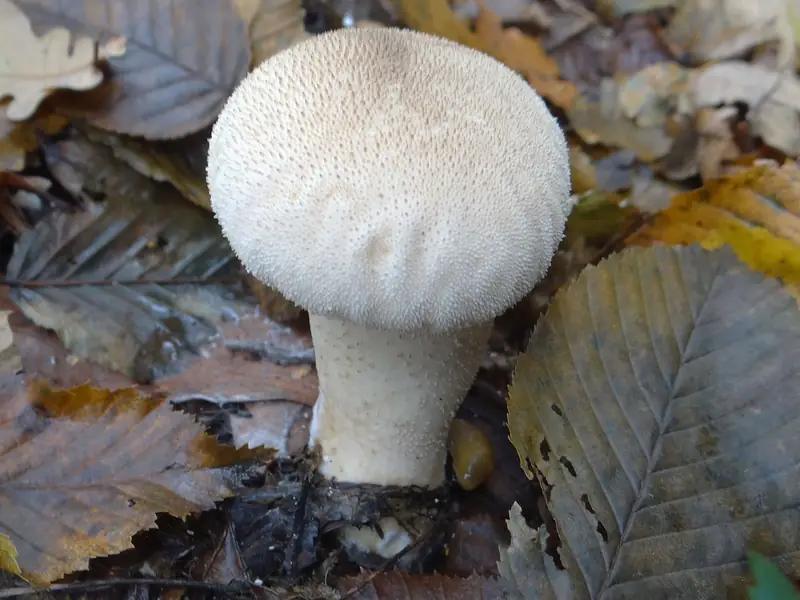
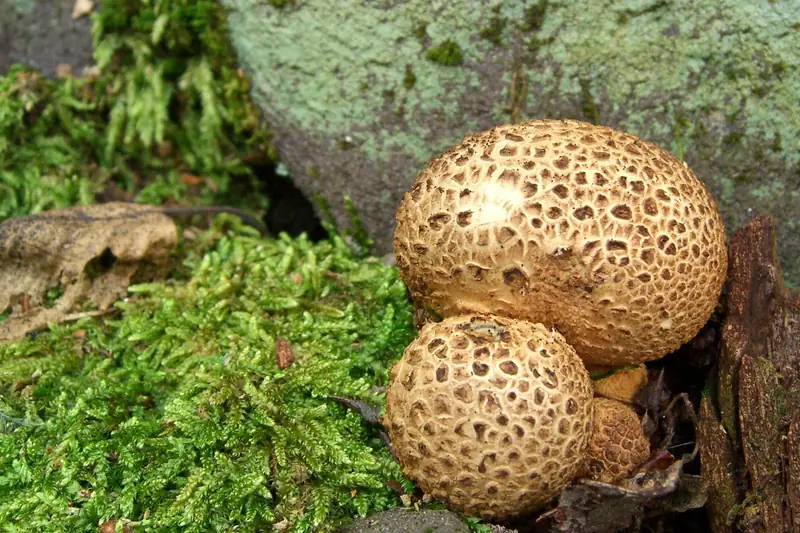
The puffball is soft, spongy, covered with spines that fall off and has a white interior (when young); the earthball is hard, with a thick cracked skin and a dark interior.
The earthball (poisonous) is hard, with a thick, yellowish, cracked skin, and its interior soon becomes purple-black (like ground poppy seed); the puffball is soft, spongy, with a white interior.
Feature by feature
| Feature | Common puffball | Common earthball |
|---|---|---|
| Edibility | Edible | Poisonous |
| Cap | Fruit body pear- to club-shaped, 3–8 cm tall, 2–6 cm wide; white when young, then ochre to brown; covered with blunt spines that fall off easily, leaving a net-like pattern; when mature it opens with a pore at the top. | Fruit body globose or tuber-like, up to 10 cm, without a stem; hard, heavy, with a thick straw-yellow to yellow-brown skin cracked into warty patches. |
| Under the cap | No gills – spores are produced inside the fruit body (the gleba): white when young, then yellow, olive and brown, finally powdery. | No gills – the interior (gleba) is whitish only in very young specimens, soon violet, then black with white veins (like ground poppy seed), finally an olive-brown powder. |
| Stem | A pseudostem (subgleba) – the narrowed, sterile lower part of the fruit body. | No stem; a tuft of whitish mycelial strands at the base. |
| Flesh | White, uniform and elastic in young specimens; with age turns yellow, olive and becomes a powder of spores. | Thick, hard skin (peridium); the interior soon purple-black. |
| Smell and taste | Smell and taste distinct, mushroomy. Spore mass olive-brown. | Smell strong, aromatic, spicy. Do not taste. |
| Habitat | Very common; on the ground in broadleaf and coniferous forests, in scrub, on heaths, rarely on lawns and rotten wood; singly or in groups. | Very common; on poor, acidic, sandy soils in forests (mainly coniferous), at forest edges, on forest track verges, heaths and bogs. |
| Season | June, July, August, September, October, November, December | June, July, August, September, October, November |
How to recognise it: common puffball
- White, pear-shaped fruit body covered with spines that fall off
- No cap and no gills
- Cut in half when young: uniformly white flesh
- When mature, puffs out brown spores from a pore at the top
How to recognise it: common earthball
- Hard, heavy tuber with a thick, yellowish, cracked skin
- Interior purple-black (like ground poppy seed)
- No stem
- Strong spicy smell
Safety rule
Never eat a mushroom identified only from a website, a photo or an app. Show any doubtful specimen to a certified mushroom inspector at the sanepid (state sanitary inspection); in season the advice points are free. Do not give wild-picked mushrooms to children.
The golden rules of foraging →Frequently asked questions
Common puffball or common earthball: how can you tell them apart?
The puffball is soft, spongy, covered with spines that fall off and has a white interior (when young); the earthball is hard, with a thick cracked skin and a dark interior. The earthball (poisonous) is hard, with a thick, yellowish, cracked skin, and its interior soon becomes purple-black (like ground poppy seed); the puffball is soft, spongy, with a white interior.
Common earthball: what to do if you have eaten it?
Call 112 at once or go to A&E (SOR), and take any leftover mushrooms with you. Gastrointestinal syndrome after eating larger amounts (nausea, vomiting, abdominal pain); the toxins are not named in the sources.
Sources
- Wikipedia (pl): Purchawka chropowata
- grzyby.pl (atlas M. Snowarskiego): Lycoperdon perlatum
- First Nature: Lycoperdon perlatum
- Wikipedia (pl): Tęgoskór cytrynowy
- grzyby.pl (atlas M. Snowarskiego): Scleroderma citrinum
- First Nature: Scleroderma citrinum
Last checked: 9 November 2026. Spotted a mistake? Write to us.