
Ridges (false gills)
Chanterelle
Cantharellus cibarius · also known as: Golden chanterelle, Girolle
EdibleApproved for sale
One of the most popular and tastiest edible mushrooms in Poland. The other Polish chanterelles (pale, amethyst, orange) are also edible. The most frequent mistake – with the inedible false chanterelle.
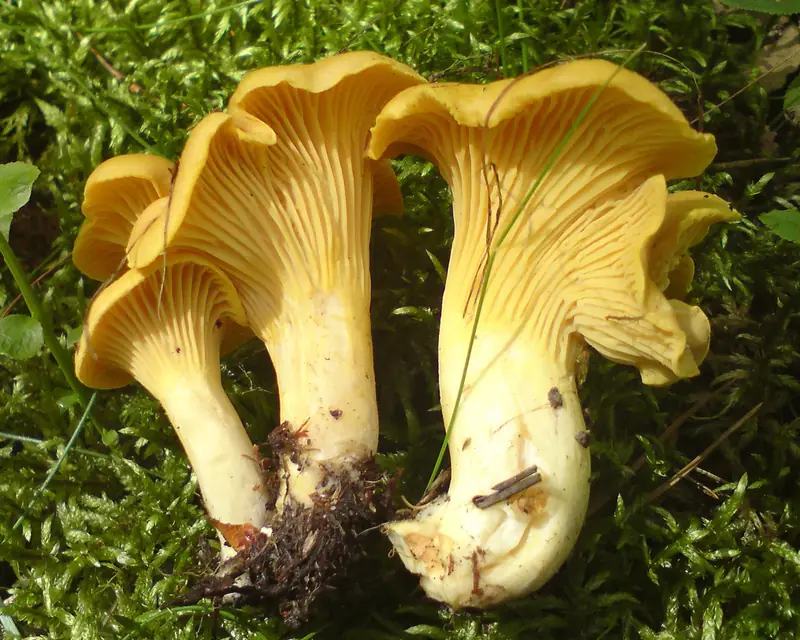
How to recognise it: chanterelle
- 1
Ridges instead of gills – thick, forked, decurrent
- 2
Egg-yolk-yellow, funnel-shaped fruit body without a clear cap–stem boundary
- 3
Firm, fibrous white flesh
- 4
Fruity (apricot) smell
Description
- Cap
- 1–12 cm, light yellow to orange-yellow (egg-yolk-coloured), matt, smooth; convex with an inrolled margin when young, then funnel-shaped, with a wavy, lobed margin.
- Ridges
- Instead of gills, thick, blunt, irregularly forked RIDGES (folds) with cross-connections, running far down the stem, the colour of the cap.
- Stem
- 3–6 cm, the colour of the cap or paler, solid, firm, narrowing downwards and merging smoothly into the cap.
- Flesh
- White to pale yellow, firm, fibrous in the stem (tears like chicken breast); does not change colour.
- Smell and taste
- Smell pleasant, fruity (apricot), spicy; taste when raw slightly hot, peppery after a moment.
Where and when it grows
Coniferous (pine, spruce) and broadleaf (oak, beech) forests, gregarious in moss or fallen leaves, especially on sandy, acidic soils. A mycorrhizal fungus.
Most often with: pine, spruce, oak, beech
Look-alikes: what it can be mistaken for
False chanterelle Inedible medium risk
The “false chanterelle”: it has true, thin, CROWDED, regularly forked, intensely orange gills, thin soft flesh, a thinner stem that often darkens at the base; it usually grows in September–November on litter and rotting wood. Inedible (stomach upset).
Hedgehog mushroom Edible low risk
Deceptively similar from above, but it has spines under the cap, not ridges. Edible – the mistake is harmless.
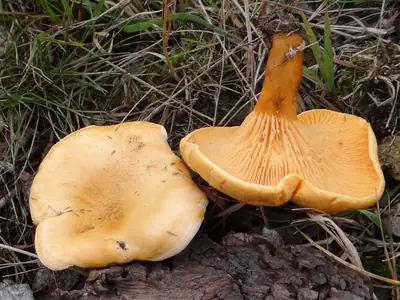
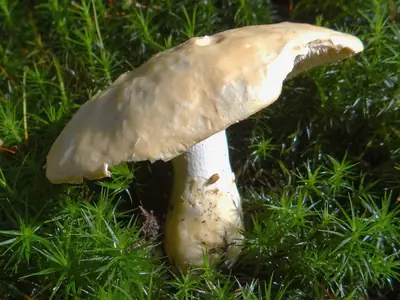
Foragers’ finds
All photosPhotos and identifications are added by users; we do not check them. Add your own find →
In the kitchen
Fried briefly (they toughen if fried long), stewed, in sauces and scrambled eggs. Best preserved by freezing after blanching; pickled and dried they turn out poorly (the dried mushroom can be ground into a powder). Rarely maggoty.
Protection and sale
- Species protection: the species is not protected.
- Sale: the species is on the list of mushrooms approved for sale (it may be sold only with a mushroom inspector’s certificate). Listed in Annex 1 as “pieprznik jadalny (kurka) – Cantharellus cibarius”.
Chanterelle: common questions
Is the chanterelle edible?
Edible. One of the most popular and tastiest edible mushrooms in Poland. The other Polish chanterelles (pale, amethyst, orange) are also edible. The most frequent mistake – with the inedible false chanterelle.
When does the chanterelle grow?
In Poland the fruiting bodies usually appear in: June, July, August, September, October, November. Habitat: Coniferous (pine, spruce) and broadleaf (oak, beech) forests, gregarious in moss or fallen leaves, especially on sandy, acidic soils. A mycorrhizal fungus.
What can the chanterelle be mistaken for?
False chanterelle (inedible): The “false chanterelle”: it has true, thin, CROWDED, regularly forked, intensely orange gills, thin soft flesh, a thinner stem that often darkens at the base; it usually grows in September–November on litter and rotting wood. Inedible (stomach upset). Hedgehog mushroom (edible): Deceptively similar from above, but it has spines under the cap, not ridges. Edible – the mistake is harmless.
Sources
- Pieprznik jadalny – Wikipedia (PL)
- Cantharellus cibarius – Atlas grzybów Polski (grzyby.pl, M. Snowarski)
- Cantharellus cibarius – First Nature
- Bezpieczne grzybobranie – ulotka WSSE w Warszawie (publikacja Nadleśnictwa Nowa Dęba, Lasy Państwowe)
- Rozporządzenie Ministra Zdrowia w sprawie grzybów dopuszczonych do obrotu… – tekst jednolity Dz.U. 2026 poz. 258 (załącznik nr 1)
Last checked: 9 November 2026. Spotted a mistake? Write to us.