Gilled mushrooms
False chanterelle
Hygrophoropsis aurantiaca
Inedible
We classify it as INEDIBLE (the safer class). Sources differ: WSSE and Wikipedia – inedible, First Nature recommends treating it as inedible, grzyby.pl – edible but of no value. They agree that eaten in larger amounts it can cause gastrointestinal upset (it contains, among other things, arabitol). It is not a deadly poisonous mushroom.
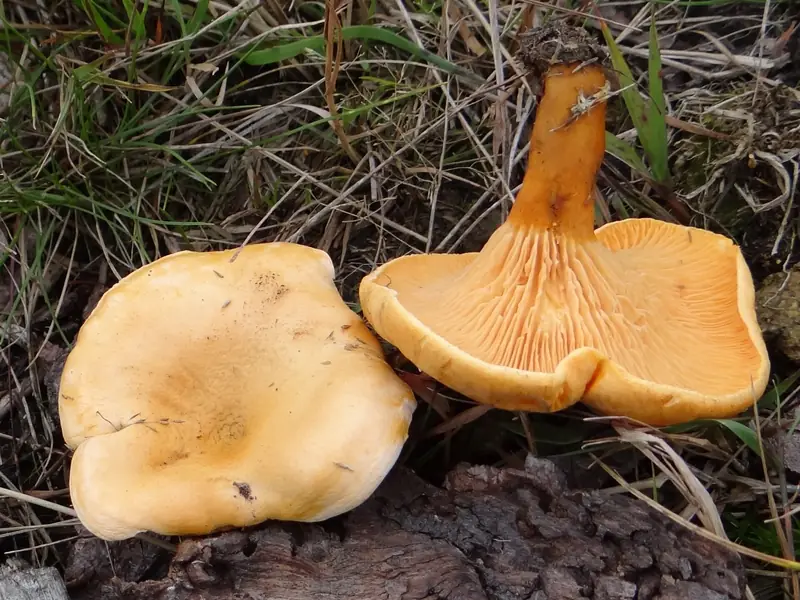
How to recognise it: false chanterelle
- 1
Crowded, thin, forked gills – not thick ridges
- 2
Intensely orange gills
- 3
Thin, soft flesh and a thin stem
- 4
Autumn, litter in coniferous forests
Description
- Cap
- 2–7 cm, orange-yellow to orange or red-orange (sometimes paler), matt, suede-felty, soon funnel-shaped, margin long inrolled.
- Gills
- True gills: thin, CROWDED, repeatedly and regularly forked, decurrent, intensely orange (usually brighter than the cap).
- Stem
- 3–5 cm, 3–10 mm, thin, the colour of the gills, often darker (blackish) or whitish at the base, sometimes off-centre.
- Flesh
- Thin, soft, cottony, whitish to cream; does not change colour.
- Smell and taste
- Smell and taste mild, nondescript (sometimes bitterish-sour).
Where and when it grows
Coniferous and mixed forests (under pine, spruce, fir, beech), on needle litter, humus, moss, sometimes on rotting wood; singly or in numbers.
Most often with: pine, spruce, fir, beech
Look-alikes: what it can be mistaken for
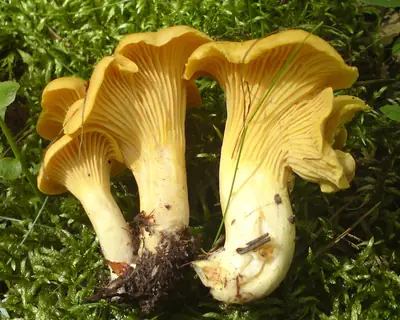
Chanterelle Edible medium risk
The chanterelle has thick, blunt ridges (not thin gills), is more yellow (egg-yolk-coloured), fleshy, has firm fibrous flesh and a thicker stem. Look under the cap.
Foragers’ finds
All photosPhotos and identifications are added by users; we do not check them. Add your own find →
Watch out for toxins
No potent toxins; in some people, especially after larger amounts, mild gastrointestinal upset.
Protection and sale
- Species protection: the species is not protected.
- Sale: the species is not on the list of mushrooms approved for sale.
False chanterelle: common questions
Is the false chanterelle edible?
Inedible. We classify it as INEDIBLE (the safer class). Sources differ: WSSE and Wikipedia – inedible, First Nature recommends treating it as inedible, grzyby.pl – edible but of no value. They agree that eaten in larger amounts it can cause gastrointestinal upset (it contains, among other things, arabitol). It is not a deadly poisonous mushroom.
When does the false chanterelle grow?
In Poland the fruiting bodies usually appear in: September, October, November. Habitat: Coniferous and mixed forests (under pine, spruce, fir, beech), on needle litter, humus, moss, sometimes on rotting wood; singly or in numbers.
What can the false chanterelle be mistaken for?
Chanterelle (edible): The chanterelle has thick, blunt ridges (not thin gills), is more yellow (egg-yolk-coloured), fleshy, has firm fibrous flesh and a thicker stem. Look under the cap.
Sources
- Lisówka pomarańczowa – Wikipedia (PL)
- Hygrophoropsis aurantiaca – Atlas grzybów Polski (grzyby.pl, M. Snowarski)
- Hygrophoropsis aurantiaca – First Nature
- Bezpieczne grzybobranie – ulotka WSSE w Warszawie (publikacja Nadleśnictwa Nowa Dęba, Lasy Państwowe)
Last checked: 9 November 2026. Spotted a mistake? Write to us.