Gilled mushrooms
Deadly dapperling
Lepiota brunneoincarnata
Deadly poisonous
Deadly poisonous – contains amatoxins like the death cap. Rare in Poland (Red List: V), but it represents a whole group of small dapperlings, several of which (e.g. Lepiota helveola) are deadly poisonous. Do not pick any small “parasols” with a cap smaller than approx. 10 cm.
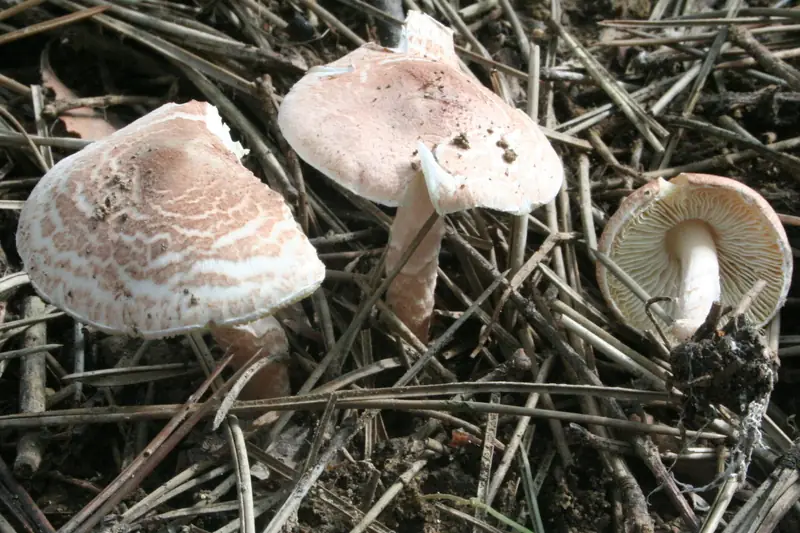
How to recognise it: deadly dapperling
- 1
Small fruit body – cap usually 2–6 cm
- 2
Wine-brown scales on a pale pink cap
- 3
Stem with bands of brown scales below a faint ring
- 4
Spore print white
Description
- Cap
- Small, 2–6(7) cm, hemispherical, then flat with an indistinct umbo; fine, dark brown to wine-brown scales on a pale pink background, denser in the centre.
- Gills
- Gills pale cream, crowded, free.
- Stem
- Short and thin (2–5 cm × 0.3–0.9 cm), whitish above the faint, quickly vanishing ring, pinkish-brown below with broken bands of brown scales; wine-red at the base.
- Flesh
- White, turning slightly red.
- Smell and taste
- Smell faint, fruity. Do not taste.
Where and when it grows
Saprotrophic; edges of forests and parks, meadows, roadsides, gardens – on soil rich in humus and organic debris, often in places altered by humans.
Look-alikes: what it can be mistaken for
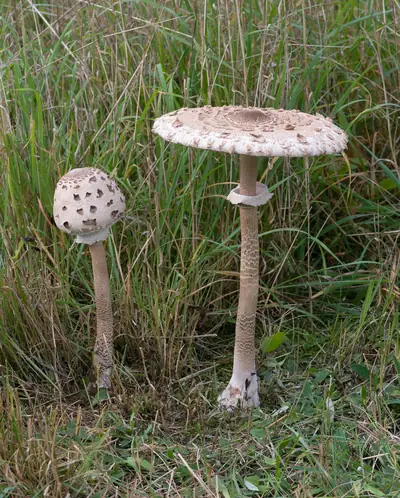
Parasol mushroom Edible high risk of confusion
Dapperlings are sometimes taken for small parasols. A mature parasol has a cap over approx. 10 cm, a tall stem with a zigzag pattern and a thick, movable ring; the dapperling is several times smaller and has a thin stem.
Step-by-step comparison: Parasol mushroom or deadly dapperling →
Foragers’ finds
All photosPhotos and identifications are added by users; we do not check them. Add your own find →
Protection and sale
- Species protection: the species is not protected.
- Sale: the species is not on the list of mushrooms approved for sale.
Deadly dapperling: common questions
Is the deadly dapperling edible?
Deadly poisonous. Deadly poisonous – contains amatoxins like the death cap. Rare in Poland (Red List: V), but it represents a whole group of small dapperlings, several of which (e.g. Lepiota helveola) are deadly poisonous. Do not pick any small “parasols” with a cap smaller than approx. 10 cm.
When does the deadly dapperling grow?
In Poland the fruiting bodies usually appear in: July, August, September, October. Habitat: Saprotrophic; edges of forests and parks, meadows, roadsides, gardens – on soil rich in humus and organic debris, often in places altered by humans.
What can the deadly dapperling be mistaken for?
Parasol mushroom (edible): Dapperlings are sometimes taken for small parasols. A mature parasol has a cap over approx. 10 cm, a tall stem with a zigzag pattern and a thick, movable ring; the dapperling is several times smaller and has a thin stem.
Sources
- Wikipedia (pl): Czubajeczka brązowoczerwonawa
- grzyby.pl (M. Snowarski): Lepiota brunneoincarnata
- First Nature: Lepiota brunneoincarnata, Deadly Dapperling
Last checked: 9 November 2026. Spotted a mistake? Write to us.