Gilled mushrooms
Deadly fibrecap
Inosperma erubescens · also known as: Red-staining fibrecap, Brick-red fibrecap
Deadly poisonous
Very severely poisonous; fatal poisonings have been recorded (high muscarine content). Since 2021 the Polish Mycological Society (PTMyk) committee has recommended the name “włókniak ceglasty”. Particularly dangerous in spring for people picking St George's mushroom (they grow in the same places) – St George's mushroom has a white spore print.
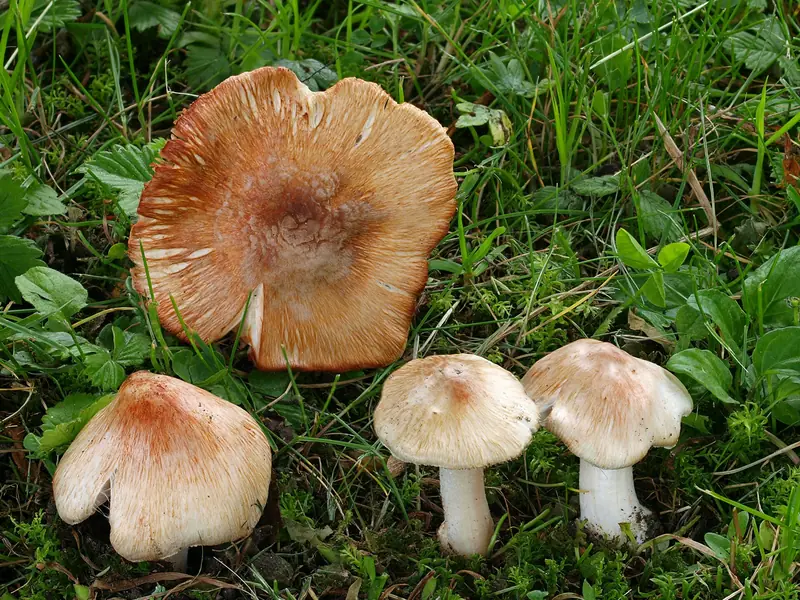
How to recognise it: deadly fibrecap
- 1
White mushroom that reddens/blotches brick-red
- 2
Radially split, fibrous cap
- 3
Brown (not white) spore print
- 4
Late spring–summer under beeches and limes on limestone
Description
- Cap
- 3–9 cm, white to cream when young, with age or when damaged blotched brick-red to cinnabar; conical-convex with an umbo, silky, fibrillose, the margin splits radially.
- Gills
- Gills whitish, then olive-rusty, turning red when damaged; fairly crowded, emarginate. Spore print ochre-brown.
- Stem
- 5–10(20) cm, white, pink to cinnabar with age (especially at the base), fibrous, without a distinct bulb or with a small bulb.
- Flesh
- White, turning pink in the stem; whole fruit bodies turn red when touched.
- Smell and taste
- Smell sweetish, fruity (unpleasant in old fruit bodies); DO NOT TASTE.
Where and when it grows
Broadleaf forests, parks, scrub and roadsides, mainly under beech, oak, lime and hornbeam, on calcareous or neutral soils; sometimes under pine.
Most often with: beech, oak, lime, hornbeam
Look-alikes: what it can be mistaken for
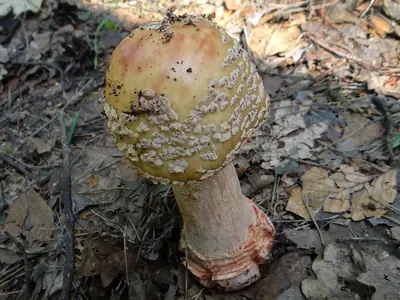
Gypsy mushroom Edible medium risk
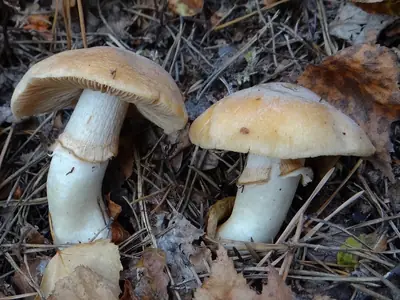
Large specimens have been confused with the gypsy mushroom (a case of poisoning has been described). The gypsy mushroom has a membranous ring on the stem, grows in acidic pine forests with bilberry and does not turn red.
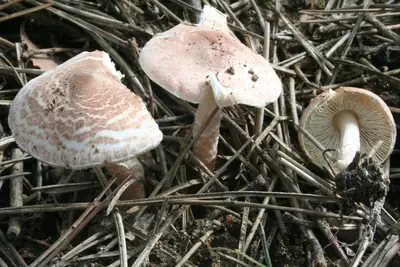
Step-by-step comparison: Gypsy mushroom or deadly fibrecap →Field mushroom Edible low risk
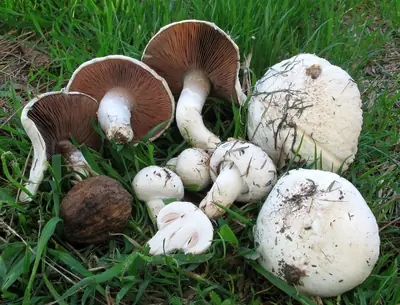
White young fruit bodies growing along roads and in parks may resemble young field mushrooms; the field mushroom has pink, then chocolate-brown gills, a ring, and does not turn red along its fibres.
Step-by-step comparison: Field mushroom or deadly fibrecap →
Foragers’ finds
All photosPhotos and identifications are added by users; we do not check them. Add your own find →
Protection and sale
- Species protection: the species is not protected.
- Sale: the species is not on the list of mushrooms approved for sale.
Deadly fibrecap: common questions
Is the deadly fibrecap edible?
Deadly poisonous. Very severely poisonous; fatal poisonings have been recorded (high muscarine content). Since 2021 the Polish Mycological Society (PTMyk) committee has recommended the name “włókniak ceglasty”. Particularly dangerous in spring for people picking St George's mushroom (they grow in the same places) – St George's mushroom has a white spore print.
When does the deadly fibrecap grow?
In Poland the fruiting bodies usually appear in: May, June, July, August, September. Habitat: Broadleaf forests, parks, scrub and roadsides, mainly under beech, oak, lime and hornbeam, on calcareous or neutral soils; sometimes under pine.
What can the deadly fibrecap be mistaken for?
Gypsy mushroom (edible): Large specimens have been confused with the gypsy mushroom (a case of poisoning has been described). The gypsy mushroom has a membranous ring on the stem, grows in acidic pine forests with bilberry and does not turn red. Field mushroom (edible): White young fruit bodies growing along roads and in parks may resemble young field mushrooms; the field mushroom has pink, then chocolate-brown gills, a ring, and does not turn red along its fibres.
Sources
- Włókniak ceglasty – Wikipedia (PL)
- Inocybe erubescens – Atlas grzybów Polski (grzyby.pl, M. Snowarski)
- Inocybe erubescens – First Nature
Last checked: 9 November 2026. Spotted a mistake? Write to us.