
Comparison
Gypsy mushroom or deadly fibrecap? How to tell them apart
Gypsy mushroom is an edible mushroom, while the deadly fibrecap is a deadly poisonous mushroom. Compare the two mushrooms point by point.
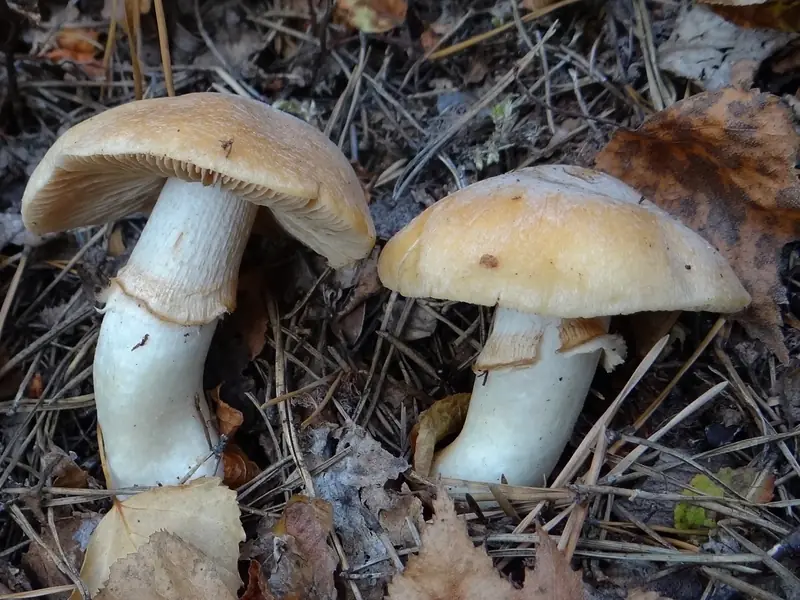
Large specimens have been confused with the gypsy mushroom (a case of poisoning has been described). The gypsy mushroom has a membranous ring on the stem, grows in acidic pine forests with bilberry and does not turn red.
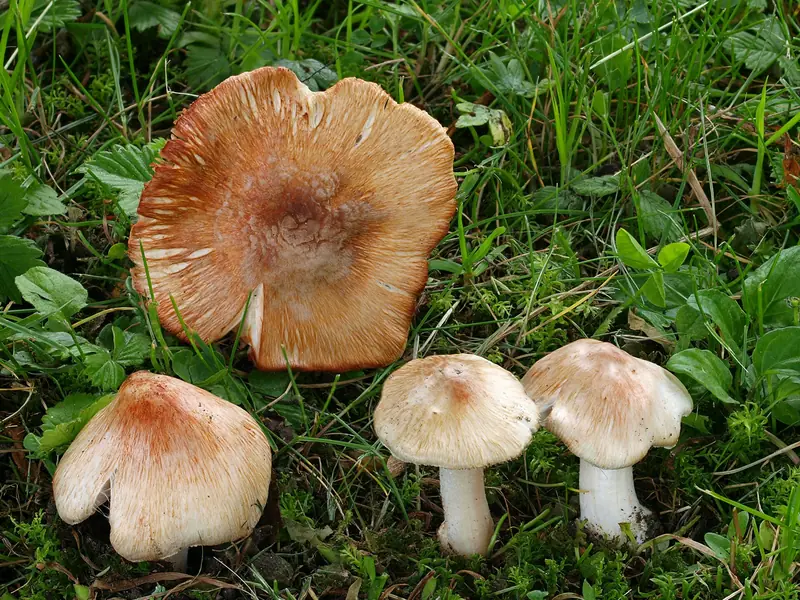
Large deadly fibrecaps have been mistaken for the gypsy mushroom (a case of poisoning has been described). The fibrecap has no ring, has a fibrous, radially splitting cap that turns red when touched, and grows under broadleaf trees on limestone.
Feature by feature
| Feature | Gypsy mushroom | Deadly fibrecap |
|---|---|---|
| Edibility | Edible | Deadly poisonous |
| Cap | 4–12 cm, straw-coloured to ochre-brown, with a silvery-violet, frosted bloom when young; egg-shaped, then expanded with a blunt umbo; radially wrinkled, the margin splits. | 3–9 cm, white to cream when young, with age or when damaged blotched brick-red to cinnabar; conical-convex with an umbo, silky, fibrillose, the margin splits radially. |
| Under the cap | Gills crowded, emarginate, clay-yellow, then rusty-brown; in young specimens covered by a white veil. Spore print rusty-brown. | Gills whitish, then olive-rusty, turning red when damaged; fairly crowded, emarginate. Spore print ochre-brown. |
| Stem | 7–15 cm, whitish to ochre, with a narrow, MEMBRANOUS whitish ring (often ragged); flaky above the ring, fibrous below; base sometimes bulbous, but without a volva. | 5–10(20) cm, white, pink to cinnabar with age (especially at the base), fibrous, without a distinct bulb or with a small bulb. |
| Flesh | White to pale cream, does not change colour. | White, turning pink in the stem; whole fruit bodies turn red when touched. |
| Smell and taste | Smell and taste insignificant. | Smell sweetish, fruity (unpleasant in old fruit bodies); DO NOT TASTE. |
| Habitat | Spruce and pine forests on poor, acidic, sandy soils, often among bilberry, Cladonia lichens and white moss (Leucobryum); in masses, in groups. Does not grow on limestone, rare in broadleaf forests. | Broadleaf forests, parks, scrub and roadsides, mainly under beech, oak, lime and hornbeam, on calcareous or neutral soils; sometimes under pine. |
| Season | July, August, September, October | May, June, July, August, September |
How to recognise it: gypsy mushroom
- Membranous ring on the stem (an exception among webcaps)
- Radially wrinkled, buff cap with a violet-tinged frosting when young
- Rusty-brown gills and spore print
- In masses in acidic coniferous forests with bilberry
How to recognise it: deadly fibrecap
- White mushroom that reddens/blotches brick-red
- Radially split, fibrous cap
- Brown (not white) spore print
- Late spring–summer under beeches and limes on limestone
Safety rule
Never eat a mushroom identified only from a website, a photo or an app. Show any doubtful specimen to a certified mushroom inspector at the sanepid (state sanitary inspection); in season the advice points are free. Do not give wild-picked mushrooms to children.
The golden rules of foraging →Frequently asked questions
Gypsy mushroom or deadly fibrecap: how can you tell them apart?
Large specimens have been confused with the gypsy mushroom (a case of poisoning has been described). The gypsy mushroom has a membranous ring on the stem, grows in acidic pine forests with bilberry and does not turn red. Large deadly fibrecaps have been mistaken for the gypsy mushroom (a case of poisoning has been described). The fibrecap has no ring, has a fibrous, radially splitting cap that turns red when touched, and grows under broadleaf trees on limestone.
Deadly fibrecap: what to do if you have eaten it?
Call 112 at once or go to A&E (SOR), and take any leftover mushrooms with you. Muscarine – muscarinic syndrome: sweating, salivation, tearing, constricted pupils, visual disturbances, vomiting, colic, slowed heart rate; rapid onset, from approx. 15 min to a few hours. Antidote: atropine. Death is possible (especially in people with heart and respiratory diseases).
Sources
- Płachetka zwyczajna – Wikipedia (PL)
- Rozites caperatus – Atlas grzybów Polski (grzyby.pl, M. Snowarski)
- Cortinarius caperatus – First Nature
- Włókniak ceglasty – Wikipedia (PL)
- Inocybe erubescens – Atlas grzybów Polski (grzyby.pl, M. Snowarski)
- Inocybe erubescens – First Nature
Last checked: 9 November 2026. Spotted a mistake? Write to us.