Gilled mushrooms
Gypsy mushroom
Cortinarius caperatus · also known as: The gypsy, Wrinkled webcap
EdibleApproved for sale
A tasty edible mushroom, traditionally collected in Poland. However, it belongs to the genus Cortinarius (webcaps), which includes deadly poisonous species – sources advise less experienced foragers against picking it. Key feature: a membranous ring on the stem.
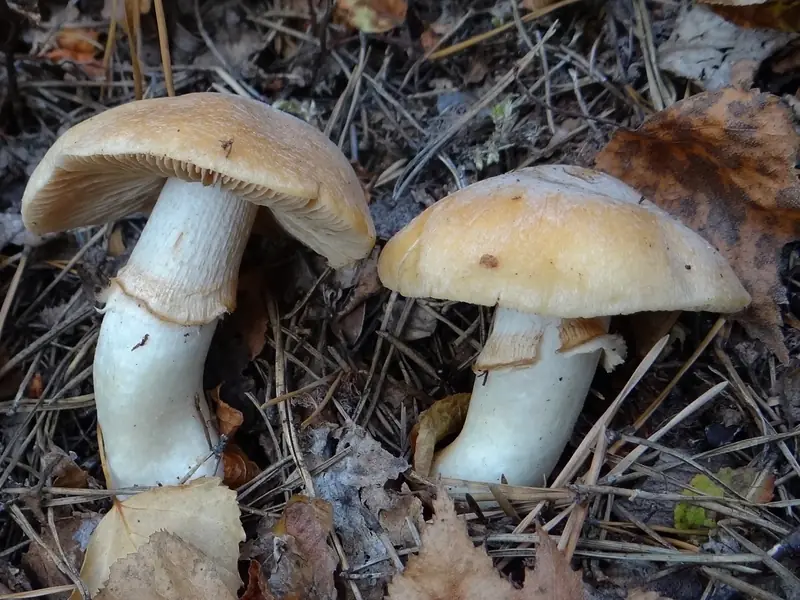
How to recognise it: gypsy mushroom
- 1
Membranous ring on the stem (an exception among webcaps)
- 2
Radially wrinkled, buff cap with a violet-tinged frosting when young
- 3
Rusty-brown gills and spore print
- 4
In masses in acidic coniferous forests with bilberry
Description
- Cap
- 4–12 cm, straw-coloured to ochre-brown, with a silvery-violet, frosted bloom when young; egg-shaped, then expanded with a blunt umbo; radially wrinkled, the margin splits.
- Gills
- Gills crowded, emarginate, clay-yellow, then rusty-brown; in young specimens covered by a white veil. Spore print rusty-brown.
- Stem
- 7–15 cm, whitish to ochre, with a narrow, MEMBRANOUS whitish ring (often ragged); flaky above the ring, fibrous below; base sometimes bulbous, but without a volva.
- Flesh
- White to pale cream, does not change colour.
- Smell and taste
- Smell and taste insignificant.
Where and when it grows
Spruce and pine forests on poor, acidic, sandy soils, often among bilberry, Cladonia lichens and white moss (Leucobryum); in masses, in groups. Does not grow on limestone, rare in broadleaf forests.
Most often with: spruce, pine
Look-alikes: what it can be mistaken for
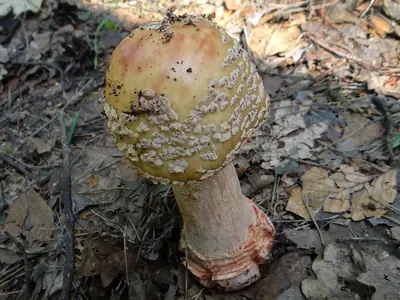
Deadly fibrecap Deadly poisonous medium risk
Large deadly fibrecaps have been mistaken for the gypsy mushroom (a case of poisoning has been described). The fibrecap has no ring, has a fibrous, radially splitting cap that turns red when touched, and grows under broadleaf trees on limestone.
Step-by-step comparison: Gypsy mushroom or deadly fibrecap →Fool's webcap Deadly poisonous medium risk
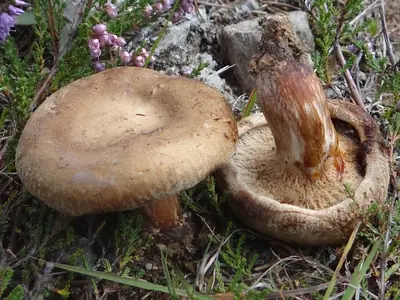
Mature gypsy mushrooms that have lost their ring may resemble other webcaps, including deadly poisonous ones. Pick only specimens with a distinct membranous ring.
Step-by-step comparison: Gypsy mushroom or fool's webcap →Death cap Deadly poisonous low risk
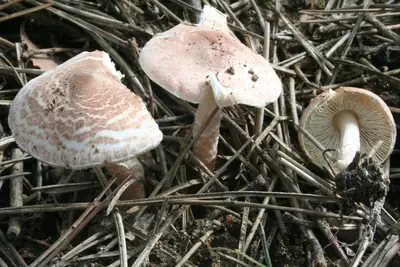
Amanitas have WHITE gills and a white spore print and a bulb with a volva at the base; the gypsy mushroom has rusty-brown gills and no volva.
Step-by-step comparison: Gypsy mushroom or death cap →
Foragers’ finds
All photosPhotos and identifications are added by users; we do not check them. Add your own find →
In the kitchen
Good for pickling in vinegar, also fried and stewed. Quickly becomes maggoty – pick young specimens.
Protection and sale
- Species protection: the species is not protected.
- Sale: the species is on the list of mushrooms approved for sale (it may be sold only with a mushroom inspector’s certificate). Listed in Annex 1 as “płachetka zwyczajna – Cortinarius caperatus”.
Gypsy mushroom: common questions
Is the gypsy mushroom edible?
Edible. A tasty edible mushroom, traditionally collected in Poland. However, it belongs to the genus Cortinarius (webcaps), which includes deadly poisonous species – sources advise less experienced foragers against picking it. Key feature: a membranous ring on the stem.
When does the gypsy mushroom grow?
In Poland the fruiting bodies usually appear in: July, August, September, October. Habitat: Spruce and pine forests on poor, acidic, sandy soils, often among bilberry, Cladonia lichens and white moss (Leucobryum); in masses, in groups. Does not grow on limestone, rare in broadleaf forests.
What can the gypsy mushroom be mistaken for?
Deadly fibrecap (deadly poisonous): Large deadly fibrecaps have been mistaken for the gypsy mushroom (a case of poisoning has been described). The fibrecap has no ring, has a fibrous, radially splitting cap that turns red when touched, and grows under broadleaf trees on limestone. Fool's webcap (deadly poisonous): Mature gypsy mushrooms that have lost their ring may resemble other webcaps, including deadly poisonous ones. Pick only specimens with a distinct membranous ring. Death cap (deadly poisonous): Amanitas have WHITE gills and a white spore print and a bulb with a volva at the base; the gypsy mushroom has rusty-brown gills and no volva.
Sources
- Płachetka zwyczajna – Wikipedia (PL)
- Rozites caperatus – Atlas grzybów Polski (grzyby.pl, M. Snowarski)
- Cortinarius caperatus – First Nature
- Rozporządzenie Ministra Zdrowia w sprawie grzybów dopuszczonych do obrotu… – tekst jednolity Dz.U. 2026 poz. 258 (załącznik nr 1)
Last checked: 9 November 2026. Spotted a mistake? Write to us.