Gilled mushrooms
Fool's webcap
Cortinarius orellanus · also known as: Deadly orellanus
Deadly poisonous
DEADLY POISONOUS. Orellanine is not destroyed by cooking and acts cumulatively. Symptoms appear after several days, and full poisoning even after approx. 2 weeks, so it is often not linked to mushrooms. In Poland in the late 1950s two waves of webcap poisonings claimed approx. 10 victims. Do not pick any small brown/rusty mushrooms with rusty gills.
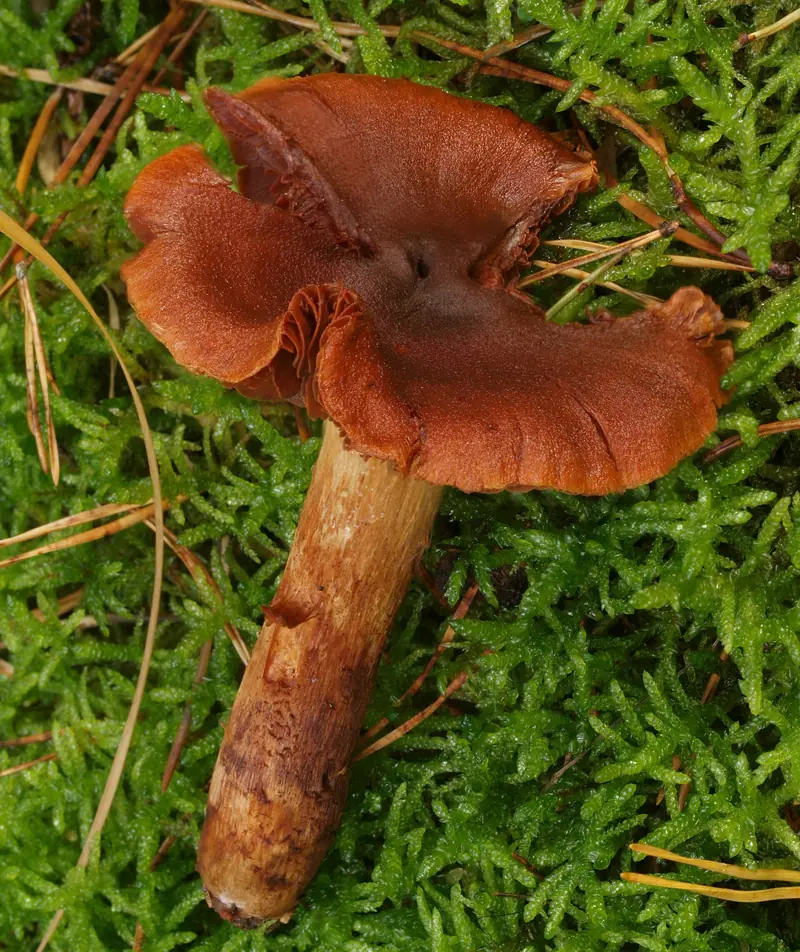
How to recognise it: fool's webcap
- 1
Rusty-orange, matt, felty cap with an umbo
- 2
Distant, orange-rusty gills and a rusty spore print
- 3
Traces of a cobweb-like cortina in young specimens
- 4
Broadleaf forest, usually under oak
Description
- Cap
- 4–7 cm, orange-brown to cinnamon- and reddish-brown, matt, felty with fine scales, with a blunt umbo.
- Gills
- Gills distant, thick, saffron-yellow at first, then orange-rusty; in young specimens covered by a cobweb-like cortina. Spore print rusty-brown.
- Stem
- 5–10 cm, yellowish to yellow-brown, with darker lengthwise fibres, narrowed at the base, without a distinct pattern from the veil.
- Flesh
- Yellowish, does not change colour noticeably.
- Smell and taste
- Faint smell of radish. DO NOT TASTE even a small piece.
Where and when it grows
Broadleaf and mixed forests, more often under oaks, less often under beech, birch and pine; on the ground, often on the verges of forest tracks. Rare in Poland.
Most often with: oak, beech, birch, pine
Look-alikes: what it can be mistaken for
Deadly webcap Deadly poisonous high risk of confusion
An equally deadly relative from coniferous forests – it has a sharper umbo and a stem with a yellow zigzag pattern. The difference makes no difference to safety: both are deadly poisonous.
Wood blewit Edible medium risk
Violet webcaps (e.g. the violet webcap, and “zasłonak wonny” – inedible, bitter, unpleasant-smelling) have a cobweb-like cortina when young and a RUSTY-BROWN spore print. Take a spore print: wood blewit – pale pink, webcaps – rusty. The genus Cortinarius includes deadly poisonous species (e.g. the fool's webcap).
Step-by-step comparison: Wood blewit or fool's webcap →Gypsy mushroom Edible medium risk
Mature gypsy mushrooms that have lost their ring may resemble other webcaps, including deadly poisonous ones. Pick only specimens with a distinct membranous ring.
Step-by-step comparison: Gypsy mushroom or fool's webcap →
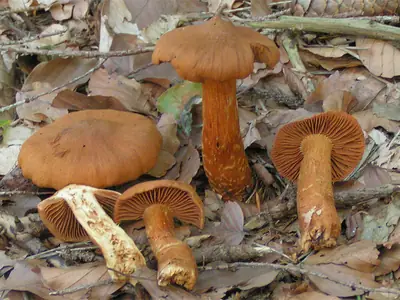
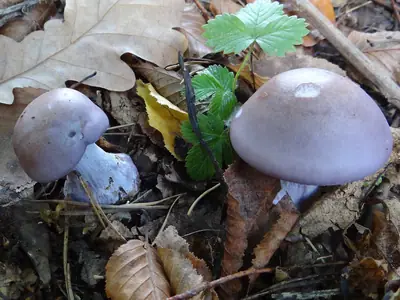
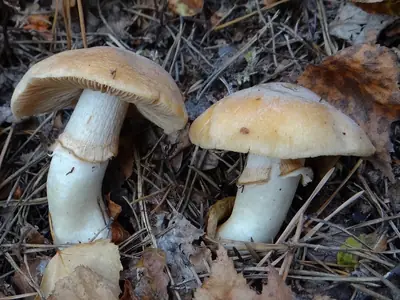
Foragers’ finds
All photosPhotos and identifications are added by users; we do not check them. Add your own find →
Protection and sale
- Species protection: the species is not protected. Not legally protected as a species; on the Red List of Polish fungi (category R – rare).
- Sale: the species is not on the list of mushrooms approved for sale.
Fool's webcap: common questions
Is the fool's webcap edible?
Deadly poisonous. DEADLY POISONOUS. Orellanine is not destroyed by cooking and acts cumulatively. Symptoms appear after several days, and full poisoning even after approx. 2 weeks, so it is often not linked to mushrooms. In Poland in the late 1950s two waves of webcap poisonings claimed approx. 10 victims. Do not pick any small brown/rusty mushrooms with rusty gills.
When does the fool's webcap grow?
In Poland the fruiting bodies usually appear in: August, September, October, November. Habitat: Broadleaf and mixed forests, more often under oaks, less often under beech, birch and pine; on the ground, often on the verges of forest tracks. Rare in Poland.
What can the fool's webcap be mistaken for?
Deadly webcap (deadly poisonous): An equally deadly relative from coniferous forests – it has a sharper umbo and a stem with a yellow zigzag pattern. The difference makes no difference to safety: both are deadly poisonous. Wood blewit (edible): Violet webcaps (e.g. the violet webcap, and “zasłonak wonny” – inedible, bitter, unpleasant-smelling) have a cobweb-like cortina when young and a RUSTY-BROWN spore print. Take a spore print: wood blewit – pale pink, webcaps – rusty. The genus Cortinarius includes deadly poisonous species (e.g. the fool's webcap). Gypsy mushroom (edible): Mature gypsy mushrooms that have lost their ring may resemble other webcaps, including deadly poisonous ones. Pick only specimens with a distinct membranous ring.
Sources
- Zasłonak rudy – Wikipedia (PL)
- Cortinarius orellanus – Atlas grzybów Polski (grzyby.pl, M. Snowarski)
- Cortinarius orellanus – First Nature
Last checked: 9 November 2026. Spotted a mistake? Write to us.