Gilled mushrooms
Deadly webcap
Cortinarius rubellus
Deadly poisonous
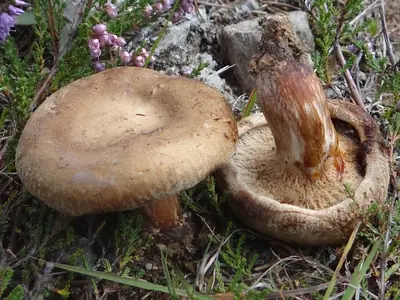
DEADLY POISONOUS – contains orellanine, like the fool's webcap. Cooking does not help. Inexperienced foragers sometimes confuse it with small brown edible mushrooms (e.g. “klejek czerwonawy”, a spike of the genus Gomphidius, or the trumpet chanterelle).
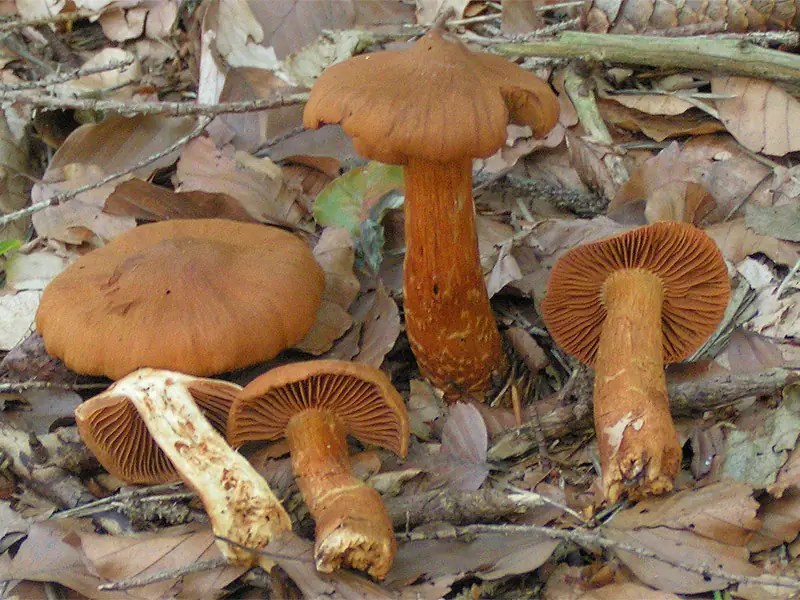
How to recognise it: deadly webcap
- 1
Sharp umbo on a rusty, matt cap
- 2
Yellow zigzag bands on the stem
- 3
Rusty gills and spore print
- 4
Moist spruce/pine forests, bogs
Description
- Cap
- 2–8 cm, orange-brown to rusty-brown, matt, felty, conical when young, then with a distinct, often sharp umbo.
- Gills
- Gills distant, rather thick, cinnamon-orange to rusty-brown; a cortina in young specimens. Spore print rusty-brown.
- Stem
- 5–8(13) cm, distinct yellow zigzag bands of veil remnants on a rusty-brown background; slightly club-shaped at the base.
- Flesh
- Yellowish, rusty-brownish in the stem.
- Smell and taste
- Faint smell of radish. DO NOT TASTE.
Where and when it grows
Moist and boggy coniferous forests under spruce or pine, bog margins, among bilberry and sphagnum mosses, on acidic soils; usually in groups. Its frequency in Poland is poorly known.
Most often with: spruce, pine
Look-alikes: what it can be mistaken for
Fool's webcap Deadly poisonous high risk of confusion
A sister species from broadleaf forests (oak), with a paler stem without a distinct pattern – equally deadly.
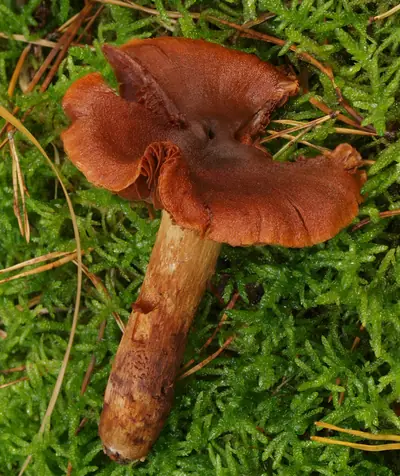
Foragers’ finds
All photosPhotos and identifications are added by users; we do not check them. Add your own find →
Protection and sale
- Species protection: the species is not protected.
- Sale: the species is not on the list of mushrooms approved for sale.
Deadly webcap: common questions
Is the deadly webcap edible?
Deadly poisonous. DEADLY POISONOUS – contains orellanine, like the fool's webcap. Cooking does not help. Inexperienced foragers sometimes confuse it with small brown edible mushrooms (e.g. “klejek czerwonawy”, a spike of the genus Gomphidius, or the trumpet chanterelle).
When does the deadly webcap grow?
In Poland the fruiting bodies usually appear in: August, September, October. Habitat: Moist and boggy coniferous forests under spruce or pine, bog margins, among bilberry and sphagnum mosses, on acidic soils; usually in groups. Its frequency in Poland is poorly known.
What can the deadly webcap be mistaken for?
Fool's webcap (deadly poisonous): A sister species from broadleaf forests (oak), with a paler stem without a distinct pattern – equally deadly.
Sources
- Zasłonak rudawy – Wikipedia (PL)
- Cortinarius rubellus – Atlas grzybów Polski (grzyby.pl, M. Snowarski)
- Cortinarius rubellus – First Nature
Last checked: 9 November 2026. Spotted a mistake? Write to us.