Gilled mushrooms
Common inkcap
Coprinopsis atramentaria · also known as: Tippler's bane, Common ink cap
Edible with care
Edible with care: only young fruit bodies that have not started blackening and ONLY without alcohol. Coprine blocks the breakdown of alcohol – do not drink alcohol for several days before and for at least 3 days after the meal (sources give from 24 h before/72 h after to 2 days before and after – apply the longer period). Because of the risk we do not recommend it to beginners. Since 2025 the Polish Mycological Society (PTMyk) committee has recommended the name “czernidłówka pospolita”.
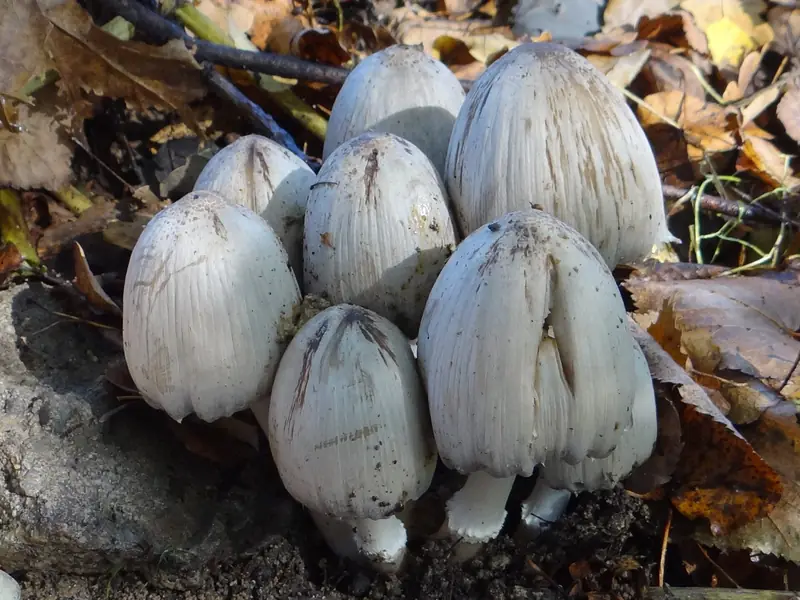
How to recognise it: common inkcap
- 1
Grey, smooth, grooved cap (without raised scales)
- 2
Clusters by stumps and buried wood
- 3
Gills turn black and dissolve
- 4
With alcohol – poisoning
Description
- Cap
- 3–7(10) cm, egg-shaped, then bell-shaped; ash-grey to grey-brown, radially grooved, smooth, only at the top with fine brownish scales; with age dissolves from the margin.
- Gills
- Gills broad, crowded, white, then pink, finally black and dissolving. Spore print black.
- Stem
- 5–15 cm, white, smooth, hollow, breaks easily; instead of a ring a faint ring-like ridge in the lower part, base narrowed.
- Flesh
- White, thin and brittle; turns black with age.
- Smell and taste
- Smell and taste insignificant.
Where and when it grows
Gardens, parks, meadows, forests, wasteland, fields – in places rich in organic debris, usually gregarious in clusters at the base of trunks, on roots or on buried decaying wood.
Look-alikes: what it can be mistaken for
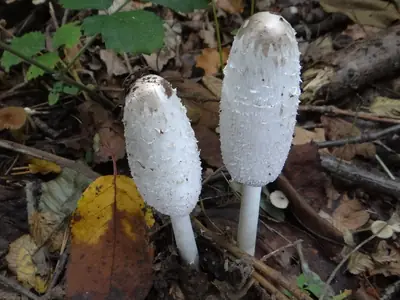
Shaggy inkcap Edible low risk
The shaggy inkcap is white, tall, covered with raised scales and has a movable ring; it does not react with alcohol. A grey, smooth cap = common inkcap.
Foragers’ finds
All photosPhotos and identifications are added by users; we do not check them. Add your own find →
In the kitchen
Only young fruit bodies with white gills, cooked straight away (frying, soup). Absolutely no alcohol for several days before and after the meal.
Watch out for toxins
Coprine – coprine (Antabuse-like, alcohol intolerance) syndrome: blocks the breakdown of acetaldehyde. Symptoms from a few minutes to approx. 1 h after drinking alcohol: flushing of the face and neck, feeling of heat, palpitations, rapid pulse, nausea. The risk persists for several days after the meal.
Protection and sale
- Species protection: the species is not protected.
- Sale: the species is not on the list of mushrooms approved for sale.
Common inkcap: common questions
Is the common inkcap edible?
Edible with care. Edible with care: only young fruit bodies that have not started blackening and ONLY without alcohol. Coprine blocks the breakdown of alcohol – do not drink alcohol for several days before and for at least 3 days after the meal (sources give from 24 h before/72 h after to 2 days before and after – apply the longer period). Because of the risk we do not recommend it to beginners. Since 2025 the Polish Mycological Society (PTMyk) committee has recommended the name “czernidłówka pospolita”.
When does the common inkcap grow?
In Poland the fruiting bodies usually appear in: April, May, June, July, August, September, October, November. Habitat: Gardens, parks, meadows, forests, wasteland, fields – in places rich in organic debris, usually gregarious in clusters at the base of trunks, on roots or on buried decaying wood.
What can the common inkcap be mistaken for?
Shaggy inkcap (edible): The shaggy inkcap is white, tall, covered with raised scales and has a movable ring; it does not react with alcohol. A grey, smooth cap = common inkcap.
Sources
- Czernidłówka pospolita – Wikipedia (PL)
- Coprinus atramentarius – Atlas grzybów Polski (grzyby.pl, M. Snowarski)
- Coprinopsis atramentaria – First Nature
Last checked: 9 November 2026. Spotted a mistake? Write to us.