Gilled mushrooms
Wood blewit
Collybia nuda · also known as: Blewit, Blue stalk
EdibleApproved for sale
A good edible mushroom, but only after cooking – raw it contains a substance that destroys red blood cells, which is destroyed by boiling/frying. It disagrees with some people – the first time, eat a small portion. Beware of violet webcaps.
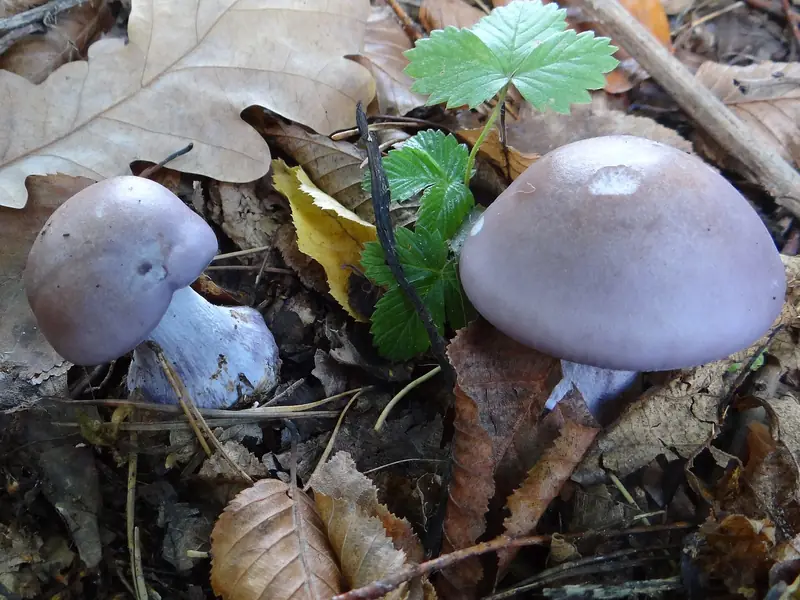
How to recognise it: wood blewit
- 1
Whole fruit body violet in young specimens
- 2
No cortina and no ring
- 3
Pale pink spore print
- 4
Spicy smell
- 5
Late autumn, leaf litter, fairy rings
Description
- Cap
- 5–15 cm, bright violet or lilac when young, then brownish-violet, ochre-brown when old; smooth, matt, margin long inrolled.
- Gills
- Gills crowded, thin, emarginate, clearly violet when young, then brownish. Spore print pale pink (cream-pink) – NEVER rusty.
- Stem
- 5–12 cm, violet with white fibrils, then grey-violet, solid, club-shaped at the base with violet mycelium; no ring and no cortina.
- Flesh
- Fleshy, violet-tinged when young, later cream; does not change colour when cut.
- Smell and taste
- Smell pleasant, spicy or fruity (sometimes aniseed-like); taste mild.
Where and when it grows
Saprotrophic on leaf and needle litter in broadleaf forests (especially beech woods) and coniferous forests (spruce forests), also in parks, gardens, on compost and meadows; in groups, rows and fairy rings. Single fruit bodies sometimes in May; main flush September–November, sometimes even in snow.
Most often with: beech, spruce
Look-alikes: what it can be mistaken for
Fool's webcap Deadly poisonous medium risk
Violet webcaps (e.g. the violet webcap, and “zasłonak wonny” – inedible, bitter, unpleasant-smelling) have a cobweb-like cortina when young and a RUSTY-BROWN spore print. Take a spore print: wood blewit – pale pink, webcaps – rusty. The genus Cortinarius includes deadly poisonous species (e.g. the fool's webcap).
Step-by-step comparison: Wood blewit or fool's webcap →
Foragers’ finds
All photosPhotos and identifications are added by users; we do not check them. Add your own find →
In the kitchen
Always cook thoroughly or fry – never raw. Good for pickling in vinegar, frying, can be frozen. Rarely maggoty. Sometimes cultivated on compost.
Watch out for toxins
Raw – a heat-labile haemolytic substance (destroys red blood cells); harmless after cooking.
Protection and sale
- Species protection: the species is not protected.
- Sale: the species is on the list of mushrooms approved for sale (it may be sold only with a mushroom inspector’s certificate). Listed in Annex 1 as “gąsówka fioletowawa – Clitocybe nuda”.
Wood blewit: common questions
Is the wood blewit edible?
Edible. A good edible mushroom, but only after cooking – raw it contains a substance that destroys red blood cells, which is destroyed by boiling/frying. It disagrees with some people – the first time, eat a small portion. Beware of violet webcaps.
When does the wood blewit grow?
In Poland the fruiting bodies usually appear in: September, October, November, December. Habitat: Saprotrophic on leaf and needle litter in broadleaf forests (especially beech woods) and coniferous forests (spruce forests), also in parks, gardens, on compost and meadows; in groups, rows and fairy rings. Single fruit bodies sometimes in May; main flush September–November, sometimes even in snow.
What can the wood blewit be mistaken for?
Fool's webcap (deadly poisonous): Violet webcaps (e.g. the violet webcap, and “zasłonak wonny” – inedible, bitter, unpleasant-smelling) have a cobweb-like cortina when young and a RUSTY-BROWN spore print. Take a spore print: wood blewit – pale pink, webcaps – rusty. The genus Cortinarius includes deadly poisonous species (e.g. the fool's webcap).
Sources
- Gąsówka fioletowawa – Wikipedia (PL)
- Lepista nuda – Atlas grzybów Polski (grzyby.pl, M. Snowarski)
- Lepista nuda – First Nature
- Rozporządzenie Ministra Zdrowia w sprawie grzybów dopuszczonych do obrotu… – tekst jednolity Dz.U. 2026 poz. 258 (załącznik nr 1)
Last checked: 9 November 2026. Spotted a mistake? Write to us.