
Comparison
Wood blewit or fool's webcap? How to tell them apart
Wood blewit is an edible mushroom, while the fool's webcap is a deadly poisonous mushroom. Compare the two mushrooms point by point.
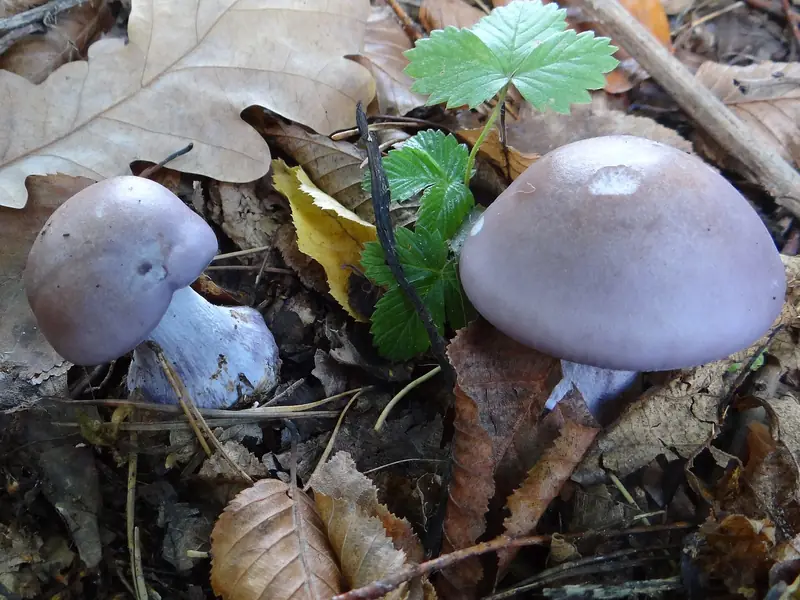
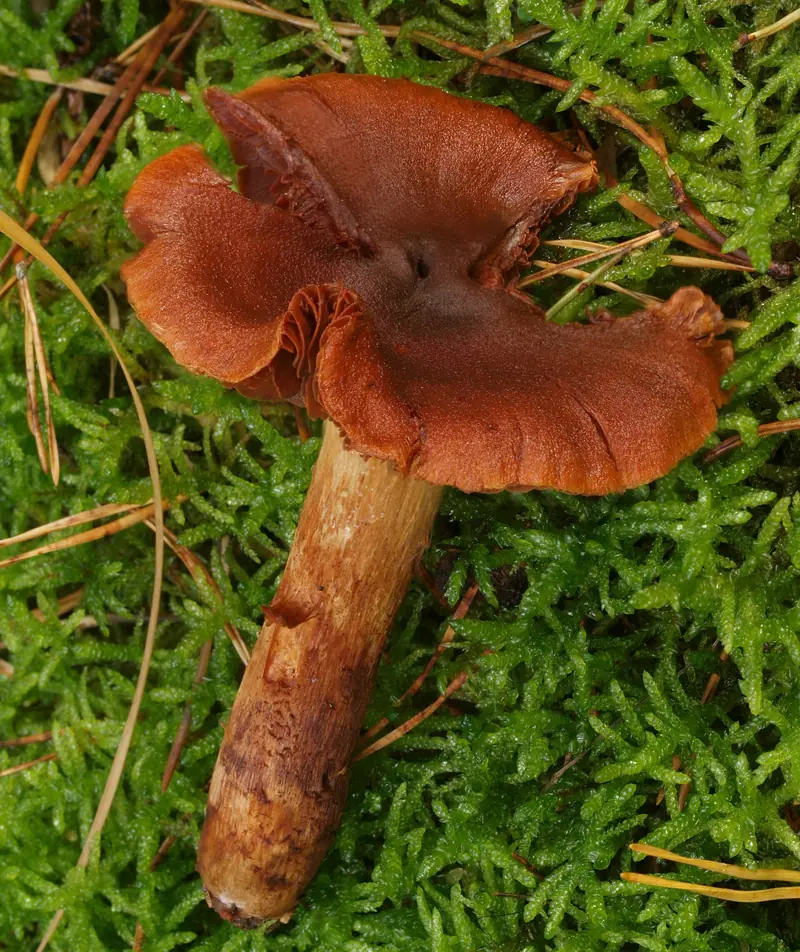
Violet webcaps (e.g. the violet webcap, and “zasłonak wonny” – inedible, bitter, unpleasant-smelling) have a cobweb-like cortina when young and a RUSTY-BROWN spore print. Take a spore print: wood blewit – pale pink, webcaps – rusty. The genus Cortinarius includes deadly poisonous species (e.g. the fool's webcap).
Feature by feature
| Feature | Wood blewit | Fool's webcap |
|---|---|---|
| Edibility | Edible | Deadly poisonous |
| Cap | 5–15 cm, bright violet or lilac when young, then brownish-violet, ochre-brown when old; smooth, matt, margin long inrolled. | 4–7 cm, orange-brown to cinnamon- and reddish-brown, matt, felty with fine scales, with a blunt umbo. |
| Under the cap | Gills crowded, thin, emarginate, clearly violet when young, then brownish. Spore print pale pink (cream-pink) – NEVER rusty. | Gills distant, thick, saffron-yellow at first, then orange-rusty; in young specimens covered by a cobweb-like cortina. Spore print rusty-brown. |
| Stem | 5–12 cm, violet with white fibrils, then grey-violet, solid, club-shaped at the base with violet mycelium; no ring and no cortina. | 5–10 cm, yellowish to yellow-brown, with darker lengthwise fibres, narrowed at the base, without a distinct pattern from the veil. |
| Flesh | Fleshy, violet-tinged when young, later cream; does not change colour when cut. | Yellowish, does not change colour noticeably. |
| Smell and taste | Smell pleasant, spicy or fruity (sometimes aniseed-like); taste mild. | Faint smell of radish. DO NOT TASTE even a small piece. |
| Habitat | Saprotrophic on leaf and needle litter in broadleaf forests (especially beech woods) and coniferous forests (spruce forests), also in parks, gardens, on compost and meadows; in groups, rows and fairy rings. Single fruit bodies sometimes in May; main flush September–November, sometimes even in snow. | Broadleaf and mixed forests, more often under oaks, less often under beech, birch and pine; on the ground, often on the verges of forest tracks. Rare in Poland. |
| Season | September, October, November, December | August, September, October, November |
How to recognise it: wood blewit
- Whole fruit body violet in young specimens
- No cortina and no ring
- Pale pink spore print
- Spicy smell
- Late autumn, leaf litter, fairy rings
How to recognise it: fool's webcap
- Rusty-orange, matt, felty cap with an umbo
- Distant, orange-rusty gills and a rusty spore print
- Traces of a cobweb-like cortina in young specimens
- Broadleaf forest, usually under oak
Safety rule
Never eat a mushroom identified only from a website, a photo or an app. Show any doubtful specimen to a certified mushroom inspector at the sanepid (state sanitary inspection); in season the advice points are free. Do not give wild-picked mushrooms to children.
The golden rules of foraging →Frequently asked questions
Wood blewit or fool's webcap: how can you tell them apart?
Violet webcaps (e.g. the violet webcap, and “zasłonak wonny” – inedible, bitter, unpleasant-smelling) have a cobweb-like cortina when young and a RUSTY-BROWN spore print. Take a spore print: wood blewit – pale pink, webcaps – rusty. The genus Cortinarius includes deadly poisonous species (e.g. the fool's webcap).
Fool's webcap: what to do if you have eaten it?
Call 112 at once or go to A&E (SOR), and take any leftover mushrooms with you. Orellanine – orellanus (nephrotoxic) syndrome: damage to the renal tubules and acute kidney failure. Latency from approx. 2–3 to a dozen or more days (fully developed symptoms even after ~2 weeks). No antidote – dialysis or kidney transplant.
Sources
- Gąsówka fioletowawa – Wikipedia (PL)
- Lepista nuda – Atlas grzybów Polski (grzyby.pl, M. Snowarski)
- Lepista nuda – First Nature
- Zasłonak rudy – Wikipedia (PL)
- Cortinarius orellanus – Atlas grzybów Polski (grzyby.pl, M. Snowarski)
- Cortinarius orellanus – First Nature
Last checked: 9 November 2026. Spotted a mistake? Write to us.