
Comparison
Gypsy mushroom or death cap? How to tell them apart
Gypsy mushroom is an edible mushroom, while the death cap is a deadly poisonous mushroom. Compare the two mushrooms point by point.
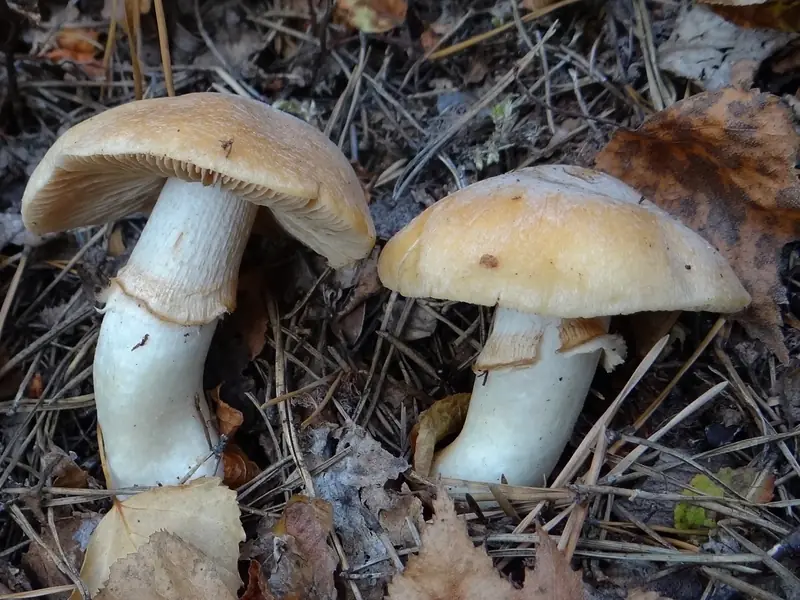
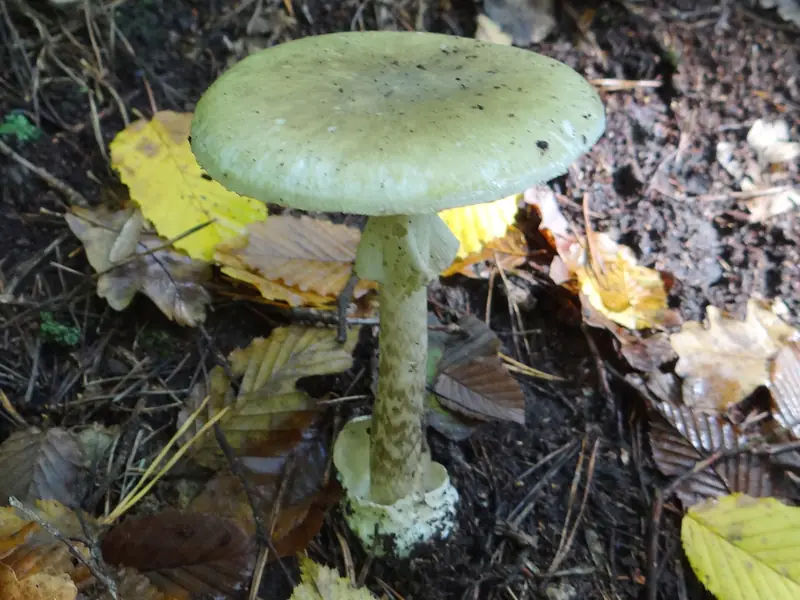
Amanitas have WHITE gills and a white spore print and a bulb with a volva at the base; the gypsy mushroom has rusty-brown gills and no volva.
Feature by feature
| Feature | Gypsy mushroom | Death cap |
|---|---|---|
| Edibility | Edible | Deadly poisonous |
| Cap | 4–12 cm, straw-coloured to ochre-brown, with a silvery-violet, frosted bloom when young; egg-shaped, then expanded with a blunt umbo; radially wrinkled, the margin splits. | 5–15 cm, hemispherical, then expanded; greenish, olive, yellowish-green to white (white form), with darker, radially innate fibrils; smooth, usually without patches, margin not striate. |
| Under the cap | Gills crowded, emarginate, clay-yellow, then rusty-brown; in young specimens covered by a white veil. Spore print rusty-brown. | Gills always white (slightly cream-greenish in old specimens), crowded, free; in young specimens covered by a white veil. |
| Stem | 7–15 cm, whitish to ochre, with a narrow, MEMBRANOUS whitish ring (often ragged); flaky above the ring, fibrous below; base sometimes bulbous, but without a volva. | 8–15 cm, whitish with a yellowish-greenish zigzag pattern; a distinct, hanging white ring; base bulbous, surrounded by a tall, free-standing, white, sac-like volva (often hidden in the soil). |
| Flesh | White to pale cream, does not change colour. | White, slightly yellow-green under the cap cuticle; does not change colour when broken. |
| Smell and taste | Smell and taste insignificant. | Mature fruit bodies smell sweetish and sickly (like artificial honey), young ones mild. Never taste. |
| Habitat | Spruce and pine forests on poor, acidic, sandy soils, often among bilberry, Cladonia lichens and white moss (Leucobryum); in masses, in groups. Does not grow on limestone, rare in broadleaf forests. | Common in broadleaf and mixed forests, especially oak and beech woods, less often in coniferous forests; also in parks and grassy areas near trees. Likes fertile soils, neutral to alkaline. |
| Season | July, August, September, October | June, July, August, September, October, November |
How to recognise it: gypsy mushroom
- Membranous ring on the stem (an exception among webcaps)
- Radially wrinkled, buff cap with a violet-tinged frosting when young
- Rusty-brown gills and spore print
- In masses in acidic coniferous forests with bilberry
How to recognise it: death cap
- Gills white throughout the life of the fruit body (field mushrooms have pink, then brown gills)
- Sac-like volva at the bulbous stem base – dig up the whole mushroom to see it
- Hanging ring below the cap
- Greenish cap with radial fibrils (can also be white)
- White spore print; sweetish, sickly smell of older fruit bodies
Safety rule
Never eat a mushroom identified only from a website, a photo or an app. Show any doubtful specimen to a certified mushroom inspector at the sanepid (state sanitary inspection); in season the advice points are free. Do not give wild-picked mushrooms to children.
The golden rules of foraging →Frequently asked questions
Gypsy mushroom or death cap: how can you tell them apart?
Amanitas have WHITE gills and a white spore print and a bulb with a volva at the base; the gypsy mushroom has rusty-brown gills and no volva.
Death cap: what to do if you have eaten it?
Call 112 at once or go to A&E (SOR), and take any leftover mushrooms with you. Amatoxins (mainly α-amanitin) and phallotoxins – phalloides (cytotoxic) syndrome. First symptoms (vomiting, diarrhoea, abdominal pain) only after approx. 8–16 h (on average approx. 12 h), earlier in children; then a deceptive improvement, and after 2–6 days damage to the liver and kidneys; death usually after several days. Hospital treatment, sometimes a liver transplant. At any suspicion go to hospital immediately and keep the mushroom remains.
Sources
- Płachetka zwyczajna – Wikipedia (PL)
- Rozites caperatus – Atlas grzybów Polski (grzyby.pl, M. Snowarski)
- Cortinarius caperatus – First Nature
- Wikipedia (pl): Muchomor zielonawy
- grzyby.pl (M. Snowarski): Amanita phalloides
- First Nature: Amanita phalloides, Deathcap
Last checked: 9 November 2026. Spotted a mistake? Write to us.