Other (brackets, puffballs)
Common earthball
Scleroderma citrinum · also known as: Pigskin poison puffball, Earthball
Poisonous
Poisonous – eaten in larger amounts it causes gastrointestinal poisoning. It is sometimes used as a seasoning (“poor man's truffle”) – this should not be done. Confused with puffballs and truffles. The current Polish scientific name is “tęgoskór cytrynowy”.
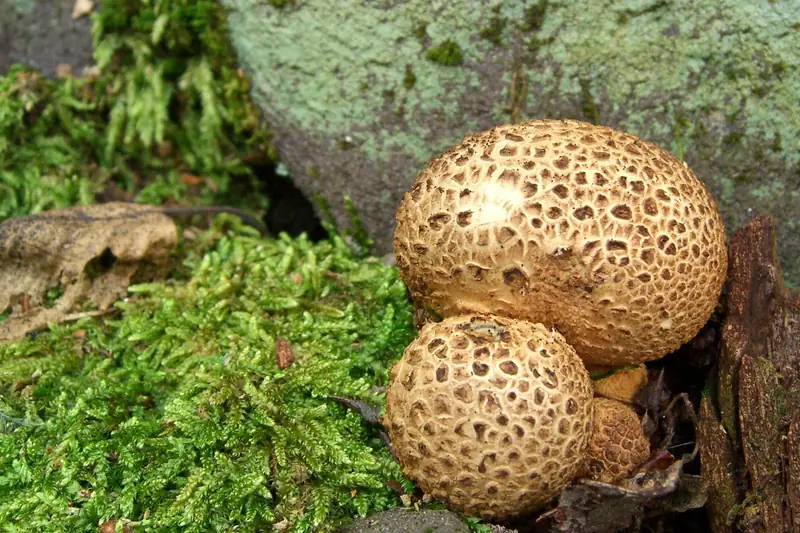
How to recognise it: common earthball
- 1
Hard, heavy tuber with a thick, yellowish, cracked skin
- 2
Interior purple-black (like ground poppy seed)
- 3
No stem
- 4
Strong spicy smell
Description
- Cap
- Fruit body globose or tuber-like, up to 10 cm, without a stem; hard, heavy, with a thick straw-yellow to yellow-brown skin cracked into warty patches.
- Underside
- No gills – the interior (gleba) is whitish only in very young specimens, soon violet, then black with white veins (like ground poppy seed), finally an olive-brown powder.
- Stem
- No stem; a tuft of whitish mycelial strands at the base.
- Flesh
- Thick, hard skin (peridium); the interior soon purple-black.
- Smell and taste
- Smell strong, aromatic, spicy. Do not taste.
Where and when it grows
Very common; on poor, acidic, sandy soils in forests (mainly coniferous), at forest edges, on forest track verges, heaths and bogs.
Look-alikes: what it can be mistaken for
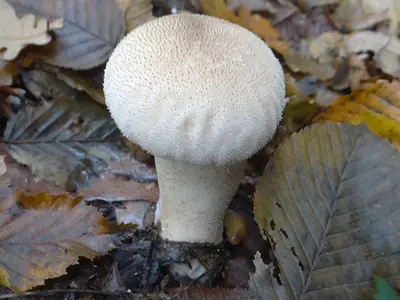
Common puffball Edible medium risk
The puffball is soft, spongy, covered with spines that fall off and has a white interior (when young); the earthball is hard, with a thick cracked skin and a dark interior.
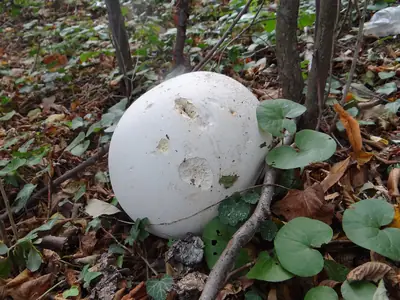
Step-by-step comparison: Common puffball or common earthball →Giant puffball Edible low risk
The giant puffball is much larger, smooth and white, with a white interior; the earthball is small, yellowish, cracked, dark inside.
Step-by-step comparison: Giant puffball or common earthball →
Foragers’ finds
All photosPhotos and identifications are added by users; we do not check them. Add your own find →
Protection and sale
- Species protection: the species is not protected. The rare, protected parasitic bolete (Pseudoboletus/Xerocomus parasiticus – partial protection) develops on its mycelium.
- Sale: the species is not on the list of mushrooms approved for sale.
Common earthball: common questions
Is the common earthball edible?
Poisonous. Poisonous – eaten in larger amounts it causes gastrointestinal poisoning. It is sometimes used as a seasoning (“poor man's truffle”) – this should not be done. Confused with puffballs and truffles. The current Polish scientific name is “tęgoskór cytrynowy”.
When does the common earthball grow?
In Poland the fruiting bodies usually appear in: June, July, August, September, October, November. Habitat: Very common; on poor, acidic, sandy soils in forests (mainly coniferous), at forest edges, on forest track verges, heaths and bogs.
What can the common earthball be mistaken for?
Common puffball (edible): The puffball is soft, spongy, covered with spines that fall off and has a white interior (when young); the earthball is hard, with a thick cracked skin and a dark interior. Giant puffball (edible): The giant puffball is much larger, smooth and white, with a white interior; the earthball is small, yellowish, cracked, dark inside.
Sources
- Wikipedia (pl): Tęgoskór cytrynowy
- grzyby.pl (atlas M. Snowarskiego): Scleroderma citrinum
- First Nature: Scleroderma citrinum
- Rozporządzenie Ministra Środowiska z dnia 9 października 2014 r. w sprawie ochrony gatunkowej grzybów (Dz.U. 2014 poz. 1408)
Last checked: 9 November 2026. Spotted a mistake? Write to us.