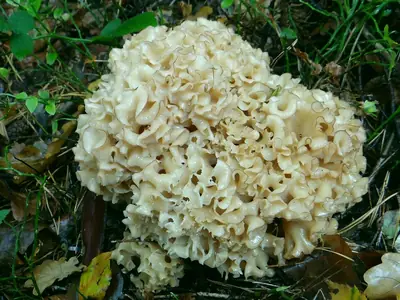
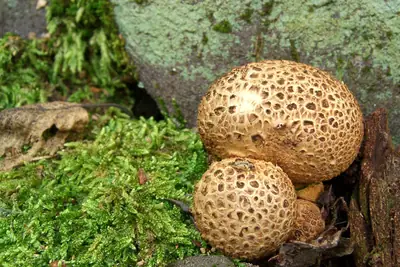
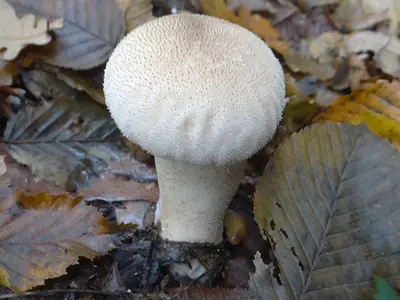
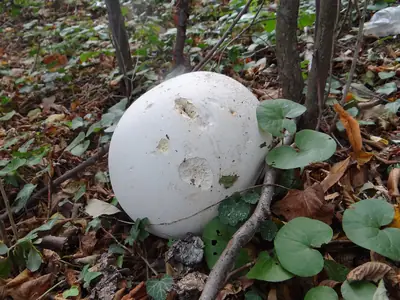
Other (brackets, puffballs)
Horn of plenty
Craterellus cornucopioides · also known as: Black trumpet, Trumpet of death
EdibleApproved for sale
Edible and aromatic (it keeps its aroma when dried), though unappetising in appearance and it turns black when cooked. No dangerous look-alikes; similar are the ashen chanterelle (pieprznik szary) and “lejkowiec pełnotrzonowy”, a solid-stemmed Craterellus (both harmless). Wikipedia suggests not picking it because it is becoming increasingly rare, grzyby.pl rates it as fairly common.
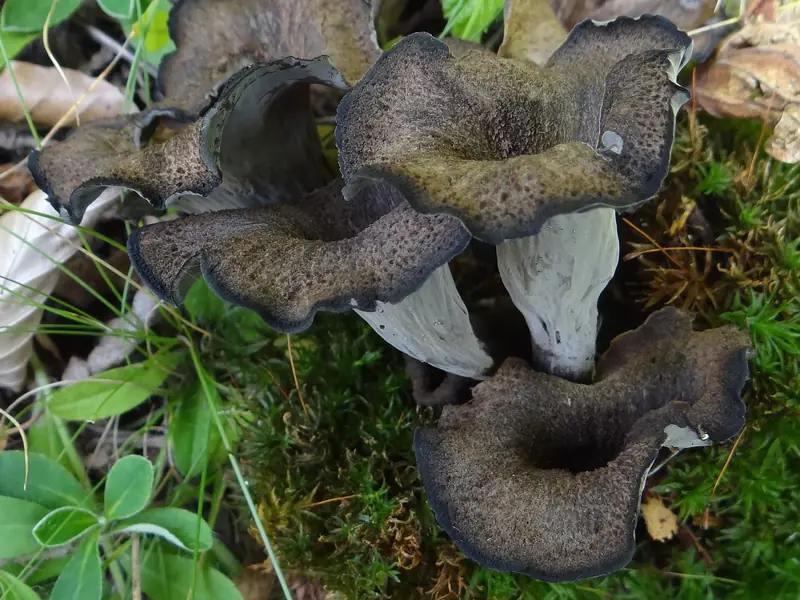
How to recognise it: horn of plenty
- 1
Black or dark grey trumpet, hollow right down to the ground
- 2
No gills – outside smooth or wrinkled, grey
- 3
Gregarious under beeches and oaks
- 4
Thin, elastic flesh
Description
- Cap
- Fruit body funnel- to trumpet-shaped, 4–12 cm tall, hollow right down to the base; inside of the funnel black to blackish-brown, finely scaly; margin turned outwards, wavy.
- Underside
- No gills – the outer surface of the funnel is smooth or wrinkled, grey to blue-grey, in older specimens dusted white with spores.
- Stem
- The stem merges smoothly into the funnel, hollow, grey-brown to grey-black.
- Flesh
- Thin, elastic, grey-black to black; brittle when dried, regains its elasticity after soaking.
- Smell and taste
- Smell pleasant, aromatic; taste insignificant. Spore print white to cream.
Where and when it grows
A mycorrhizal fungus of broadleaf and mixed forests, mainly under beeches and oaks, often in foothill areas; grows gregariously, often by damp hollows; avoids sandy and acidic soils.
Most often with: beech, oak
Foragers’ finds
All photosPhotos and identifications are added by users; we do not check them. Add your own find →
In the kitchen
Most often dried and ground into a powder as a seasoning for soups and sauces; can also be cooked fresh (e.g. a sauce). Turns black during cooking.
Protection and sale
- Species protection: the species is not protected.
- Sale: the species is on the list of mushrooms approved for sale (it may be sold only with a mushroom inspector’s certificate).
Horn of plenty: common questions
Is the horn of plenty edible?
Edible. Edible and aromatic (it keeps its aroma when dried), though unappetising in appearance and it turns black when cooked. No dangerous look-alikes; similar are the ashen chanterelle (pieprznik szary) and “lejkowiec pełnotrzonowy”, a solid-stemmed Craterellus (both harmless). Wikipedia suggests not picking it because it is becoming increasingly rare, grzyby.pl rates it as fairly common.
When does the horn of plenty grow?
In Poland the fruiting bodies usually appear in: August, September, October, November. Habitat: A mycorrhizal fungus of broadleaf and mixed forests, mainly under beeches and oaks, often in foothill areas; grows gregariously, often by damp hollows; avoids sandy and acidic soils.
Sources
- Wikipedia (pl): Lejkowiec dęty
- grzyby.pl (atlas M. Snowarskiego): Craterellus cornucopioides
- First Nature: Craterellus cornucopioides
- Rozporządzenie Ministra Zdrowia w sprawie grzybów dopuszczonych do obrotu… – tekst jednolity Dz.U. 2026 poz. 258
Last checked: 9 November 2026. Spotted a mistake? Write to us.