Other (brackets, puffballs)
Jelly ear
Auricularia auricula-judae · also known as: Wood ear, Tree ear
EdibleApproved for sale
Edible, valued mainly in Chinese and Japanese cuisine for its cartilaginous texture (it has almost no taste of its own). In Asia related species are cultivated (e.g. Auricularia polytricha – “mun mushrooms”).
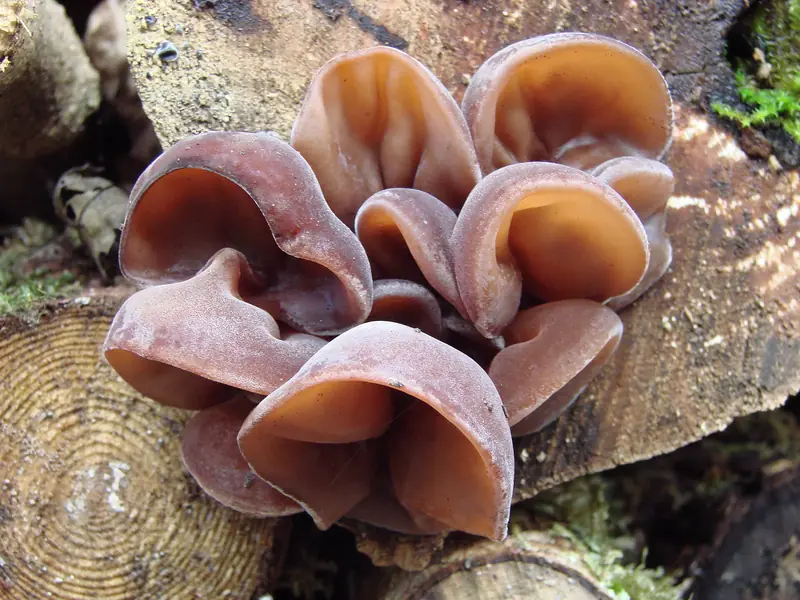
How to recognise it: jelly ear
- 1
Brown, jelly-like “ears” on elder
- 2
Elastic, cartilaginous flesh
- 3
Found all year round
- 4
Hardens when dried, regains its shape after soaking
Description
- Cap
- Fruit body 2–10 cm, cup-shaped, folded with age, shaped like an outer ear; reddish-brown to olive-brown; outer surface finely suede-like.
- Underside
- The spore-bearing layer is on the inner (lower) side of the “ear” – smooth, shiny, folded, sometimes dusted white with spores.
- Stem
- No stem – the fruit body is attached to the wood at its centre or side.
- Flesh
- Thin (1–3 mm), jelly-like, elastic and translucent when moist; hard and horny when dried, regains its form after soaking.
- Smell and taste
- No smell, taste mild. Spore print white.
Where and when it grows
On dying and dead trunks and branches of elder, less often other broadleaf trees (maple, alder, black locust); all year round in wet periods, also in mild winters. Common.
Most often with: elder, maple, alder, black locust
Foragers’ finds
All photosPhotos and identifications are added by users; we do not check them. Add your own find →
In the kitchen
Most often dried; soak before use. An ingredient in Asian dishes, rice, stir-fried vegetables, soups. Young fruit bodies are best.
Protection and sale
- Species protection: the species is not protected.
- Sale: the species is on the list of mushrooms approved for sale (it may be sold only with a mushroom inspector’s certificate).
Jelly ear: common questions
Is the jelly ear edible?
Edible. Edible, valued mainly in Chinese and Japanese cuisine for its cartilaginous texture (it has almost no taste of its own). In Asia related species are cultivated (e.g. Auricularia polytricha – “mun mushrooms”).
When does the jelly ear grow?
In Poland the fruiting bodies usually appear in: January, February, March, April, May, June, July, August, September, October, November, December. Habitat: On dying and dead trunks and branches of elder, less often other broadleaf trees (maple, alder, black locust); all year round in wet periods, also in mild winters. Common.
Sources
- Wikipedia (pl): Uszak bzowy
- grzyby.pl (atlas M. Snowarskiego): Hirneola auricula-judae
- First Nature: Auricularia auricula judae
- Rozporządzenie Ministra Zdrowia w sprawie grzybów dopuszczonych do obrotu… – tekst jednolity Dz.U. 2026 poz. 258
Last checked: 9 November 2026. Spotted a mistake? Write to us.