Gilled mushrooms
Green brittlegill
Russula virescens · also known as: Green-cracking russula, Quilted green russula
Edible
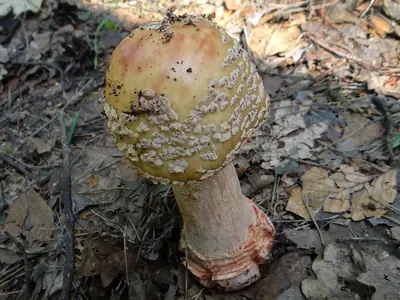
One of the tastiest brittlegills. Young specimens, before the cap cracks into patches, can be confused by inexperienced foragers with the deadly poisonous death cap – always check the stem base. It is not on the list of mushrooms permitted for sale.
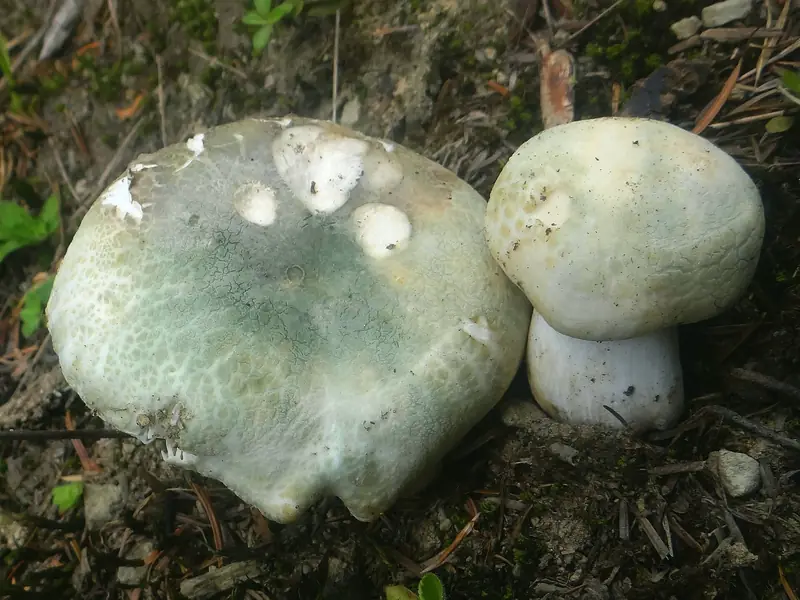
How to recognise it: green brittlegill
- 1
Green cap cracked into small patches, matt
- 2
Brittle white stem without a ring and without a volva
- 3
White, brittle gills
- 4
Mild, nutty taste
Description
- Cap
- 6–15 cm, globose, then expanded to slightly depressed; grey-green to verdigris, matt, dry; the cuticle cracks into small green patches on a paler background (a “cobbled” pattern).
- Gills
- Gills white, then pale cream, brittle; spore print white to light cream.
- Stem
- 2–12 cm, white, stout, solid, spongy with age, brittle; no ring, no bulb and no volva.
- Flesh
- White, thick, firm, brittle; turns slightly brown when damaged.
- Smell and taste
- Smell faint, nutty; taste mild, nutty.
Where and when it grows
Broadleaf forests, mainly under beeches and oaks, also under birches; less often coniferous forests (spruce forests). Usually solitary.
Most often with: beech, oak, birch
Look-alikes: what it can be mistaken for
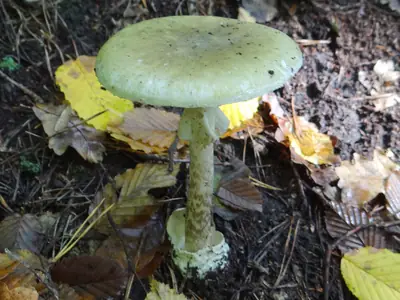
Death cap Deadly poisonous high risk of confusion
The death cap has a smooth, slightly shiny cap with radial fibrils (not cracked into patches), a hanging ring and a bulb with a sac-like volva at the base. Dig up the whole stem – the brittlegill has an even, brittle stem with no volva.
Step-by-step comparison: Green brittlegill or death cap →
Foragers’ finds
All photosPhotos and identifications are added by users; we do not check them. Add your own find →
In the kitchen
Fried, stewed with onion, grilled, in omelettes, soups and goulashes; drying intensifies the nutty aroma.
Protection and sale
- Species protection: the species is not protected.
- Sale: the species is not on the list of mushrooms approved for sale. Not on the list of mushrooms permitted for sale (the list contains no brittlegill at all).
Green brittlegill: common questions
Is the green brittlegill edible?
Edible. One of the tastiest brittlegills. Young specimens, before the cap cracks into patches, can be confused by inexperienced foragers with the deadly poisonous death cap – always check the stem base. It is not on the list of mushrooms permitted for sale.
When does the green brittlegill grow?
In Poland the fruiting bodies usually appear in: July, August, September. Habitat: Broadleaf forests, mainly under beeches and oaks, also under birches; less often coniferous forests (spruce forests). Usually solitary.
What can the green brittlegill be mistaken for?
Death cap (deadly poisonous): The death cap has a smooth, slightly shiny cap with radial fibrils (not cracked into patches), a hanging ring and a bulb with a sac-like volva at the base. Dig up the whole stem – the brittlegill has an even, brittle stem with no volva.
Sources
- Wikipedia (pl): Gołąbek zielonawy
- grzyby.pl (M. Snowarski): Russula virescens
- First Nature: Russula virescens, Greencracked Brittlegill
- Medycyna Praktyczna (mp.pl): Zatrucie grzybami
Last checked: 9 November 2026. Spotted a mistake? Write to us.