Gilled mushrooms
Yellow knight
Tricholoma equestre · also known as: Man on horseback, Canary trich
PoisonousApproved for sale
Traditionally collected, and still (as of 2026, Dz.U. 2026 poz. 258) on the list of mushrooms permitted for sale in Poland – contrary to the frequently repeated claim that it was removed from it. However, since 2001 severe poisonings with muscle breakdown (rhabdomyolysis) have been described, including fatal ones: in France (2001–2003) and in Poland (2009: three people, one died), usually after eating large portions for several days in a row. Germany and France consider it poisonous; some Polish researchers dispute the evidence. As a precaution, we classify it as poisonous and do not recommend eating it. The similar Tricholoma frondosae (aspen knight) is suspected of being even more harmful.
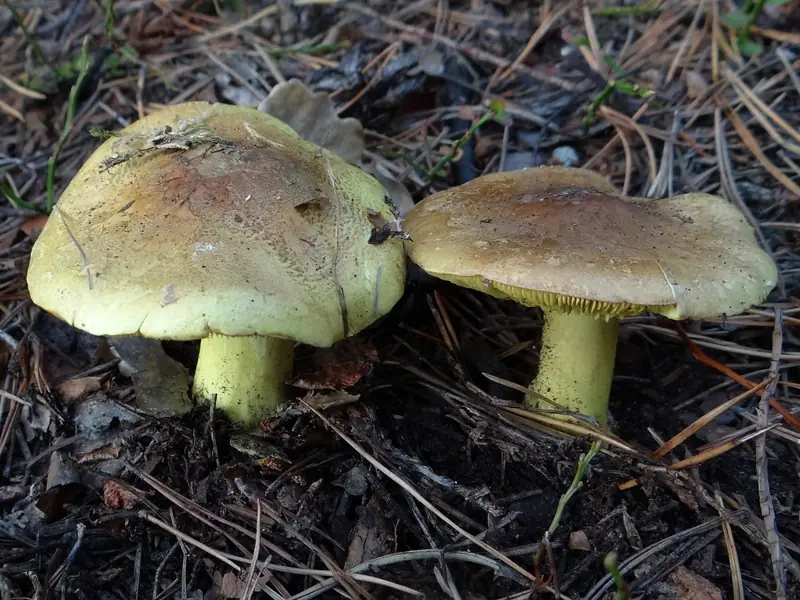
How to recognise it: yellow knight
- 1
Yellow gills notched at the stem
- 2
Yellow-green, sticky cap with sand, darker in the centre
- 3
Stout yellow stem without ring or volva, buried in sand
- 4
Late autumn in pine forests
Description
- Cap
- 4–10(12) cm, yellow-green to yellow-brown, darker and olive-brown scaly in the centre; sticky, often with grains of sand stuck to it; margin long inrolled.
- Gills
- Gills sulphur-yellow to pale yellow, moderately crowded, emarginate (notched with a tooth at the stem).
- Stem
- 3–9 cm, stout, light yellow, solid, often almost entirely buried in the substrate; no ring and no volva.
- Flesh
- White to pale yellow, firm; does not change colour when cut.
- Smell and taste
- Smell faint, mealy (according to First Nature no distinct smell); taste mild, nutty.
Where and when it grows
Pine forests on sandy soils, often with lichens and mosses; usually gregarious, sometimes together with the sooty head. The fruit body develops almost entirely in the sand – only the cap shows above the moss.
Most often with: pine, birch
Look-alikes: what it can be mistaken for
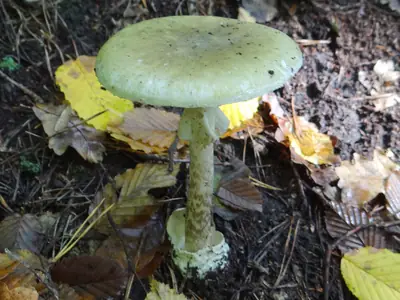
Death cap Deadly poisonous high risk of confusion
Deadly poisonous. The death cap has white (not yellow), free gills, a tall stem with a ring and a sac-like volva, and a sweetish, sickly smell. Always check the gill colour and the stem base.
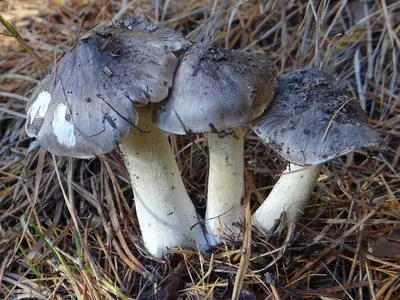
Sooty head Edible low risk
The sooty head grows in the same pine forests and can be yellow-tinged, but it has a grey cap with black fibrils and white to greyish gills. The mistake itself is not dangerous.
Step-by-step comparison: Sooty head or yellow knight →
Foragers’ finds
All photosPhotos and identifications are added by users; we do not check them. Add your own find →
Protection and sale
- Species protection: the species is not protected. Not protected; on the Red List of Polish fungi (category I – threat status indeterminate).
- Sale: the species is on the list of mushrooms approved for sale (it may be sold only with a mushroom inspector’s certificate). Still on the Ministry of Health (MZ) list (item 11 of Annex 1 in the consolidated text Dz.U. 2026 poz. 258), despite reports of poisonings.
Yellow knight: common questions
Is the yellow knight edible?
Poisonous. Traditionally collected, and still (as of 2026, Dz.U. 2026 poz. 258) on the list of mushrooms permitted for sale in Poland – contrary to the frequently repeated claim that it was removed from it. However, since 2001 severe poisonings with muscle breakdown (rhabdomyolysis) have been described, including fatal ones: in France (2001–2003) and in Poland (2009: three people, one died), usually after eating large portions for several days in a row. Germany and France consider it poisonous; some Polish researchers dispute the evidence. As a precaution, we classify it as poisonous and do not recommend eating it. The similar Tricholoma frondosae (aspen knight) is suspected of being even more harmful.
When does the yellow knight grow?
In Poland the fruiting bodies usually appear in: September, October, November, December. Habitat: Pine forests on sandy soils, often with lichens and mosses; usually gregarious, sometimes together with the sooty head. The fruit body develops almost entirely in the sand – only the cap shows above the moss.
What can the yellow knight be mistaken for?
Death cap (deadly poisonous): Deadly poisonous. The death cap has white (not yellow), free gills, a tall stem with a ring and a sac-like volva, and a sweetish, sickly smell. Always check the gill colour and the stem base. Sooty head (edible): The sooty head grows in the same pine forests and can be yellow-tinged, but it has a grey cap with black fibrils and white to greyish gills. The mistake itself is not dangerous.
Sources
- Wikipedia (pl): Gąska zielonka
- grzyby.pl (M. Snowarski): Tricholoma equestre
- First Nature: Tricholoma equestre, Yellow Knight
- Bedry R. i in., Wild-mushroom intoxication as a cause of rhabdomyolysis, N Engl J Med 2001;345:798-802 (PubMed)
- Rozporządzenie MZ w sprawie grzybów dopuszczonych do obrotu – tekst jednolity Dz.U. 2026 poz. 258
- Medycyna Praktyczna (mp.pl): Zatrucie grzybami
Last checked: 9 November 2026. Spotted a mistake? Write to us.