
Comparison
Sooty head or yellow knight? How to tell them apart
Sooty head is an edible mushroom, while the yellow knight is a poisonous mushroom. Compare the two mushrooms point by point.
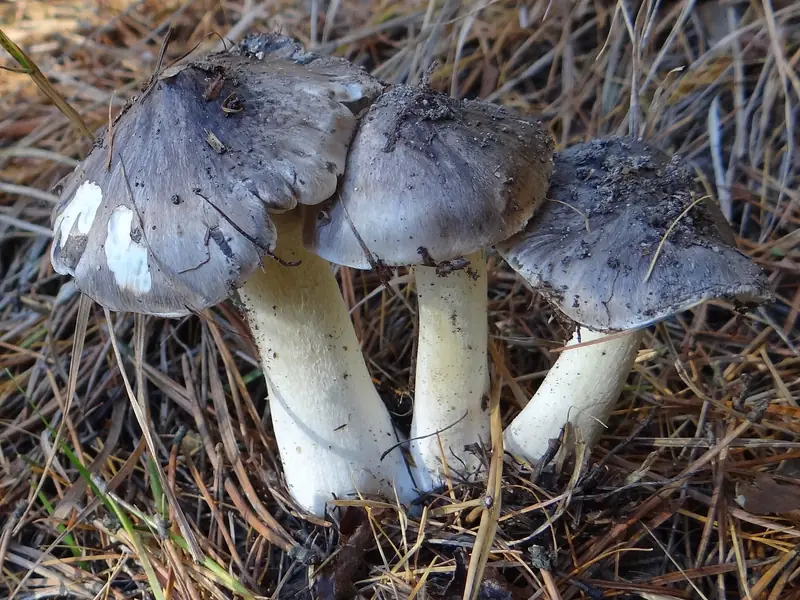
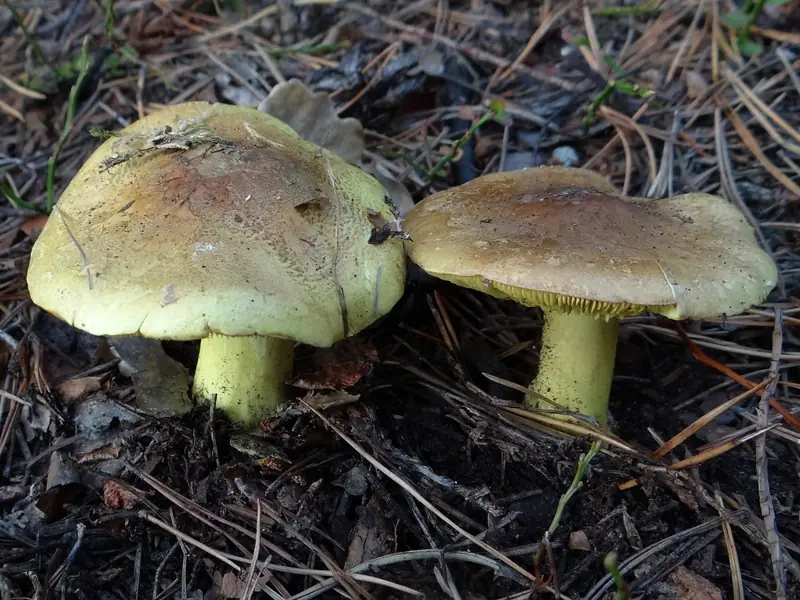
The yellow knight has a yellow cap and yellow gills; it grows in the same places. The yellow knight is considered poisonous (rhabdomyolysis).
The sooty head grows in the same pine forests and can be yellow-tinged, but it has a grey cap with black fibrils and white to greyish gills. The mistake itself is not dangerous.
Feature by feature
| Feature | Sooty head | Yellow knight |
|---|---|---|
| Edibility | Edible | Poisonous |
| Cap | 3–10(12) cm, grey to dark grey, often with an olive, yellowish or violet tinge and distinct, black, radially innate fibrils; with a blunt umbo, margin wavy; slightly slippery when wet. | 4–10(12) cm, yellow-green to yellow-brown, darker and olive-brown scaly in the centre; sticky, often with grains of sand stuck to it; margin long inrolled. |
| Under the cap | Gills white, then greyish or yellowish, moderately crowded, emarginate (notched with a tooth). | Gills sulphur-yellow to pale yellow, moderately crowded, emarginate (notched with a tooth at the stem). |
| Stem | 5–10 cm, white with a yellowish or greyish tinge, solid, firm, fibrillose; no ring. | 3–9 cm, stout, light yellow, solid, often almost entirely buried in the substrate; no ring and no volva. |
| Flesh | White, greyish under the cap cuticle; does not change colour. | White to pale yellow, firm; does not change colour when cut. |
| Smell and taste | Smell mealy (faint); taste mild, sweetish-nutty. | Smell faint, mealy (according to First Nature no distinct smell); taste mild, nutty. |
| Habitat | Pine forests with lichens or mosses on sandy soils, also mixed forests; gregarious, often together with the yellow knight. | Pine forests on sandy soils, often with lichens and mosses; usually gregarious, sometimes together with the sooty head. The fruit body develops almost entirely in the sand – only the cap shows above the moss. |
| Season | October, November, December | September, October, November, December |
How to recognise it: sooty head
- Grey cap with black, radial fibrils (not scales)
- White to greyish gills, notched with a tooth
- Mild taste and mealy smell
- Late autumn, pine forests on sand
How to recognise it: yellow knight
- Yellow gills notched at the stem
- Yellow-green, sticky cap with sand, darker in the centre
- Stout yellow stem without ring or volva, buried in sand
- Late autumn in pine forests
Safety rule
Never eat a mushroom identified only from a website, a photo or an app. Show any doubtful specimen to a certified mushroom inspector at the sanepid (state sanitary inspection); in season the advice points are free. Do not give wild-picked mushrooms to children.
The golden rules of foraging →Frequently asked questions
Sooty head or yellow knight: how can you tell them apart?
The yellow knight has a yellow cap and yellow gills; it grows in the same places. The yellow knight is considered poisonous (rhabdomyolysis). The sooty head grows in the same pine forests and can be yellow-tinged, but it has a grey cap with black fibrils and white to greyish gills. The mistake itself is not dangerous.
Yellow knight: what to do if you have eaten it?
Call 112 at once or go to A&E (SOR), and take any leftover mushrooms with you. Toxic substance unidentified. Rhabdomyolysis (breakdown of skeletal muscle) after eating large amounts on several consecutive days: muscle weakness and pain, dark brown urine (myoglobinuria), in severe cases cardiac and renal complications, deaths.
Sources
- Wikipedia (pl): Gąska niekształtna
- grzyby.pl (M. Snowarski): Tricholoma portentosum
- First Nature: Tricholoma portentosum, Coalman
- Wikipedia (pl): Gąska zielonka
- grzyby.pl (M. Snowarski): Tricholoma equestre
- First Nature: Tricholoma equestre, Yellow Knight
Last checked: 9 November 2026. Spotted a mistake? Write to us.