Gilled mushrooms
Sooty head
Tricholoma portentosum · also known as: Charbonnier, Grey knight
Edible
A good, sought-after edible mushroom of late autumn (said to be best after the first frosts). Caution: it is easily confused with other grey Tricholoma species, some of which are poisonous (e.g. the tiger tricholoma) or acrid (“gąska pieprzna”, a peppery-tasting knight). It is not on the list of mushrooms permitted for sale.
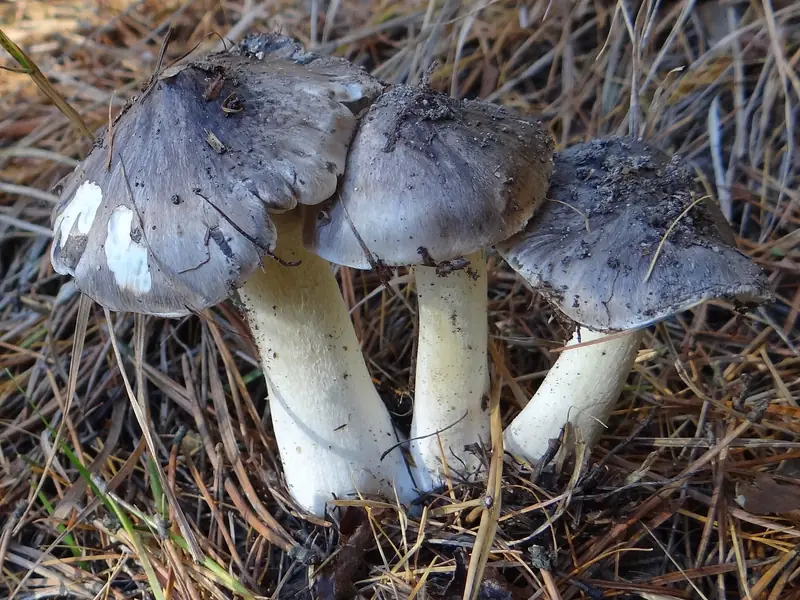
How to recognise it: sooty head
- 1
Grey cap with black, radial fibrils (not scales)
- 2
White to greyish gills, notched with a tooth
- 3
Mild taste and mealy smell
- 4
Late autumn, pine forests on sand
Description
- Cap
- 3–10(12) cm, grey to dark grey, often with an olive, yellowish or violet tinge and distinct, black, radially innate fibrils; with a blunt umbo, margin wavy; slightly slippery when wet.
- Gills
- Gills white, then greyish or yellowish, moderately crowded, emarginate (notched with a tooth).
- Stem
- 5–10 cm, white with a yellowish or greyish tinge, solid, firm, fibrillose; no ring.
- Flesh
- White, greyish under the cap cuticle; does not change colour.
- Smell and taste
- Smell mealy (faint); taste mild, sweetish-nutty.
Where and when it grows
Pine forests with lichens or mosses on sandy soils, also mixed forests; gregarious, often together with the yellow knight.
Most often with: pine, spruce, fir
Look-alikes: what it can be mistaken for
Yellow knight Poisonous low risk
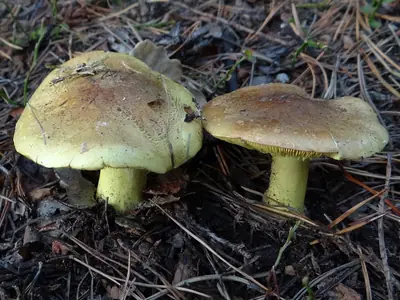
The yellow knight has a yellow cap and yellow gills; it grows in the same places. The yellow knight is considered poisonous (rhabdomyolysis).
Step-by-step comparison: Sooty head or yellow knight →Tiger tricholoma Poisonous medium risk
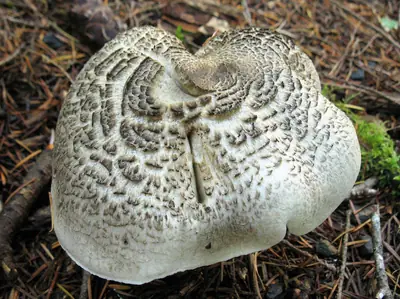
The tiger tricholoma has a pale cap covered with concentrically arranged dark scales (not fibrils), a massive stem, and grows on calcareous soils under beeches, spruces and firs – not in acidic pine forests. It causes severe gastrointestinal poisoning.
Step-by-step comparison: Sooty head or tiger tricholoma →
Foragers’ finds
All photosPhotos and identifications are added by users; we do not check them. Add your own find →
In the kitchen
For soups, stewing and pickling in vinegar.
Protection and sale
- Species protection: the species is not protected.
- Sale: the species is not on the list of mushrooms approved for sale. Not on the list of mushrooms permitted for sale (picking for your own use is not restricted by this).
Sooty head: common questions
Is the sooty head edible?
Edible. A good, sought-after edible mushroom of late autumn (said to be best after the first frosts). Caution: it is easily confused with other grey Tricholoma species, some of which are poisonous (e.g. the tiger tricholoma) or acrid (“gąska pieprzna”, a peppery-tasting knight). It is not on the list of mushrooms permitted for sale.
When does the sooty head grow?
In Poland the fruiting bodies usually appear in: October, November, December. Habitat: Pine forests with lichens or mosses on sandy soils, also mixed forests; gregarious, often together with the yellow knight.
What can the sooty head be mistaken for?
Yellow knight (poisonous): The yellow knight has a yellow cap and yellow gills; it grows in the same places. The yellow knight is considered poisonous (rhabdomyolysis). Tiger tricholoma (poisonous): The tiger tricholoma has a pale cap covered with concentrically arranged dark scales (not fibrils), a massive stem, and grows on calcareous soils under beeches, spruces and firs – not in acidic pine forests. It causes severe gastrointestinal poisoning.
Sources
- Wikipedia (pl): Gąska niekształtna
- grzyby.pl (M. Snowarski): Tricholoma portentosum
- First Nature: Tricholoma portentosum, Coalman
Last checked: 9 November 2026. Spotted a mistake? Write to us.