Gilled mushrooms
Tiger tricholoma
Tricholoma pardinum · also known as: Leopard knight, Spotted tricholoma
Poisonous
Poisonous – causes very severe gastrointestinal poisoning; in extreme cases collapse and even death. Beware of the naming: in 2025 the Polish Mycological Society (PTMyk) Committee for Polish Fungal Nomenclature assigned the name “gąska tygrysowata” to another species (Tricholoma pardalotum); for T. pardinum the valid name is “gąska tygrysia”.
How to recognise it: tiger tricholoma
- 1
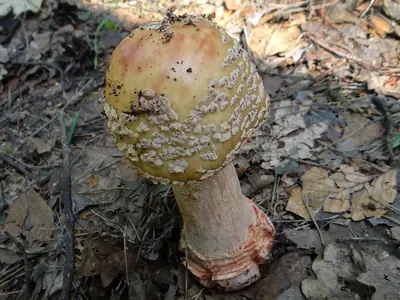
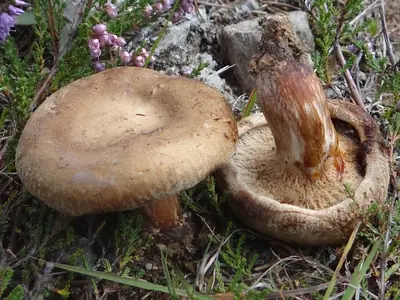
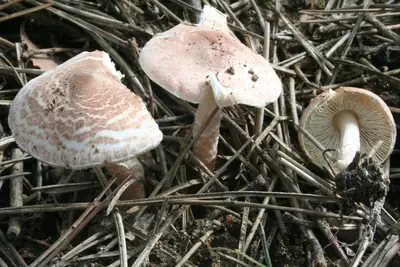
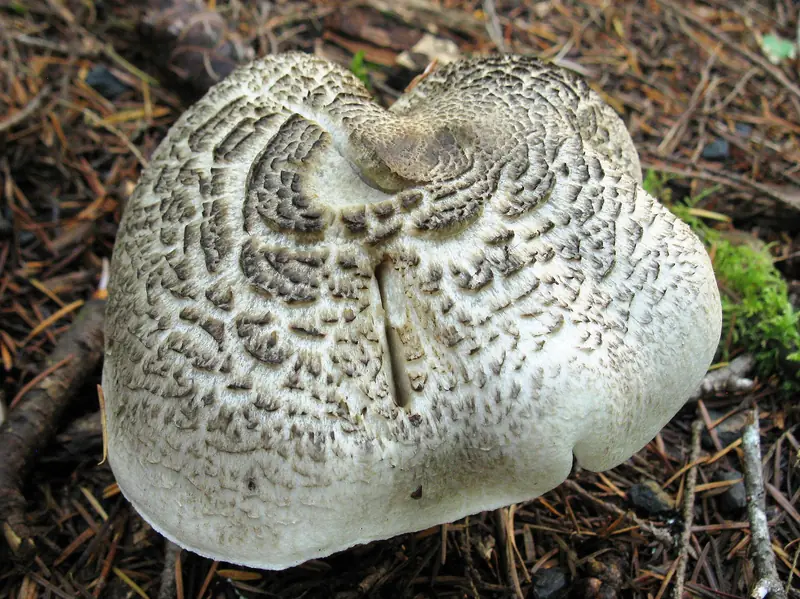
Large, massive fruit body with a grey cap in concentric dark scales
- 2
Gills white to yellowish with a greenish tinge, never grey
- 3
Water droplets on the gills and stem apex in young specimens
- 4
Only on calcareous soils
Description
- Cap
- (3)6–10(15) cm, fleshy, long convex with a flat umbo; whitish to ash-grey, covered with concentrically arranged, grey-brown to black-grey scales; margin long inrolled.
- Gills
- Gills white, often with a greenish tinge, then pale yellowish (never grey), emarginate (notched with a tooth); in young specimens with water droplets on the edges.
- Stem
- 5–12 cm, stout and massive, white, ochre-tinged at the base, often thickened; in young specimens droplets of liquid near the apex; no ring.
- Flesh
- White, does not change colour when cut.
- Smell and taste
- Smell faint, pleasant or mealy; taste insignificant. Do not taste.
Where and when it grows
Only on calcareous or alkaline soils, in broadleaf forests (beech and oak woods) and coniferous forests (under spruces and firs), singly or in small groups. Fairly rare in Poland (locally common on limestone).
Most often with: beech, spruce, fir, oak
Look-alikes: what it can be mistaken for
Sooty head Edible medium risk
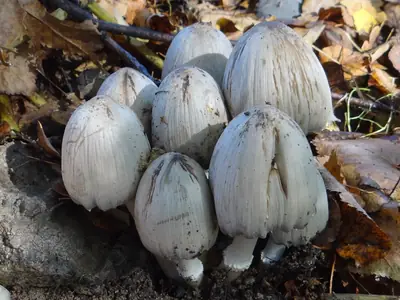
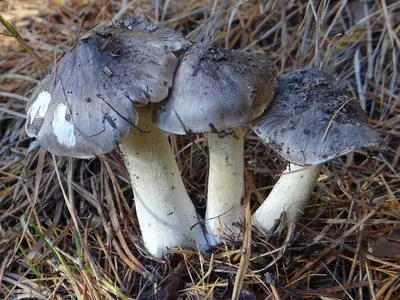
The edible sooty head has a cap with radial black fibrils (not concentric scales), is more delicate, and grows in late autumn in acidic pine forests.
Step-by-step comparison: Sooty head or tiger tricholoma →
Foragers’ finds
All photosPhotos and identifications are added by users; we do not check them. Add your own find →
Protection and sale
- Species protection: the species is not protected.
- Sale: the species is not on the list of mushrooms approved for sale.
Tiger tricholoma: common questions
Is the tiger tricholoma edible?
Poisonous. Poisonous – causes very severe gastrointestinal poisoning; in extreme cases collapse and even death. Beware of the naming: in 2025 the Polish Mycological Society (PTMyk) Committee for Polish Fungal Nomenclature assigned the name “gąska tygrysowata” to another species (Tricholoma pardalotum); for T. pardinum the valid name is “gąska tygrysia”.
When does the tiger tricholoma grow?
In Poland the fruiting bodies usually appear in: August, September, October. Habitat: Only on calcareous or alkaline soils, in broadleaf forests (beech and oak woods) and coniferous forests (under spruces and firs), singly or in small groups. Fairly rare in Poland (locally common on limestone).
What can the tiger tricholoma be mistaken for?
Sooty head (edible): The edible sooty head has a cap with radial black fibrils (not concentric scales), is more delicate, and grows in late autumn in acidic pine forests.
Sources
- Wikipedia (pl): Gąska tygrysia
- grzyby.pl (M. Snowarski): Tricholoma pardinum
- First Nature: Tricholoma pardinum, Leopard Knight
Last checked: 9 November 2026. Spotted a mistake? Write to us.