
Comparison
Field mushroom or yellow stainer? How to tell them apart
Field mushroom is an edible mushroom, while the yellow stainer is a poisonous mushroom. Compare the two mushrooms point by point.
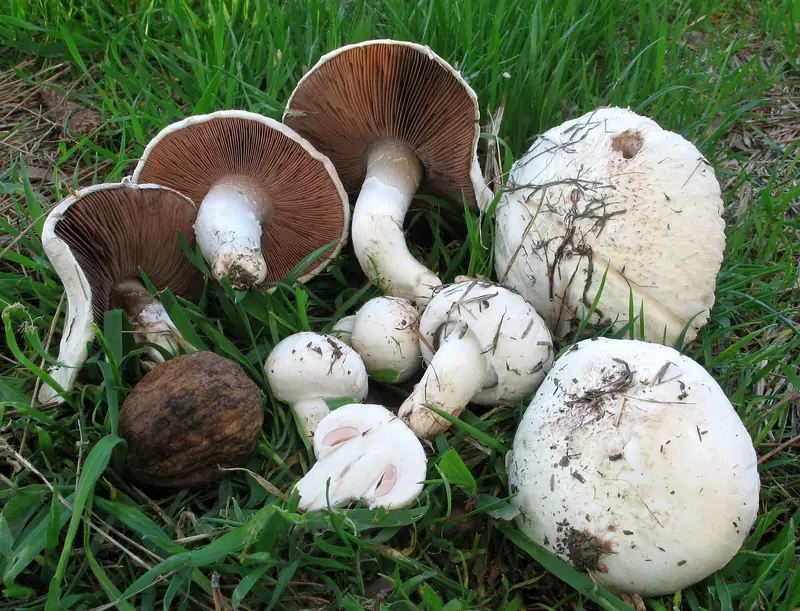
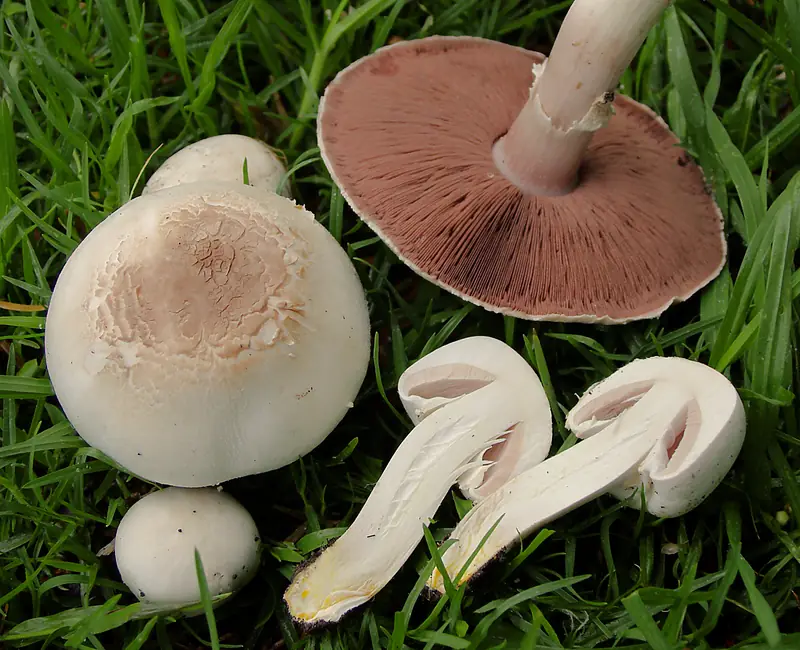
The yellow stainer, when rubbed (especially at the stem base), immediately turns chrome-yellow and smells of carbolic/ink, more strongly when cooked.
The field mushroom does not turn yellow (or only slightly) and does not smell of carbolic; it has a shorter stem without a bulb and a delicate, vanishing ring.
Feature by feature
| Feature | Field mushroom | Yellow stainer |
|---|---|---|
| Edibility | Edible | Poisonous |
| Cap | 5–12 cm, hemispherical when young, then flat; white, grey-ochre with age, smooth, silky or finely scaly; does not turn yellow when pressed, or only slightly. | 4–15 cm, at first hemispherical with a flattened (“trapezoid”) top, then convex; white to cream, sometimes darker in the centre; light yellow when scratched. |
| Under the cap | Gills free, crowded; pink in young specimens, then chocolate-brown to blackish-brown. Spore print chocolate-brown. | Gills pinkish-whitish at first, then chocolate-brown; spore print chocolate-brown. |
| Stem | 4–8 cm, white, short, solid, easily broken off; a delicate, quickly vanishing ring; no bulb and no volva. | 6–12 cm, white, slender, bulbous at the base; when rubbed the base immediately turns intensely chrome-yellow; ring high on the stem, with a thick rim on its underside. |
| Flesh | White, turning slightly pink in places when cut; does not turn yellow. | White; when cut – especially in the stem base – quickly chrome-yellow, then turning brown. |
| Smell and taste | Smell lightly mushroomy, without a note of carbolic or aniseed; taste pleasant. | Unpleasant smell of carbolic, ink or iodine, strongest at the stem base and during cooking. |
| Habitat | Saprotrophic; meadows, pastures (especially those fertilised with manure, e.g. horse manure), fields, roadside ditches; less often parks and forest edges. | Saprotrophic; broadleaf and coniferous forests, parks, gardens, roadsides, scrub and grassy areas, in fertile places rich in organic debris. |
| Season | May, June, July, August, September, October | May, June, July, August, September, October |
How to recognise it: field mushroom
- Gills pink in young specimens, then chocolate-brown – never permanently white
- Dark brown spore print
- Grows in meadows and pastures, not deep in the forest
- Does not turn yellow when rubbed or cut, does not smell of carbolic
- No volva at the stem base
How to recognise it: yellow stainer
- Stem base turns bright yellow immediately when rubbed or cut
- Smell of carbolic/ink, intensifying during cooking
- White cap that turns yellow when scratched
- Chocolate-brown gills and spore print as in other Agaricus species
Safety rule
Never eat a mushroom identified only from a website, a photo or an app. Show any doubtful specimen to a certified mushroom inspector at the sanepid (state sanitary inspection); in season the advice points are free. Do not give wild-picked mushrooms to children.
The golden rules of foraging →Frequently asked questions
Field mushroom or yellow stainer: how can you tell them apart?
The yellow stainer, when rubbed (especially at the stem base), immediately turns chrome-yellow and smells of carbolic/ink, more strongly when cooked. The field mushroom does not turn yellow (or only slightly) and does not smell of carbolic; it has a shorter stem without a bulb and a delicate, vanishing ring.
Yellow stainer: what to do if you have eaten it?
Call 112 at once or go to A&E (SOR), and take any leftover mushrooms with you. Compounds irritating the digestive tract (no specific substance named in the sources) – gastrointestinal syndrome: nausea, vomiting, diarrhoea.
Sources
- Wikipedia (pl): Pieczarka łąkowa
- grzyby.pl (M. Snowarski): Agaricus campestris
- First Nature: Agaricus campestris, Field Mushroom
- Wikipedia (pl): Pieczarka karbolowa
- grzyby.pl (M. Snowarski): Agaricus xanthodermus
- First Nature: Agaricus xanthodermus, Yellow Stainer
Last checked: 9 November 2026. Spotted a mistake? Write to us.