
Dangerous mistake
Parasol mushroom or panther cap? How to tell them apart
Parasol mushroom is an edible mushroom, while the panther cap is a deadly poisonous mushroom. Compare the two mushrooms point by point.
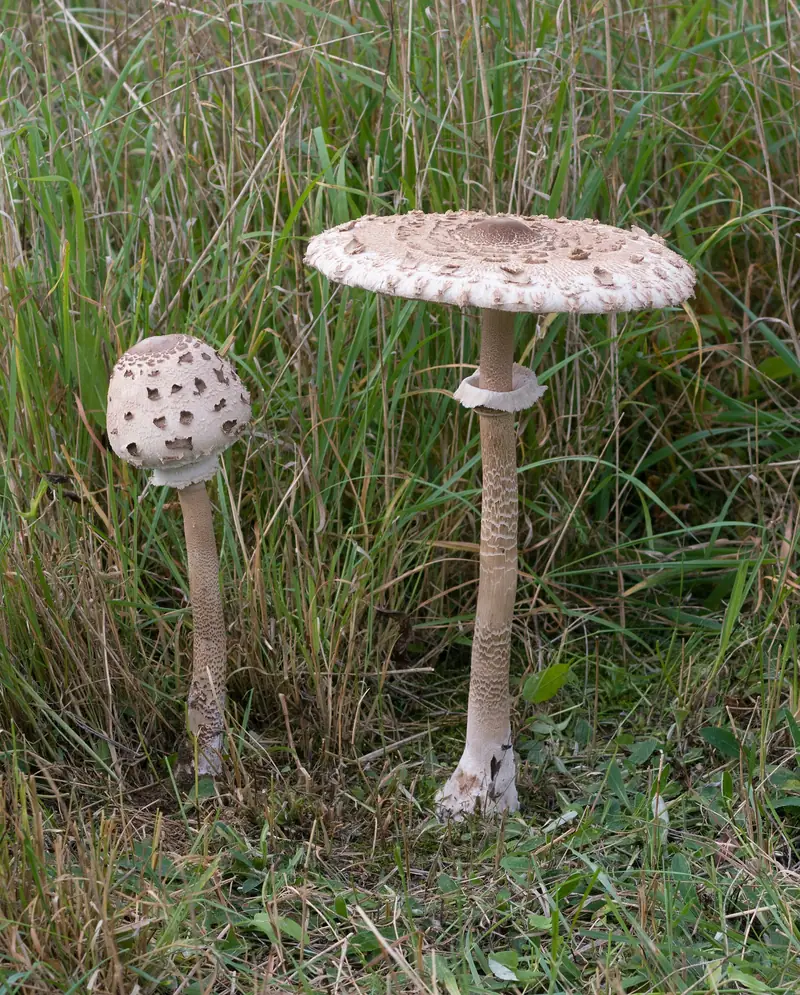
Severe poisonings have been recorded from panther caps taken for parasols. The parasol has scales (not patches), a stem with a snakeskin pattern, a thick movable ring and a bulb without rolls of veil.
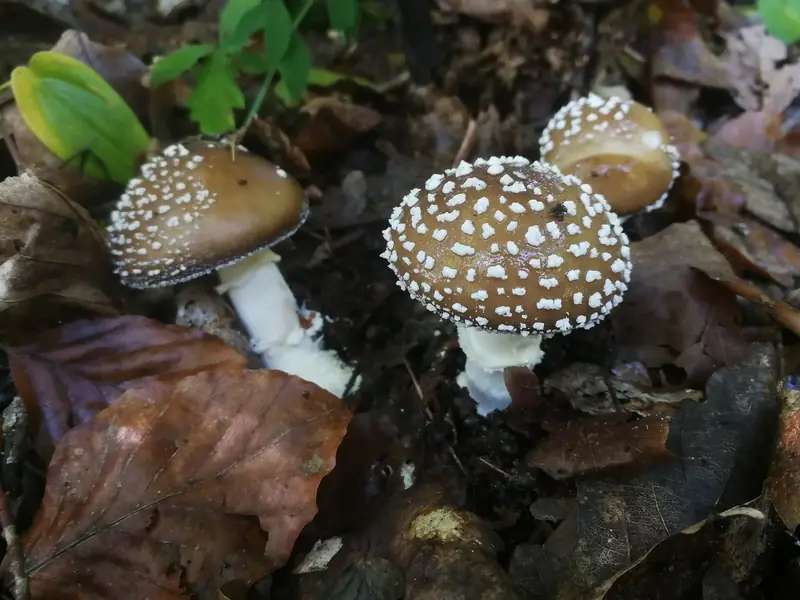
Severe poisonings have been recorded from panther caps taken for parasols. The panther cap has white patches (not scales) on a brown cap, a striate cap margin, a smooth stem without a snakeskin pattern, an immovable ring and a bulb with rolls of veil remnants.
Feature by feature
| Feature | Parasol mushroom | Panther cap |
|---|---|---|
| Edibility | Edible | Deadly poisonous |
| Cap | Large, 10–30 cm across, egg-shaped when young (a “drumstick”), then parasol-shaped with a central umbo; whitish with large, brown, raised scales, the centre uniformly brown. | 4–12 cm, hemispherical, then flat; brown, brown-grey to brown-yellow, with numerous, regularly spaced, pure white patches; margin distinctly striate (may be absent in the mountain form). |
| Under the cap | Gills white or cream, crowded, broad, free – clearly separated from the stem. | Gills white, crowded, free. |
| Stem | Tall (15–40 cm), slender, with a bulb at the base; covered with a brown zigzag (“snakeskin”) pattern; a thick, double ring that can be slid along the stem. No volva. | 5–15 cm, white; ring smooth, not striate on the upper side, disappearing with age; a small bulb rimmed with one or several roll-like rings (a “turned-down sock”). |
| Flesh | White, soft in the cap, fibrous in the stem; does not change colour when cut. | White, including under the cap cuticle; does not change colour when damaged. |
| Smell and taste | Smell pleasant, sweetish-aromatic, nutty; taste mild. | Smell faint, sickly, reminiscent of radish or raw potatoes. Do not taste. |
| Habitat | Saprotrophic; edges of broadleaf and coniferous forests, glades, clearings, meadows, parks, roadsides. Avoids acidic and waterlogged soils, likes calcium-rich clay soils. | Common in broadleaf forests (often under oaks and beeches) and coniferous forests (in the mountains under spruces – a darker form), in the lowlands and mountains, on clay and sandy soils. |
| Season | July, August, September, October | June, July, August, September, October |
How to recognise it: parasol mushroom
- Cap usually over 10 cm, with brown scales on a pale background and a dark umbo
- Stem with a brown zigzag pattern and a bulb, but no volva
- Ring thick, double, movable – it can be slid along the stem
- Flesh does not turn red when cut
- Spore print white
How to recognise it: panther cap
- Brown cap with pure white patches and a striate margin
- Flesh does not turn red when damaged
- Ring smooth (no striations on the upper side)
- Small bulb with rolls of veil, like a “turned-down sock”
Safety rule
Never eat a mushroom identified only from a website, a photo or an app. Show any doubtful specimen to a certified mushroom inspector at the sanepid (state sanitary inspection); in season the advice points are free. Do not give wild-picked mushrooms to children.
The golden rules of foraging →Frequently asked questions
Parasol mushroom or panther cap: how can you tell them apart?
Severe poisonings have been recorded from panther caps taken for parasols. The parasol has scales (not patches), a stem with a snakeskin pattern, a thick movable ring and a bulb without rolls of veil. Severe poisonings have been recorded from panther caps taken for parasols. The panther cap has white patches (not scales) on a brown cap, a striate cap margin, a smooth stem without a snakeskin pattern, an immovable ring and a bulb with rolls of veil remnants.
Panther cap: what to do if you have eaten it?
Call 112 at once or go to A&E (SOR), and take any leftover mushrooms with you. Ibotenic acid and muscimol – the pantherina (neurotoxic) syndrome, as with the fly agaric. Rapid onset of symptoms: vomiting, diarrhoea, agitation as if after alcohol, hallucinations, seizures and visual disturbances, then drowsiness and loss of consciousness; deaths have been described.
Sources
- Wikipedia (pl): Czubajka kania
- grzyby.pl (M. Snowarski): Macrolepiota procera
- First Nature: Macrolepiota procera, Parasol
- Wikipedia (pl): Muchomor plamisty
- grzyby.pl (M. Snowarski): Amanita pantherina
- First Nature: Amanita pantherina, Panthercap
Last checked: 9 November 2026. Spotted a mistake? Write to us.