Gilled mushrooms
Panther cap
Amanita pantherina · also known as: Panther amanita
Deadly poisonous
Severely poisonous; poisonings are violent. Polish sources (grzyby.pl) write that deaths are rare but do occur, and First Nature describes it as deadly poisonous – which is why we place it in the highest risk category. Confused with the edible blusher and the grey spotted amanita (Amanita excelsa), and with the parasol.
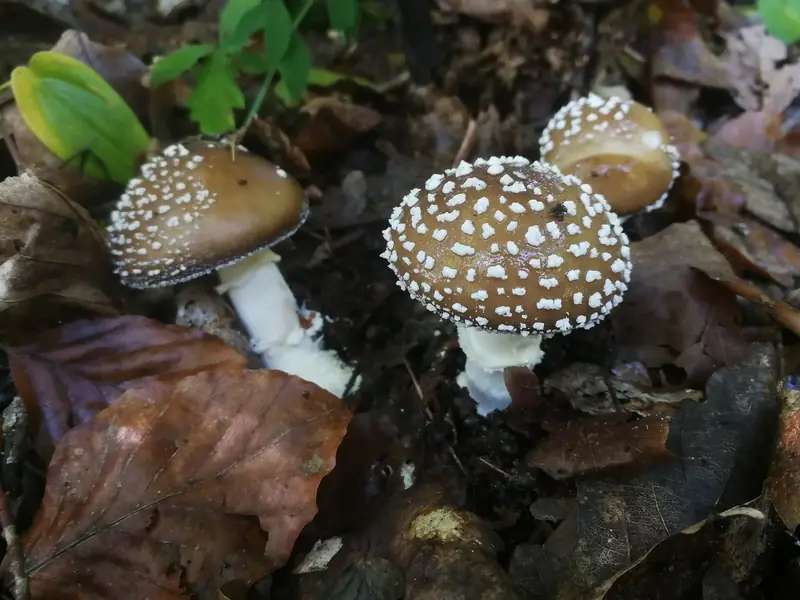
How to recognise it: panther cap
- 1
Brown cap with pure white patches and a striate margin
- 2
Flesh does not turn red when damaged
- 3
Ring smooth (no striations on the upper side)
- 4
Small bulb with rolls of veil, like a “turned-down sock”
Description
- Cap
- 4–12 cm, hemispherical, then flat; brown, brown-grey to brown-yellow, with numerous, regularly spaced, pure white patches; margin distinctly striate (may be absent in the mountain form).
- Gills
- Gills white, crowded, free.
- Stem
- 5–15 cm, white; ring smooth, not striate on the upper side, disappearing with age; a small bulb rimmed with one or several roll-like rings (a “turned-down sock”).
- Flesh
- White, including under the cap cuticle; does not change colour when damaged.
- Smell and taste
- Smell faint, sickly, reminiscent of radish or raw potatoes. Do not taste.
Where and when it grows
Common in broadleaf forests (often under oaks and beeches) and coniferous forests (in the mountains under spruces – a darker form), in the lowlands and mountains, on clay and sandy soils.
Most often with: oak, beech, spruce
Look-alikes: what it can be mistaken for
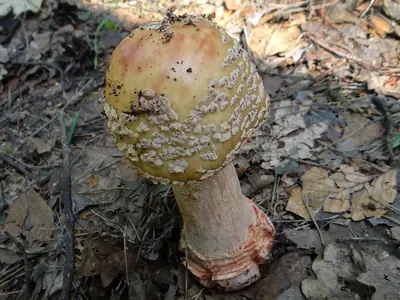
Blusher Edible with care high risk of confusion
The blusher has flesh and stem that turn red when damaged (especially at the base, also where eaten by larvae), a striate upper side of the ring, a non-striate cap margin and pinkish patches.
Step-by-step comparison: Blusher or panther cap →Parasol mushroom Edible high risk of confusion
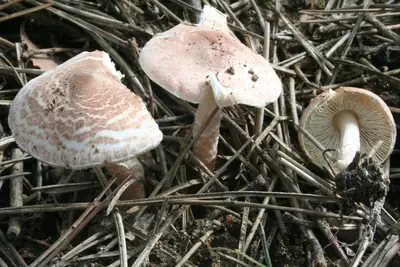
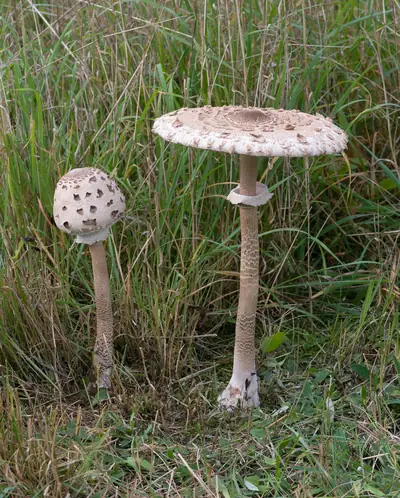
Severe poisonings have been recorded from panther caps taken for parasols. The parasol has scales (not patches), a stem with a snakeskin pattern, a thick movable ring and a bulb without rolls of veil.
Step-by-step comparison: Parasol mushroom or panther cap →
Foragers’ finds
All photosPhotos and identifications are added by users; we do not check them. Add your own find →
Protection and sale
- Species protection: the species is not protected.
- Sale: the species is not on the list of mushrooms approved for sale.
Panther cap: common questions
Is the panther cap edible?
Deadly poisonous. Severely poisonous; poisonings are violent. Polish sources (grzyby.pl) write that deaths are rare but do occur, and First Nature describes it as deadly poisonous – which is why we place it in the highest risk category. Confused with the edible blusher and the grey spotted amanita (Amanita excelsa), and with the parasol.
When does the panther cap grow?
In Poland the fruiting bodies usually appear in: June, July, August, September, October. Habitat: Common in broadleaf forests (often under oaks and beeches) and coniferous forests (in the mountains under spruces – a darker form), in the lowlands and mountains, on clay and sandy soils.
What can the panther cap be mistaken for?
Blusher (edible with care): The blusher has flesh and stem that turn red when damaged (especially at the base, also where eaten by larvae), a striate upper side of the ring, a non-striate cap margin and pinkish patches. Parasol mushroom (edible): Severe poisonings have been recorded from panther caps taken for parasols. The parasol has scales (not patches), a stem with a snakeskin pattern, a thick movable ring and a bulb without rolls of veil.
Sources
- Wikipedia (pl): Muchomor plamisty
- grzyby.pl (M. Snowarski): Amanita pantherina
- First Nature: Amanita pantherina, Panthercap
Last checked: 9 November 2026. Spotted a mistake? Write to us.