
Dangerous mistake
Common morel or false morel? How to tell them apart
Common morel is edible only with care, while the false morel is a deadly poisonous mushroom. Compare the two mushrooms point by point.
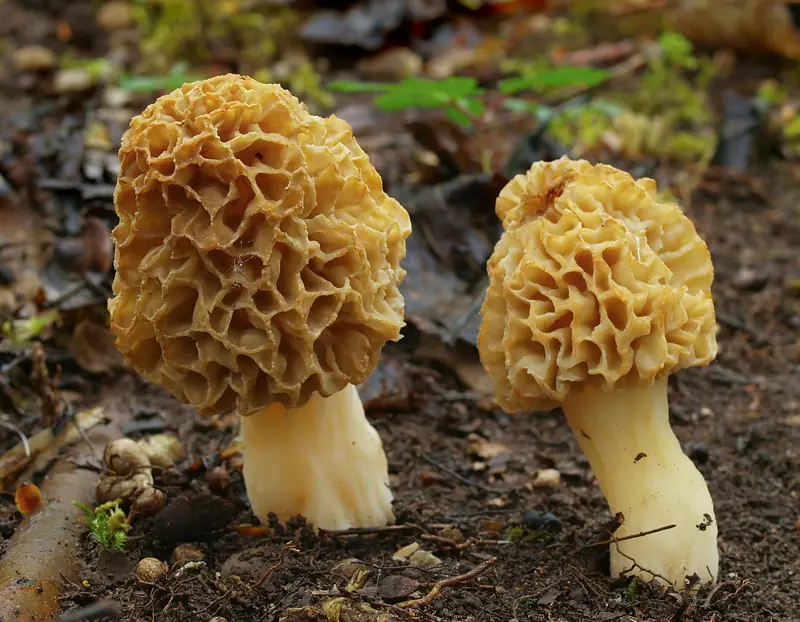
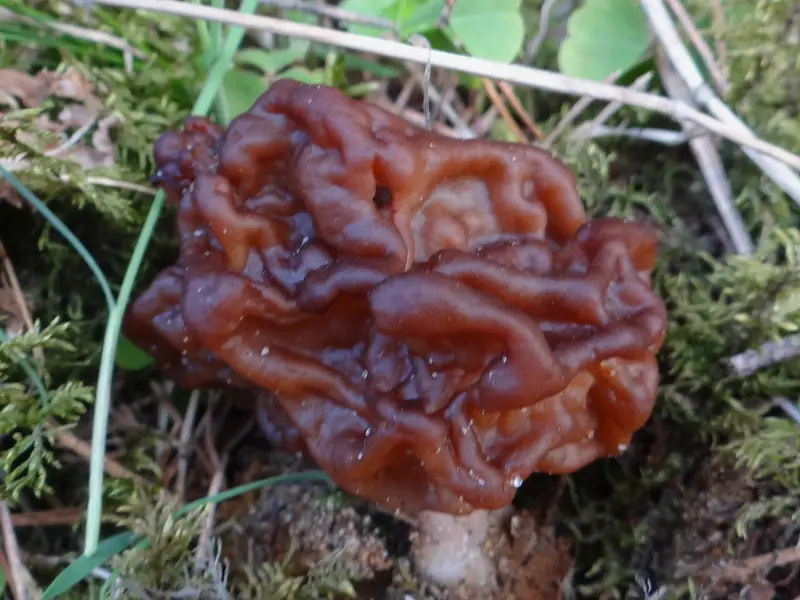
Deadly poisonous. The false morel has a brain-like folded head (convolutions, no pits), usually chestnut-brown, and when cut its interior is divided into many irregular chambers; it grows in early spring mainly in pine forests on sand. The morel has honeycomb pits and a single hollow chamber.
The morel (edible, protected) has a head with honeycomb pits and a single hollow chamber inside; the false morel – brain-like convolutions and a multi-chambered interior.
Feature by feature
| Feature | Common morel | False morel |
|---|---|---|
| Edibility | Edible with care | Deadly poisonous |
| Cap | Head 3–10 cm tall, egg-shaped to conical, beige, ochre, honey-yellow (sometimes greyish), covered with irregularly arranged pits (alveoli) like a honeycomb; attached to the stem at its lower edge; hollow inside. | Head 5–15 cm wide, irregularly globose, strongly brain-like folded (convolutions, no pits), yellow-brown through chestnut-brown to blackish-brown. |
| Under the cap | No gills or tubes – the spore-bearing layer lines the pits on the surface of the head. | No gills or tubes – the spore-bearing layer covers the outer, folded surface of the head. |
| Stem | 2–9 cm × 2–4 cm, whitish to cream, finely granular, hollow inside; in mature specimens the base is widened and folded. | Short and thick, irregularly furrowed, dirty white with purplish-brown spots; with a few irregular channels inside. |
| Flesh | Whitish to cream, brittle, waxy. Cut lengthwise – a single shared hollow chamber from the head to the stem. | Brittle, cartilaginous, whitish; the interior of the head is divided into irregular chambers, cream-coloured. |
| Smell and taste | Smell pleasant, spicy; taste mild. Spore print cream to yellow-ochre. | No distinct smell or taste. Spore print cream. |
| Habitat | In spring in broadleaf and mixed forests, riparian woods, in meadows, scrub, parks and gardens, on fertile soils, often under ash trees. Rare in Poland (Red List: R). | In early spring in pine forests on sandy soils, often in clear-cuts, young stands, plantations and in places with disturbed ground (churned-up litter, edges of roads and streams). Fairly common in Poland. |
| Season | April, May | March, April, May |
How to recognise it: common morel
- Spring (April–May)
- Head with honeycomb pits, not brain-like folds
- Head fused to the stem at its margin
- When cut, a single hollow chamber
- Never eat raw
How to recognise it: false morel
- Spring in pine forests on sand
- Head brain-like folded, without pits
- Chestnut- to blackish-brown
- Interior divided into many chambers (morel – a single hollow chamber)
- Vapours from cooking are also toxic
Safety rule
Never eat a mushroom identified only from a website, a photo or an app. Show any doubtful specimen to a certified mushroom inspector at the sanepid (state sanitary inspection); in season the advice points are free. Do not give wild-picked mushrooms to children.
The golden rules of foraging →Frequently asked questions
Common morel or false morel: how can you tell them apart?
Deadly poisonous. The false morel has a brain-like folded head (convolutions, no pits), usually chestnut-brown, and when cut its interior is divided into many irregular chambers; it grows in early spring mainly in pine forests on sand. The morel has honeycomb pits and a single hollow chamber. The morel (edible, protected) has a head with honeycomb pits and a single hollow chamber inside; the false morel – brain-like convolutions and a multi-chambered interior.
False morel: what to do if you have eaten it?
Call 112 at once or go to A&E (SOR), and take any leftover mushrooms with you. Gyromitrin, metabolised to monomethylhydrazine (MMH); damages the liver, kidneys, nervous system and red blood cells (haemolysis). First symptoms usually after several to a dozen or so hours: nausea, vomiting, diarrhoea, dizziness, loss of coordination, seizures, coma, liver failure. The antidote is intravenous vitamin B6. Poisoning by inhalation during heat treatment is possible.
Sources
- Wikipedia (pl): Smardz jadalny
- grzyby.pl (atlas M. Snowarskiego): Morchella esculenta
- First Nature: Morchella esculenta
- Wikipedia (pl): Piestrzenica kasztanowata
- grzyby.pl (atlas M. Snowarskiego): Gyromitra esculenta
- First Nature: Gyromitra esculenta
Last checked: 9 November 2026. Spotted a mistake? Write to us.