
Cup and sac fungi (no gills or pores)
Common morel
Morchella esculenta · also known as: Yellow morel, Morel
Edible with care Partially protectedApproved for sale
A prized edible mushroom, but poisonous raw (and undercooked) – always cook thoroughly. It is crucial to tell it apart from the deadly poisonous false morel. A protected species – it may not be picked in the forest without a permit.
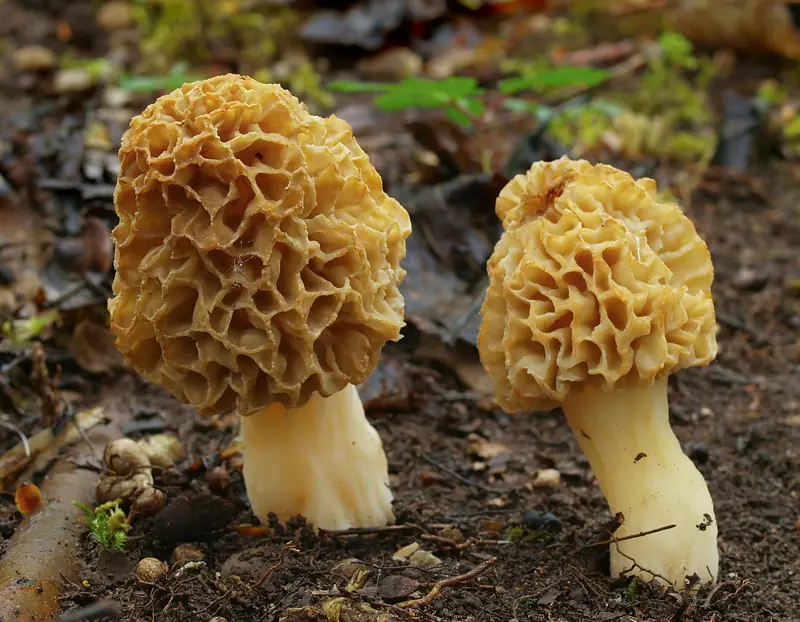
How to recognise it: common morel
- 1
Spring (April–May)
- 2
Head with honeycomb pits, not brain-like folds
- 3
Head fused to the stem at its margin
- 4
When cut, a single hollow chamber
- 5
Never eat raw
Description
- Cap
- Head 3–10 cm tall, egg-shaped to conical, beige, ochre, honey-yellow (sometimes greyish), covered with irregularly arranged pits (alveoli) like a honeycomb; attached to the stem at its lower edge; hollow inside.
- Underside
- No gills or tubes – the spore-bearing layer lines the pits on the surface of the head.
- Stem
- 2–9 cm × 2–4 cm, whitish to cream, finely granular, hollow inside; in mature specimens the base is widened and folded.
- Flesh
- Whitish to cream, brittle, waxy. Cut lengthwise – a single shared hollow chamber from the head to the stem.
- Smell and taste
- Smell pleasant, spicy; taste mild. Spore print cream to yellow-ochre.
Where and when it grows
In spring in broadleaf and mixed forests, riparian woods, in meadows, scrub, parks and gardens, on fertile soils, often under ash trees. Rare in Poland (Red List: R).
Most often with: ash
Look-alikes: what it can be mistaken for
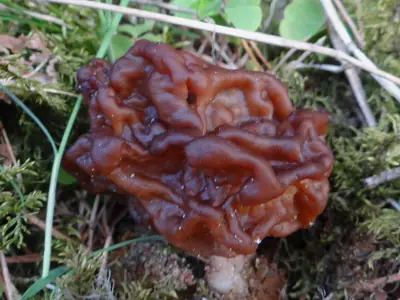
False morel Deadly poisonous high risk of confusion
Deadly poisonous. The false morel has a brain-like folded head (convolutions, no pits), usually chestnut-brown, and when cut its interior is divided into many irregular chambers; it grows in early spring mainly in pine forests on sand. The morel has honeycomb pits and a single hollow chamber.
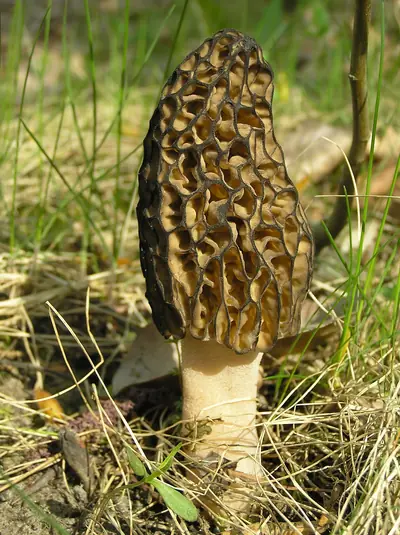
Step-by-step comparison: Common morel or false morel →Black morel Edible with care low risk
Also edible and protected; it has a darker, elongated, conical head with pits in vertical rows.
Foragers’ finds
All photosPhotos and identifications are added by users; we do not check them. How points work →
In the kitchen
Always cook or fry thoroughly (never raw). Suitable for drying, frying in butter, cream sauces and soups. Pick legally only in gardens/green areas.
Watch out for toxins
Raw and undercooked morels cause severe gastrointestinal illness (First Nature links this to heat-labile hydrazine-type toxins, broken down by cooking).
Protection and sale
- Species protection: partially protected. Partial protection applies to specimens growing outside gardens, horticultural crops, forest nurseries and outside green areas (previously, in 1983–2014, strict protection). The species is in Annex 3 (harvesting by hand-picking of fruit bodies), but only on the basis of a permit from the regional or general directorate for environmental protection (RDOŚ/GDOŚ) – there is no general exemption for picking for your own use. Specimens from gardens, crops, nurseries and green areas are not protected.
- Sale: the species is on the list of mushrooms approved for sale (it may be sold only with a mushroom inspector’s certificate). Permitted for sale only from gardens, horticultural crops, forest nurseries and green areas, or from outside the territory of the Republic of Poland.
Common morel: common questions
Is the common morel edible?
Edible with care. A prized edible mushroom, but poisonous raw (and undercooked) – always cook thoroughly. It is crucial to tell it apart from the deadly poisonous false morel. A protected species – it may not be picked in the forest without a permit.
When does the common morel grow?
In Poland the fruiting bodies usually appear in: April, May. Habitat: In spring in broadleaf and mixed forests, riparian woods, in meadows, scrub, parks and gardens, on fertile soils, often under ash trees. Rare in Poland (Red List: R).
What can the common morel be mistaken for?
False morel (deadly poisonous): Deadly poisonous. The false morel has a brain-like folded head (convolutions, no pits), usually chestnut-brown, and when cut its interior is divided into many irregular chambers; it grows in early spring mainly in pine forests on sand. The morel has honeycomb pits and a single hollow chamber. Black morel (edible with care): Also edible and protected; it has a darker, elongated, conical head with pits in vertical rows.
Is the common morel a protected species?
Yes: partially protected (regulation on the species protection of fungi, Dz.U. 2014 poz. 1408). Partial protection applies to specimens growing outside gardens, horticultural crops, forest nurseries and outside green areas (previously, in 1983–2014, strict protection). The species is in Annex 3 (harvesting by hand-picking of fruit bodies), but only on the basis of a permit from the regional or general directorate for environmental protection (RDOŚ/GDOŚ) – there is no general exemption for picking for your own use. Specimens from gardens, crops, nurseries and green areas are not protected.
Sources
- Wikipedia (pl): Smardz jadalny
- grzyby.pl (atlas M. Snowarskiego): Morchella esculenta
- First Nature: Morchella esculenta
- Rozporządzenie Ministra Środowiska z dnia 9 października 2014 r. w sprawie ochrony gatunkowej grzybów (Dz.U. 2014 poz. 1408)
- Rozporządzenie Ministra Zdrowia w sprawie grzybów dopuszczonych do obrotu… – tekst jednolity Dz.U. 2026 poz. 258
Last checked: 9 November 2026. Spotted a mistake? Write to us.