
Cup and sac fungi (no gills or pores)
False morel
Gyromitra esculenta · also known as: Brain mushroom, Turban fungus
Deadly poisonous
Deadly poisonous (gyromitrin). Formerly sold and eaten on a large scale (hence “esculenta” = edible), its sale was banned after poisonings were established. Drying and long boiling reduce the amount of toxin, but it is impossible to determine when the mushroom becomes safe; poisonings have also occurred after well-cooked mushrooms, and poisoning can occur by inhaling the vapours during cooking or drying. Do not eat it in any form.
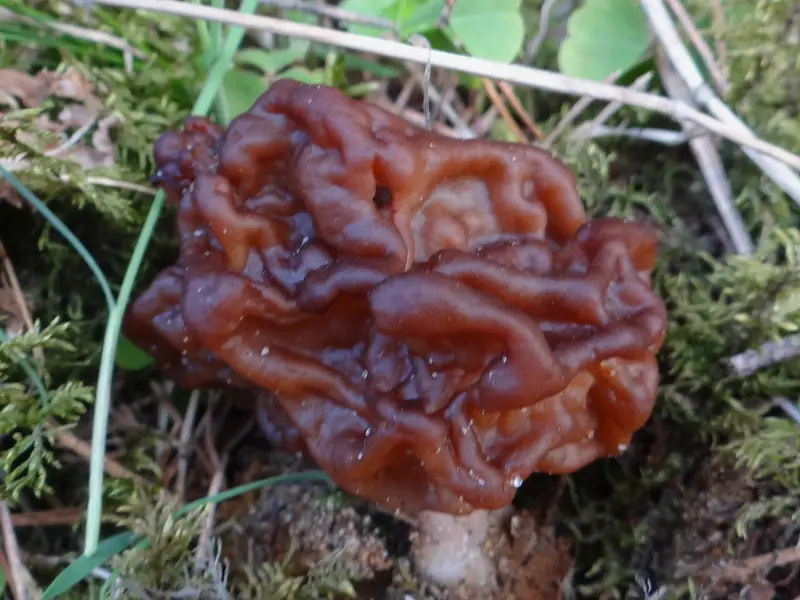
How to recognise it: false morel
- 1
Spring in pine forests on sand
- 2
Head brain-like folded, without pits
- 3
Chestnut- to blackish-brown
- 4
Interior divided into many chambers (morel – a single hollow chamber)
- 5
Vapours from cooking are also toxic
Description
- Cap
- Head 5–15 cm wide, irregularly globose, strongly brain-like folded (convolutions, no pits), yellow-brown through chestnut-brown to blackish-brown.
- Underside
- No gills or tubes – the spore-bearing layer covers the outer, folded surface of the head.
- Stem
- Short and thick, irregularly furrowed, dirty white with purplish-brown spots; with a few irregular channels inside.
- Flesh
- Brittle, cartilaginous, whitish; the interior of the head is divided into irregular chambers, cream-coloured.
- Smell and taste
- No distinct smell or taste. Spore print cream.
Where and when it grows
In early spring in pine forests on sandy soils, often in clear-cuts, young stands, plantations and in places with disturbed ground (churned-up litter, edges of roads and streams). Fairly common in Poland.
Most often with: pine
Look-alikes: what it can be mistaken for
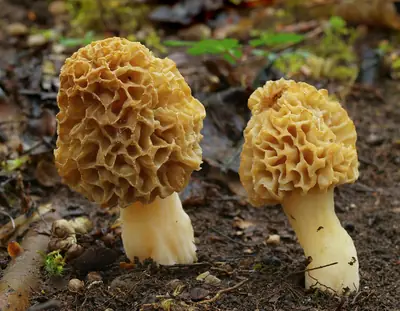
Common morel Edible with care high risk of confusion
The morel (edible, protected) has a head with honeycomb pits and a single hollow chamber inside; the false morel – brain-like convolutions and a multi-chambered interior.
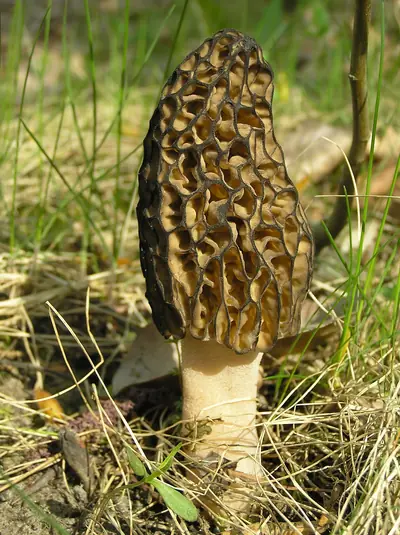
Step-by-step comparison: Common morel or false morel →Black morel Edible with care high risk of confusion
The black morel has a conical head with pits in vertical rows and a single hollow chamber; the false morel – irregular, brain-like convolutions.
Step-by-step comparison: Black morel or false morel →
Foragers’ finds
All photosPhotos and identifications are added by users; we do not check them. Add your own find →
Protection and sale
- Species protection: the species is not protected. The species itself is not protected; Gyromitra ambigua and G. fastigiata (piestrzenica wzniesiona) are partially protected.
- Sale: the species is not on the list of mushrooms approved for sale.
False morel: common questions
Is the false morel edible?
Deadly poisonous. Deadly poisonous (gyromitrin). Formerly sold and eaten on a large scale (hence “esculenta” = edible), its sale was banned after poisonings were established. Drying and long boiling reduce the amount of toxin, but it is impossible to determine when the mushroom becomes safe; poisonings have also occurred after well-cooked mushrooms, and poisoning can occur by inhaling the vapours during cooking or drying. Do not eat it in any form.
When does the false morel grow?
In Poland the fruiting bodies usually appear in: March, April, May. Habitat: In early spring in pine forests on sandy soils, often in clear-cuts, young stands, plantations and in places with disturbed ground (churned-up litter, edges of roads and streams). Fairly common in Poland.
What can the false morel be mistaken for?
Common morel (edible with care): The morel (edible, protected) has a head with honeycomb pits and a single hollow chamber inside; the false morel – brain-like convolutions and a multi-chambered interior. Black morel (edible with care): The black morel has a conical head with pits in vertical rows and a single hollow chamber; the false morel – irregular, brain-like convolutions.
Sources
- Wikipedia (pl): Piestrzenica kasztanowata
- grzyby.pl (atlas M. Snowarskiego): Gyromitra esculenta
- First Nature: Gyromitra esculenta
- mp.pl – Zatrucie piestrzenicą kasztanowatą
- Rozporządzenie Ministra Środowiska z dnia 9 października 2014 r. w sprawie ochrony gatunkowej grzybów (Dz.U. 2014 poz. 1408)
Last checked: 9 November 2026. Spotted a mistake? Write to us.