
Cup and sac fungi (no gills or pores)
Black morel
Morchella conica · also known as: Conical morel
Edible with care Partially protectedApproved for sale
Edible only after thorough cooking – poisonous raw (like all morels). A protected species. The taxonomy of the dark morels is uncertain: Polish Wikipedia treats the name M. conica as a synonym of the common morel, grzyby.pl and Polish law list the conical morel as a separate species, and First Nature describes the dark morels as M. elata.
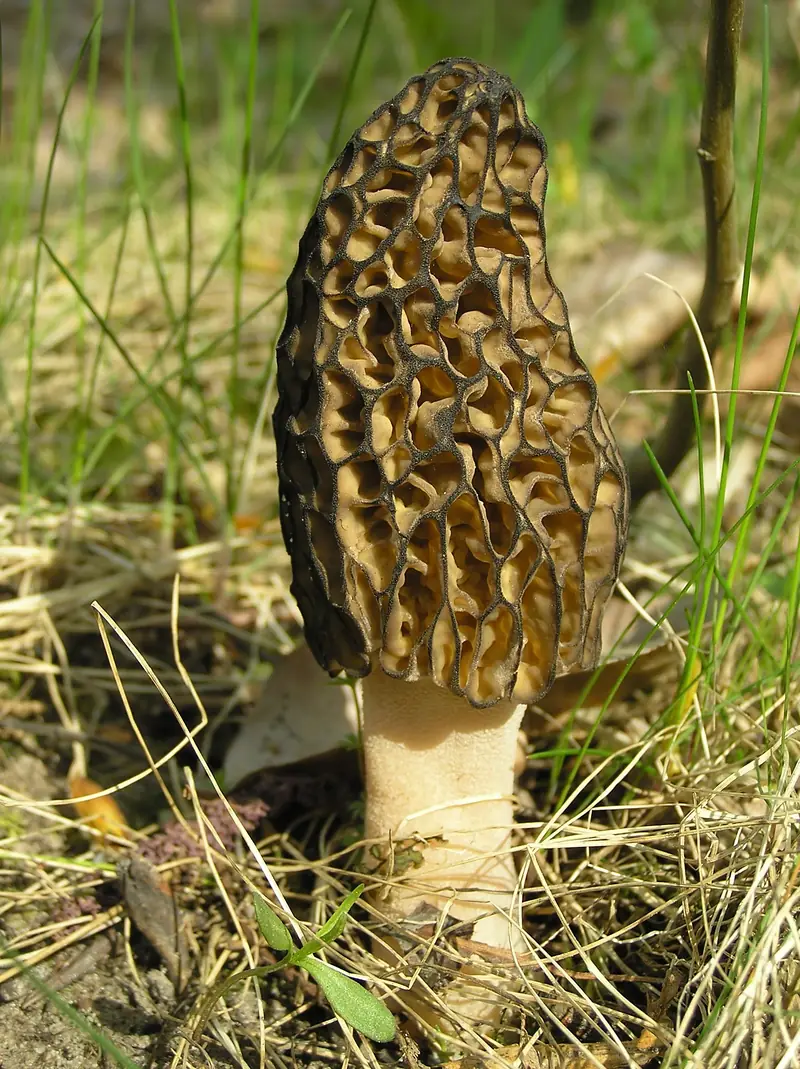
How to recognise it: black morel
- 1
Spring, often on bark mulch in gardens and parks
- 2
Dark, conical head with pits in vertical rows
- 3
Margin of the head stands slightly away from the stem
- 4
A single hollow chamber inside
- 5
Never eat raw
Description
- Cap
- Head 3–7 cm across, elongated, bluntly conical, grey-brown, olive-brown to blackish; pits elongated, arranged in vertical rows between lengthwise ribs; hollow inside.
- Underside
- No gills or tubes – the spore-bearing layer is in the pits of the head.
- Stem
- Whitish to cream, narrower than the head; the margin of the head stands slightly away from the stem at its base (a sinus-like notch) – a feature distinguishing it from Morchella elata.
- Flesh
- Brittle, waxy, whitish; head and stem form a single hollow chamber.
- Smell and taste
- Smell and taste pleasant, indistinct. Spore print dark cream, yellowish.
Where and when it grows
In early spring in damp, light places: forest edges, scrub, stream valleys (more common in the mountains, often near butterbur), and also parks and gardens – especially on freshly spread bark mulch in its first or second year. Red List: R.
Look-alikes: what it can be mistaken for
False morel Deadly poisonous high risk of confusion
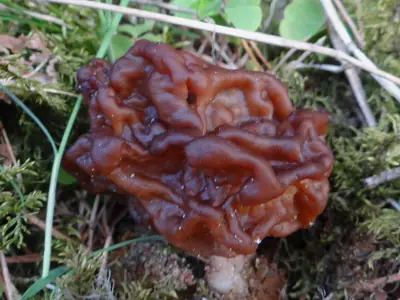
Deadly poisonous. The false morel has a brain-like folded head without pits, and its interior is divided into many chambers; the morel – regular pits and a single hollow chamber.
Step-by-step comparison: Black morel or false morel →Common morel Edible with care low risk
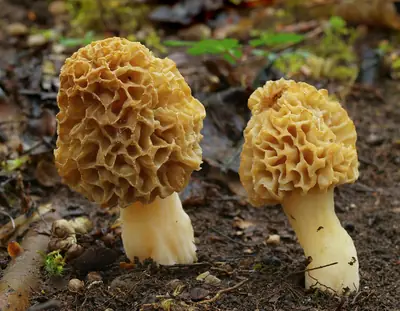
The common morel has a paler (ochre-yellow), more globose head with irregularly arranged pits; both are edible and protected.
Foragers’ finds
All photosPhotos and identifications are added by users; we do not check them. How points work →
In the kitchen
Always cook or fry thoroughly. Drying, frying in butter, sauces, soups. Pick legally only in gardens, parks and green areas.
Watch out for toxins
Raw and undercooked morels cause severe gastrointestinal illness; the toxins are broken down during cooking (First Nature).
Protection and sale
- Species protection: partially protected. Partial protection applies to specimens growing outside gardens, horticultural crops, forest nurseries and outside green areas (previously, in 1983–2014, strict protection). The species is in Annex 3 (harvesting by hand-picking of fruit bodies), but only on the basis of a permit from the regional or general directorate for environmental protection (RDOŚ/GDOŚ) – there is no general exemption for picking for your own use. Specimens from gardens, crops, nurseries and green areas are not protected.
- Sale: the species is on the list of mushrooms approved for sale (it may be sold only with a mushroom inspector’s certificate). Permitted for sale only from gardens, horticultural crops, forest nurseries and green areas, or from outside the territory of the Republic of Poland.
Black morel: common questions
Is the black morel edible?
Edible with care. Edible only after thorough cooking – poisonous raw (like all morels). A protected species. The taxonomy of the dark morels is uncertain: Polish Wikipedia treats the name M. conica as a synonym of the common morel, grzyby.pl and Polish law list the conical morel as a separate species, and First Nature describes the dark morels as M. elata.
When does the black morel grow?
In Poland the fruiting bodies usually appear in: March, April, May. Habitat: In early spring in damp, light places: forest edges, scrub, stream valleys (more common in the mountains, often near butterbur), and also parks and gardens – especially on freshly spread bark mulch in its first or second year. Red List: R.
What can the black morel be mistaken for?
False morel (deadly poisonous): Deadly poisonous. The false morel has a brain-like folded head without pits, and its interior is divided into many chambers; the morel – regular pits and a single hollow chamber. Common morel (edible with care): The common morel has a paler (ochre-yellow), more globose head with irregularly arranged pits; both are edible and protected.
Is the black morel a protected species?
Yes: partially protected (regulation on the species protection of fungi, Dz.U. 2014 poz. 1408). Partial protection applies to specimens growing outside gardens, horticultural crops, forest nurseries and outside green areas (previously, in 1983–2014, strict protection). The species is in Annex 3 (harvesting by hand-picking of fruit bodies), but only on the basis of a permit from the regional or general directorate for environmental protection (RDOŚ/GDOŚ) – there is no general exemption for picking for your own use. Specimens from gardens, crops, nurseries and green areas are not protected.
Sources
- grzyby.pl (atlas M. Snowarskiego): Morchella conica
- First Nature: Morchella elata
- Wikipedia (pl): Smardz wyniosły
- Wikipedia (pl): Smardz jadalny (Morchella conica jako synonim)
- Rozporządzenie Ministra Środowiska z dnia 9 października 2014 r. w sprawie ochrony gatunkowej grzybów (Dz.U. 2014 poz. 1408)
- Rozporządzenie Ministra Zdrowia w sprawie grzybów dopuszczonych do obrotu… – tekst jednolity Dz.U. 2026 poz. 258
Last checked: 9 November 2026. Spotted a mistake? Write to us.