
Dangerous mistake
Fairy ring champignon or fool's funnel? How to tell them apart
Fairy ring champignon is an edible mushroom, while the fool's funnel is a poisonous mushroom. Compare the two mushrooms point by point.
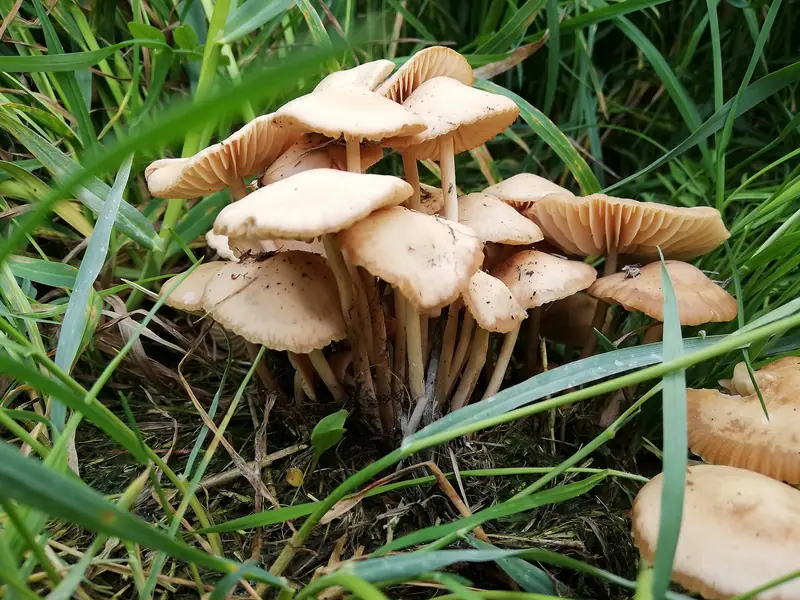
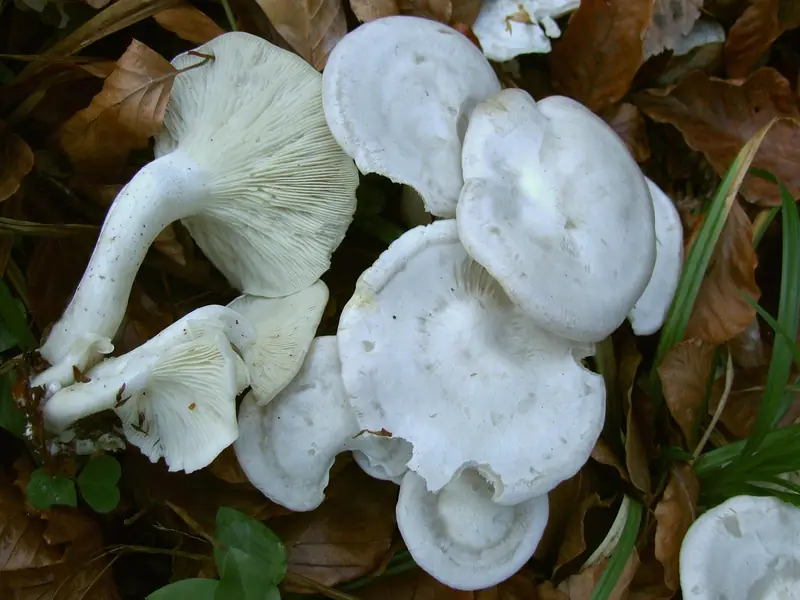
White funnels grow on the same lawns and also form rings. They have CROWDED, decurrent gills, a stiff, brittle stem and a frosted cap without an umbo – severely poisonous (muscarine).
The most dangerous mistake for people picking fairy ring champignons. The fairy ring champignon has DISTANT, free or emarginate gills, an elastic stem (it can be twisted without breaking) and a blunt umbo; the fool's funnel – crowded, decurrent gills, a stiff, brittle stem and a frosted, often depressed cap.
Feature by feature
| Feature | Fairy ring champignon | Fool's funnel |
|---|---|---|
| Edibility | Edible | Poisonous |
| Cap | 2–5(6) cm, hygrophanous: brownish to reddish-ochre when moist, pale ochre to cream when dry; with a broad blunt umbo, margin striate when moist. | 2–5(6) cm, whitish, frosted (as if dusted with flour), later with concentric flesh-coloured zones and patches; flat, often with a shallow depression. |
| Under the cap | Gills very DISTANT, broad, whitish to cream, free or emarginate (not decurrent). Spore print white. | Gills white to greyish-white, CROWDED, narrow, adnate and decurrent down the stem. Spore print white. |
| Stem | 4–8 cm, 3–5 mm, the colour of the cap, very ELASTIC and tough (it can be twisted without breaking), white mycelium at the base. | 2–4 cm, 4–6 mm thick, white to flesh-coloured, rather stiff and brittle (not elastic). |
| Flesh | Thin, whitish to pale yellow, does not change colour. | White, thin, does not change colour. |
| Smell and taste | Smell pleasant, mushroomy (sometimes described as slightly almond-like); taste mild, nutty. | Taste insignificant; smell mealy or like fresh sawdust (according to others sweetish, nondescript). Do not taste. |
| Habitat | Outside forests: meadows, pastures, lawns, roadsides, embankments, forest edges; in great numbers in fairy rings, arcs and rows. Prefers lightly fertilised soils. | Grassy areas: meadows, pastures, roadsides, lawns, parks, edges of broadleaf forests; often in the same places (and fairy rings) as the fairy ring champignon. |
| Season | May, June, July, August, September, October, November | August, September, October, November, December |
How to recognise it: fairy ring champignon
- Distant, non-decurrent gills
- Elastic stem – it can be twisted
- Blunt umbo on a buff cap
- Fairy rings in grass outside forests
How to recognise it: fool's funnel
- Small, whitish, frosted cap with flesh-coloured patches
- Crowded, decurrent gills
- Stiff, brittle stem
- Lawns, meadows, roadsides – next to fairy ring champignons
Safety rule
Never eat a mushroom identified only from a website, a photo or an app. Show any doubtful specimen to a certified mushroom inspector at the sanepid (state sanitary inspection); in season the advice points are free. Do not give wild-picked mushrooms to children.
The golden rules of foraging →Frequently asked questions
Fairy ring champignon or fool's funnel: how can you tell them apart?
White funnels grow on the same lawns and also form rings. They have CROWDED, decurrent gills, a stiff, brittle stem and a frosted cap without an umbo – severely poisonous (muscarine). The most dangerous mistake for people picking fairy ring champignons. The fairy ring champignon has DISTANT, free or emarginate gills, an elastic stem (it can be twisted without breaking) and a blunt umbo; the fool's funnel – crowded, decurrent gills, a stiff, brittle stem and a frosted, often depressed cap.
Fool's funnel: what to do if you have eaten it?
Call 112 at once or go to A&E (SOR), and take any leftover mushrooms with you. Muscarine – muscarinic syndrome: profuse sweating, tearing, salivation, visual disturbances, vomiting, colic; symptoms after approx. 15 min to 4 h, often pass after a few hours. Antidote: atropine.
Sources
- Twardzioszek przydrożny – Wikipedia (PL)
- Marasmius oreades – Atlas grzybów Polski (grzyby.pl, M. Snowarski)
- Marasmius oreades – First Nature
- Lejkówka jadowita – Wikipedia (PL)
- Clitocybe rivulosa – Atlas grzybów Polski (grzyby.pl, M. Snowarski)
- Clitocybe rivulosa – First Nature
Last checked: 9 November 2026. Spotted a mistake? Write to us.