Gilled mushrooms
Fool's funnel
Collybia rivulosa · also known as: Sweating mushroom, Ivory funnel
Poisonous
Severely poisonous (muscarine). Fatal poisonings are rare, mainly in people with heart or respiratory diseases. The naming is inconsistent: C. dealbata and C. rivulosa used to be combined; the Polish Mycological Society (PTMyk) committee (2025) recommends “lejkówka jadowita” for C. rivulosa and “lejkówka strumykowa” for C. dealbata, while the grzyby.pl atlas describes the complex under the name “lejkówka strumykowa”. Both taxa are poisonous.
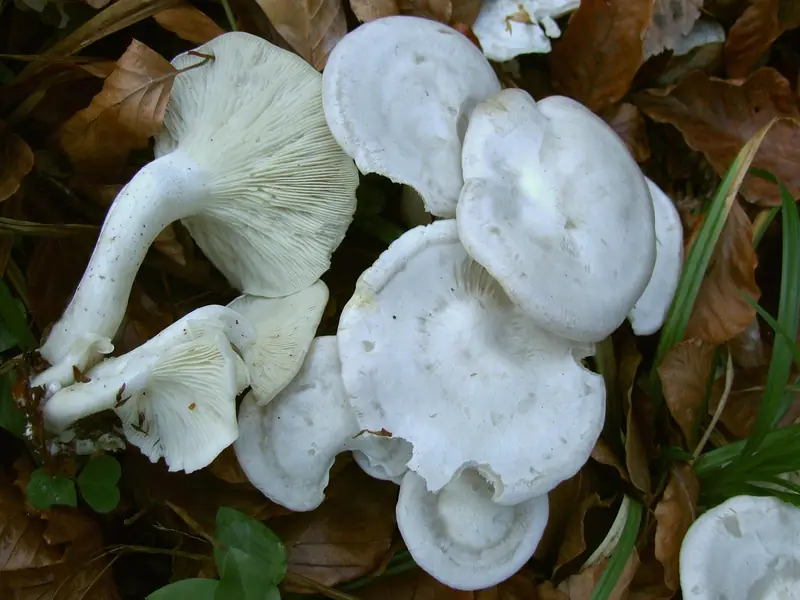
How to recognise it: fool's funnel
- 1
Small, whitish, frosted cap with flesh-coloured patches
- 2
Crowded, decurrent gills
- 3
Stiff, brittle stem
- 4
Lawns, meadows, roadsides – next to fairy ring champignons
Description
- Cap
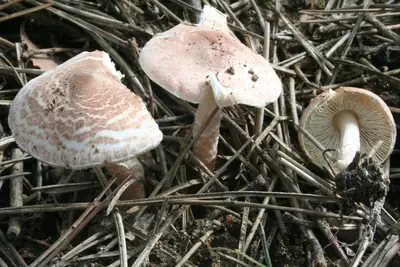
- 2–5(6) cm, whitish, frosted (as if dusted with flour), later with concentric flesh-coloured zones and patches; flat, often with a shallow depression.
- Gills
- Gills white to greyish-white, CROWDED, narrow, adnate and decurrent down the stem. Spore print white.
- Stem
- 2–4 cm, 4–6 mm thick, white to flesh-coloured, rather stiff and brittle (not elastic).
- Flesh
- White, thin, does not change colour.
- Smell and taste
- Taste insignificant; smell mealy or like fresh sawdust (according to others sweetish, nondescript). Do not taste.
Where and when it grows
Grassy areas: meadows, pastures, roadsides, lawns, parks, edges of broadleaf forests; often in the same places (and fairy rings) as the fairy ring champignon.
Look-alikes: what it can be mistaken for
Fairy ring champignon Edible high risk of confusion
The most dangerous mistake for people picking fairy ring champignons. The fairy ring champignon has DISTANT, free or emarginate gills, an elastic stem (it can be twisted without breaking) and a blunt umbo; the fool's funnel – crowded, decurrent gills, a stiff, brittle stem and a frosted, often depressed cap.
Step-by-step comparison: Fairy ring champignon or fool's funnel →
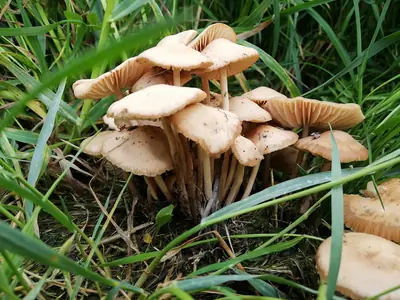
Foragers’ finds
All photosPhotos and identifications are added by users; we do not check them. Add your own find →
Protection and sale
- Species protection: the species is not protected.
- Sale: the species is not on the list of mushrooms approved for sale.
Fool's funnel: common questions
Is the fool's funnel edible?
Poisonous. Severely poisonous (muscarine). Fatal poisonings are rare, mainly in people with heart or respiratory diseases. The naming is inconsistent: C. dealbata and C. rivulosa used to be combined; the Polish Mycological Society (PTMyk) committee (2025) recommends “lejkówka jadowita” for C. rivulosa and “lejkówka strumykowa” for C. dealbata, while the grzyby.pl atlas describes the complex under the name “lejkówka strumykowa”. Both taxa are poisonous.
When does the fool's funnel grow?
In Poland the fruiting bodies usually appear in: August, September, October, November, December. Habitat: Grassy areas: meadows, pastures, roadsides, lawns, parks, edges of broadleaf forests; often in the same places (and fairy rings) as the fairy ring champignon.
What can the fool's funnel be mistaken for?
Fairy ring champignon (edible): The most dangerous mistake for people picking fairy ring champignons. The fairy ring champignon has DISTANT, free or emarginate gills, an elastic stem (it can be twisted without breaking) and a blunt umbo; the fool's funnel – crowded, decurrent gills, a stiff, brittle stem and a frosted, often depressed cap.
Sources
- Lejkówka jadowita – Wikipedia (PL)
- Clitocybe rivulosa – Atlas grzybów Polski (grzyby.pl, M. Snowarski)
- Clitocybe rivulosa – First Nature
Last checked: 9 November 2026. Spotted a mistake? Write to us.