Gilled mushrooms
Fairy ring champignon
Marasmius oreades · also known as: Fairy ring mushroom, Scotch bonnet
EdibleApproved for sale
A tasty edible mushroom (only the caps are eaten). However, it grows in the same places as the poisonous white funnels (Clitocybe; muscarine) – every fruit body must be checked individually.
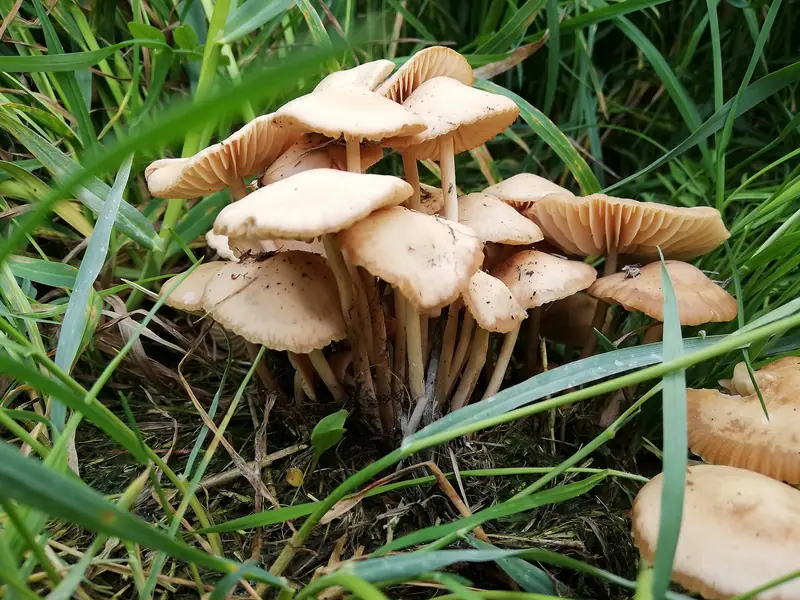
How to recognise it: fairy ring champignon
- 1
Distant, non-decurrent gills
- 2
Elastic stem – it can be twisted
- 3
Blunt umbo on a buff cap
- 4
Fairy rings in grass outside forests
Description
- Cap
- 2–5(6) cm, hygrophanous: brownish to reddish-ochre when moist, pale ochre to cream when dry; with a broad blunt umbo, margin striate when moist.
- Gills
- Gills very DISTANT, broad, whitish to cream, free or emarginate (not decurrent). Spore print white.
- Stem
- 4–8 cm, 3–5 mm, the colour of the cap, very ELASTIC and tough (it can be twisted without breaking), white mycelium at the base.
- Flesh
- Thin, whitish to pale yellow, does not change colour.
- Smell and taste
- Smell pleasant, mushroomy (sometimes described as slightly almond-like); taste mild, nutty.
Where and when it grows
Outside forests: meadows, pastures, lawns, roadsides, embankments, forest edges; in great numbers in fairy rings, arcs and rows. Prefers lightly fertilised soils.
Look-alikes: what it can be mistaken for
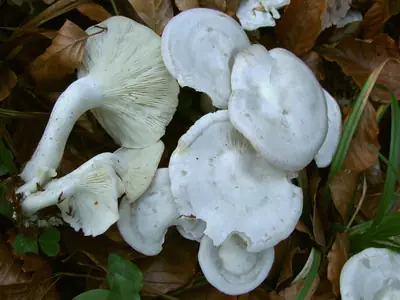
Fool's funnel Poisonous high risk of confusion
White funnels grow on the same lawns and also form rings. They have CROWDED, decurrent gills, a stiff, brittle stem and a frosted cap without an umbo – severely poisonous (muscarine).
Step-by-step comparison: Fairy ring champignon or fool's funnel →
Foragers’ finds
All photosPhotos and identifications are added by users; we do not check them. Add your own find →
In the kitchen
For soups, sauces, omelettes; the tough stems are discarded. Dries excellently and regains its shape well after soaking.
Protection and sale
- Species protection: the species is not protected.
- Sale: the species is on the list of mushrooms approved for sale (it may be sold only with a mushroom inspector’s certificate). Listed in Annex 1 as “twardzioszek przydrożny – Marasmius oreades”.
Fairy ring champignon: common questions
Is the fairy ring champignon edible?
Edible. A tasty edible mushroom (only the caps are eaten). However, it grows in the same places as the poisonous white funnels (Clitocybe; muscarine) – every fruit body must be checked individually.
When does the fairy ring champignon grow?
In Poland the fruiting bodies usually appear in: May, June, July, August, September, October, November. Habitat: Outside forests: meadows, pastures, lawns, roadsides, embankments, forest edges; in great numbers in fairy rings, arcs and rows. Prefers lightly fertilised soils.
What can the fairy ring champignon be mistaken for?
Fool's funnel (poisonous): White funnels grow on the same lawns and also form rings. They have CROWDED, decurrent gills, a stiff, brittle stem and a frosted cap without an umbo – severely poisonous (muscarine).
Sources
- Twardzioszek przydrożny – Wikipedia (PL)
- Marasmius oreades – Atlas grzybów Polski (grzyby.pl, M. Snowarski)
- Marasmius oreades – First Nature
- Rozporządzenie Ministra Zdrowia w sprawie grzybów dopuszczonych do obrotu… – tekst jednolity Dz.U. 2026 poz. 258 (załącznik nr 1)
Last checked: 9 November 2026. Spotted a mistake? Write to us.