
Comparison
False saffron milkcap or woolly milkcap? How to tell them apart
False saffron milkcap is an edible mushroom, while the woolly milkcap is a poisonous mushroom. Compare the two mushrooms point by point.
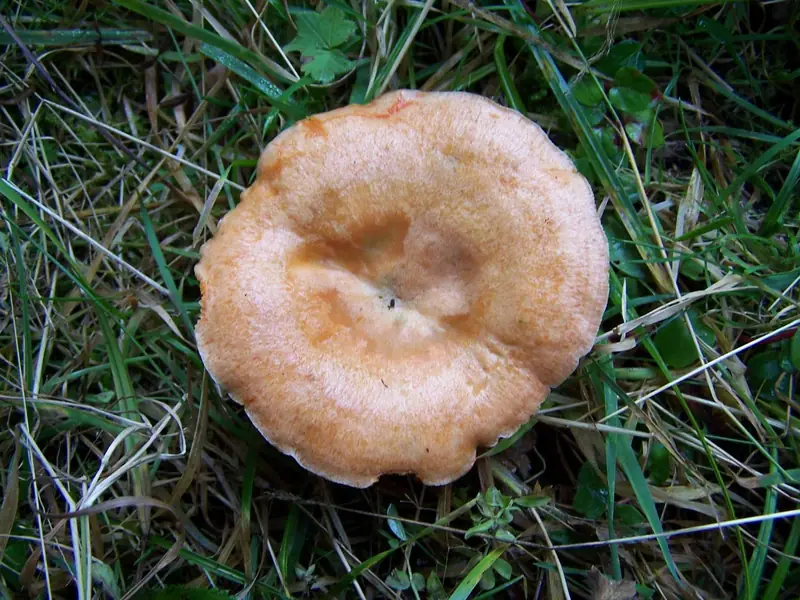
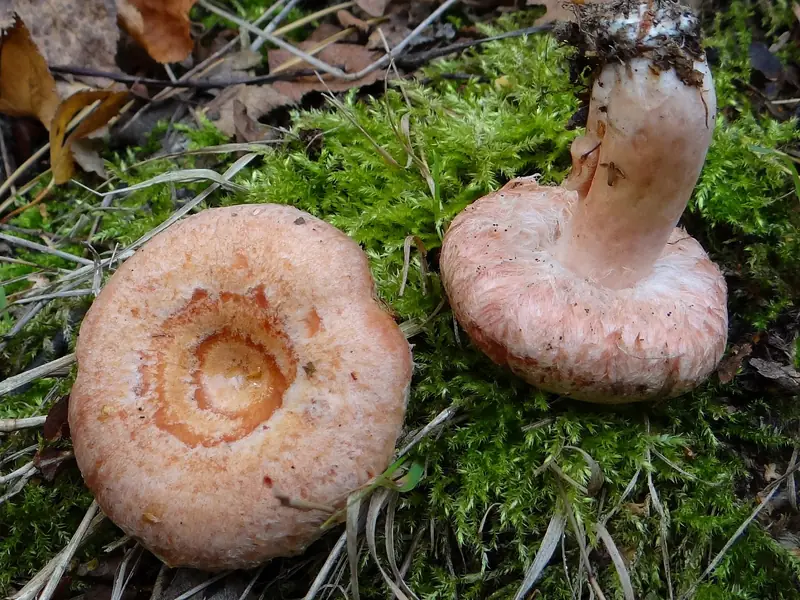
The poisonous look-alike of the “rydze”: hairy cap margin, grows under birch, milk white and burning hot.
The edible false saffron milkcap has orange milk and grows under spruces, without a woolly margin.
Feature by feature
| Feature | False saffron milkcap | Woolly milkcap |
|---|---|---|
| Edibility | Edible | Poisonous |
| Cap | 4–10 cm, orange to salmon, indistinctly zoned; older specimens and those after frost have green patches. Margin long inrolled, funnel-shaped with age. | 4–12(15) cm, flesh-pink to brick-pink, concentrically zoned, depressed; margin long inrolled, densely covered with hanging woolly hairs (best seen in young specimens). |
| Under the cap | Gills red-orange, brittle, fairly crowded, slightly decurrent; turn green when damaged. | Gills white to light cream (sometimes with a pink tinge), crowded, slightly decurrent. |
| Stem | 3–7 cm, the colour of the cap, without distinct pits (sometimes indistinct spots), soon hollow; when damaged discolours wine-red, then dark green. | 3–10 cm, cream to pinkish, short, sometimes with pits, soon hollow. |
| Flesh | Cream, stained by the orange milk. Milk orange, turning wine-red after approx. 15–30 min in the air; the flesh slowly turns green. | White, brittle. Exudes abundant WHITE milk that does not change colour in the air (turns yellow on paper). |
| Smell and taste | Smell pleasant, fruity; taste of young specimens slightly acrid or bitterish, older ones milder. | Smell fruity or turpentine-like; milk and flesh burning hot (do not taste). |
| Habitat | Coniferous and mixed forests, only under spruces; more common in the mountains and foothills, often in masses in young spruce plantations. On acidic and alkaline soils. | Always with birches: forests, parks, forest edges, heaths, often among mosses on acidic, sandy or clay soils. |
| Season | August, September, October | July, August, September, October, November |
How to recognise it: false saffron milkcap
- Orange milk that turns red in the air after a dozen or so minutes
- Grows only under spruces
- Stem without distinct pits
- Green patches on the cap of older specimens
How to recognise it: woolly milkcap
- Woolly, hairy, inrolled cap margin
- White, burning-hot milk
- Pinkish, zoned cap
- Always with birches
Safety rule
Never eat a mushroom identified only from a website, a photo or an app. Show any doubtful specimen to a certified mushroom inspector at the sanepid (state sanitary inspection); in season the advice points are free. Do not give wild-picked mushrooms to children.
The golden rules of foraging →Frequently asked questions
False saffron milkcap or woolly milkcap: how can you tell them apart?
The poisonous look-alike of the “rydze”: hairy cap margin, grows under birch, milk white and burning hot. The edible false saffron milkcap has orange milk and grows under spruces, without a woolly margin.
Woolly milkcap: what to do if you have eaten it?
Call 112 at once or go to A&E (SOR), and take any leftover mushrooms with you. Irritant resinous substances (the acrid compounds of the milk) – gastrointestinal syndrome: nausea, vomiting, diarrhoea, usually within a few hours. Not fatal.
Sources
- Mleczaj świerkowy – Wikipedia (PL)
- Lactarius deterrimus – Atlas grzybów Polski (grzyby.pl, M. Snowarski)
- Lactarius deterrimus – First Nature
- Mleczaj wełnianka – Wikipedia (PL)
- Lactarius torminosus – Atlas grzybów Polski (grzyby.pl, M. Snowarski)
- Lactarius torminosus – First Nature
Last checked: 9 November 2026. Spotted a mistake? Write to us.