Gilled mushrooms
Woolly milkcap
Lactarius torminosus · also known as: Bearded milkcap, Pink-fringed milkcap
Poisonous
We classify it as POISONOUS (the safer class). Raw or badly prepared it causes nausea, vomiting and diarrhoea. In Scandinavia, Russia and Ukraine it is eaten after repeated soaking, boiling with the water discarded, and lacto-fermenting – which is why grzyby.pl lists it as “inedible or edible after processing”, while the regional sanitary-epidemiological station (WSSE) and most European sources list it as poisonous. We do not recommend picking it. In 2025 the Polish Mycological Society (PTMyk) committee recommended the name “mleczaj żółtoobrączkowy”.
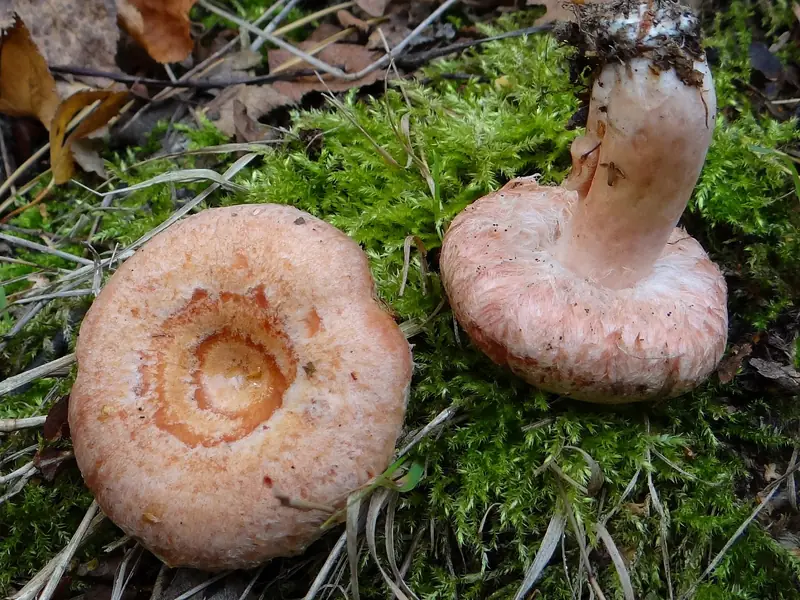
How to recognise it: woolly milkcap
- 1
Woolly, hairy, inrolled cap margin
- 2
White, burning-hot milk
- 3
Pinkish, zoned cap
- 4
Always with birches
Description
- Cap
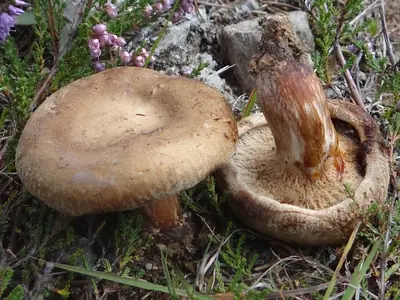
- 4–12(15) cm, flesh-pink to brick-pink, concentrically zoned, depressed; margin long inrolled, densely covered with hanging woolly hairs (best seen in young specimens).
- Gills
- Gills white to light cream (sometimes with a pink tinge), crowded, slightly decurrent.
- Stem
- 3–10 cm, cream to pinkish, short, sometimes with pits, soon hollow.
- Flesh
- White, brittle. Exudes abundant WHITE milk that does not change colour in the air (turns yellow on paper).
- Smell and taste
- Smell fruity or turpentine-like; milk and flesh burning hot (do not taste).
Where and when it grows
Always with birches: forests, parks, forest edges, heaths, often among mosses on acidic, sandy or clay soils.
Most often with: birch
Look-alikes: what it can be mistaken for
Saffron milkcap Edible high risk of confusion
The edible saffron milkcap has orange milk, turns green when damaged, has a bare cap margin and grows under pines. A simple rule: the “rydze” have orange milk, the woolly milkcap – white.
Step-by-step comparison: Saffron milkcap or woolly milkcap →False saffron milkcap Edible medium risk
The edible false saffron milkcap has orange milk and grows under spruces, without a woolly margin.
Step-by-step comparison: False saffron milkcap or woolly milkcap →
Foragers’ finds
All photosPhotos and identifications are added by users; we do not check them. Add your own find →
Protection and sale
- Species protection: the species is not protected.
- Sale: the species is not on the list of mushrooms approved for sale.
Woolly milkcap: common questions
Is the woolly milkcap edible?
Poisonous. We classify it as POISONOUS (the safer class). Raw or badly prepared it causes nausea, vomiting and diarrhoea. In Scandinavia, Russia and Ukraine it is eaten after repeated soaking, boiling with the water discarded, and lacto-fermenting – which is why grzyby.pl lists it as “inedible or edible after processing”, while the regional sanitary-epidemiological station (WSSE) and most European sources list it as poisonous. We do not recommend picking it. In 2025 the Polish Mycological Society (PTMyk) committee recommended the name “mleczaj żółtoobrączkowy”.
When does the woolly milkcap grow?
In Poland the fruiting bodies usually appear in: July, August, September, October, November. Habitat: Always with birches: forests, parks, forest edges, heaths, often among mosses on acidic, sandy or clay soils.
What can the woolly milkcap be mistaken for?
Saffron milkcap (edible): The edible saffron milkcap has orange milk, turns green when damaged, has a bare cap margin and grows under pines. A simple rule: the “rydze” have orange milk, the woolly milkcap – white. False saffron milkcap (edible): The edible false saffron milkcap has orange milk and grows under spruces, without a woolly margin.
Sources
- Mleczaj wełnianka – Wikipedia (PL)
- Lactarius torminosus – Atlas grzybów Polski (grzyby.pl, M. Snowarski)
- Lactarius torminosus – First Nature
- Bezpieczne grzybobranie – ulotka WSSE w Warszawie (publikacja Nadleśnictwa Nowa Dęba, Lasy Państwowe)
Last checked: 9 November 2026. Spotted a mistake? Write to us.