
Dangerous mistake
Honey fungus or funeral bell? How to tell them apart
Honey fungus is edible only with care, while the funeral bell is a deadly poisonous mushroom. Compare the two mushrooms point by point.
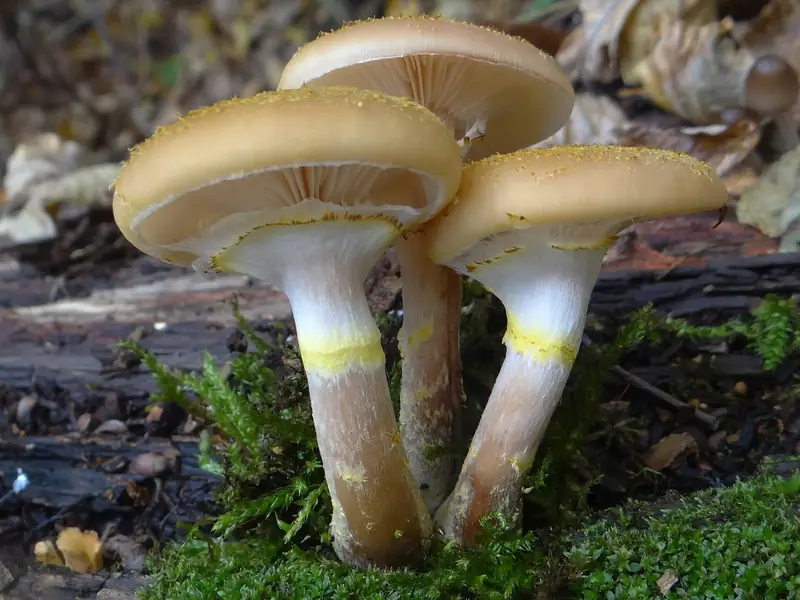
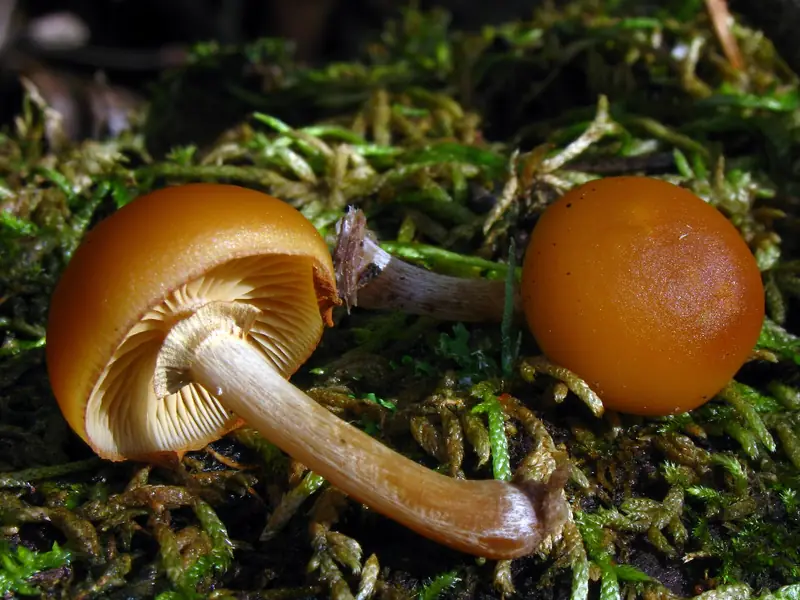
The honey fungus has a white spore print and whitish/beige gills, is larger and has a persistent membranous ring; the funeral bell has a rusty-brown spore print and rusty gills.
Deadly poisonous (amatoxins), also grows gregariously on wood. The funeral bell is smaller (cap 1.5–5 cm), has a rusty-brown spore print, rusty gills and silvery-white fibrils on the stem below a fragile ring. The honey fungus has a white spore print and whitish/beige gills.
Feature by feature
| Feature | Honey fungus | Funeral bell |
|---|---|---|
| Edibility | Edible with care | Deadly poisonous |
| Cap | 3–13 cm across, honey-yellow to olive- or reddish-brown, darker in the centre, with fine dark scales (disappearing with age); margin striate in young specimens. | Small, 1.5–5 cm, hemispherical then flat, often with a blunt umbo; strongly hygrophanous – ochre- to reddish-brown when moist, drying paler from the centre; margin striate when moist. |
| Under the cap | Gills whitish, later beige-pinkish and yellowish with brown spots, crowded, adnate to slightly decurrent. | Gills adnate, ochre-brown at first, then rusty-brown, edges paler. |
| Stem | Long (5–20 cm), slender, darker towards the base, stems in a cluster fused together; a distinct, persistent, membranous ring, whitish to yellowish. | Thin (1–6 mm), 2–8 cm, with a fragile whitish ring (often stained brown by spores); below the ring silvery-white lengthwise fibrils on a brown background, dark at the base. |
| Flesh | Whitish to pale flesh-coloured, does not change colour when cut; fibrous in the stem of older specimens. | Thin, pale ochre in the cap, brown in the stem; does not change colour. |
| Smell and taste | Smell faint, pleasant; taste when raw mild, then astringent, sourish. Spore print white to cream. | Smell and taste mealy (with a hint of radish). Spore print rusty-brown. Do not taste – a deadly poisonous mushroom. |
| Habitat | Grows gregariously, in large clusters on trunks, stumps and roots of broadleaf trees (oak, hornbeam, beech, fruit trees) in forests, parks and orchards; a parasite causing root rot. Armillaria mellea in the strict sense is fairly rare in Poland; Armillaria ostoyae on conifers is more common. | On decaying wood (stumps, trunks, branches, buried wood, sawdust), singly or in groups. In the mountains mainly with spruces; sources differ regarding broadleaf wood (Wikipedia: in the lowlands mainly beech; grzyby.pl: specimens from broadleaf wood are related species, e.g. Galerina autumnalis). |
| Season | August, September, October, November | August, September, October, November |
How to recognise it: honey fungus
- Large clusters on wood or tree roots
- Membranous ring on the stem
- White spore print
- Honey-brown cap with fine dark scales in the centre
- Do not eat raw – always parboil
How to recognise it: funeral bell
- Small brown mushroom growing gregariously on wood
- Rusty-brown spore print
- Stem below the ring with silvery-white fibrils (not scales)
- Mealy smell
- Contains amatoxins – delayed symptoms
Safety rule
Never eat a mushroom identified only from a website, a photo or an app. Show any doubtful specimen to a certified mushroom inspector at the sanepid (state sanitary inspection); in season the advice points are free. Do not give wild-picked mushrooms to children.
The golden rules of foraging →Frequently asked questions
Honey fungus or funeral bell: how can you tell them apart?
The honey fungus has a white spore print and whitish/beige gills, is larger and has a persistent membranous ring; the funeral bell has a rusty-brown spore print and rusty gills. Deadly poisonous (amatoxins), also grows gregariously on wood. The funeral bell is smaller (cap 1.5–5 cm), has a rusty-brown spore print, rusty gills and silvery-white fibrils on the stem below a fragile ring. The honey fungus has a white spore print and whitish/beige gills.
Funeral bell: what to do if you have eaten it?
Call 112 at once or go to A&E (SOR), and take any leftover mushrooms with you. Amatoxins (amanitins) – phalloides (cyclopeptide) syndrome, as after the death cap: gastrointestinal symptoms after several to a dozen or so hours, then an apparent improvement and damage to the liver and kidneys after 2–6 days.
Sources
- Wikipedia (pl): Opieńka miodowa
- grzyby.pl (atlas M. Snowarskiego): Armillaria mellea
- First Nature: Armillaria mellea
- Wikipedia (pl): Hełmówka jadowita
- grzyby.pl (atlas M. Snowarskiego): Galerina marginata
- First Nature: Galerina marginata
Last checked: 9 November 2026. Spotted a mistake? Write to us.