Gilled mushrooms
Funeral bell
Galerina marginata · also known as: Deadly galerina, Autumn skullcap
Deadly poisonous
Contains amatoxins – the same as the death cap. The most common poisoning scenario is confusion with the sheathed woodtuft or the honey fungus. Polish Wikipedia states that no death after poisoning by this species has been recorded, but grzyby.pl and First Nature classify it as deadly poisonous – we adopt the safer class.
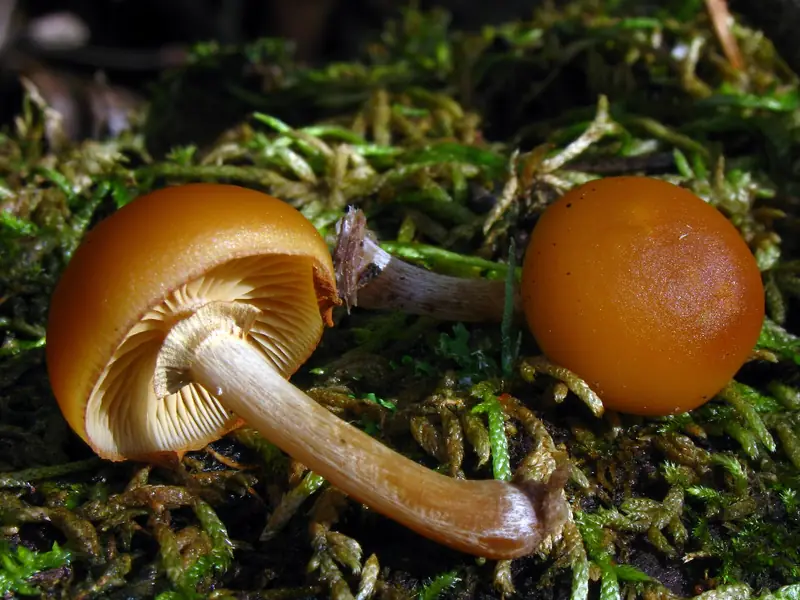
How to recognise it: funeral bell
- 1
Small brown mushroom growing gregariously on wood
- 2
Rusty-brown spore print
- 3
Stem below the ring with silvery-white fibrils (not scales)
- 4
Mealy smell
- 5
Contains amatoxins – delayed symptoms
Description
- Cap
- Small, 1.5–5 cm, hemispherical then flat, often with a blunt umbo; strongly hygrophanous – ochre- to reddish-brown when moist, drying paler from the centre; margin striate when moist.
- Gills
- Gills adnate, ochre-brown at first, then rusty-brown, edges paler.
- Stem
- Thin (1–6 mm), 2–8 cm, with a fragile whitish ring (often stained brown by spores); below the ring silvery-white lengthwise fibrils on a brown background, dark at the base.
- Flesh
- Thin, pale ochre in the cap, brown in the stem; does not change colour.
- Smell and taste
- Smell and taste mealy (with a hint of radish). Spore print rusty-brown. Do not taste – a deadly poisonous mushroom.
Where and when it grows
On decaying wood (stumps, trunks, branches, buried wood, sawdust), singly or in groups. In the mountains mainly with spruces; sources differ regarding broadleaf wood (Wikipedia: in the lowlands mainly beech; grzyby.pl: specimens from broadleaf wood are related species, e.g. Galerina autumnalis).
Most often with: spruce, pine, beech
Look-alikes: what it can be mistaken for
Sheathed woodtuft Edible high risk of confusion
The most dangerous confusion. The sheathed woodtuft has raised dark brown scales below the ring (the funeral bell – white, flattened fibrils), its cap dries from the centre (paler centre, dark margin), it grows in larger clusters on broadleaf wood and has no mealy smell. Even experienced foragers confuse these species – sometimes only a microscope settles it.
Step-by-step comparison: Sheathed woodtuft or funeral bell →Honey fungus Edible with care high risk of confusion
The honey fungus has a white spore print and whitish/beige gills, is larger and has a persistent membranous ring; the funeral bell has a rusty-brown spore print and rusty gills.
Step-by-step comparison: Honey fungus or funeral bell →
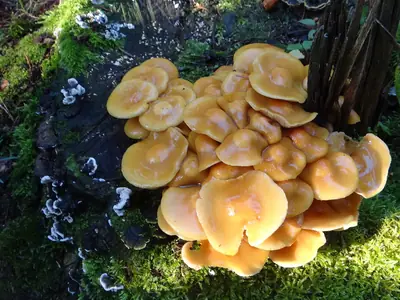
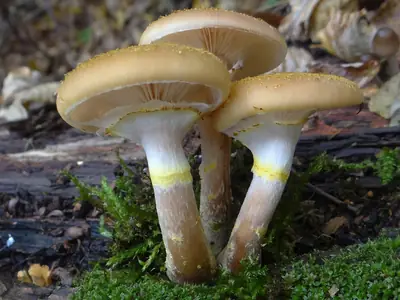
Foragers’ finds
All photosPhotos and identifications are added by users; we do not check them. Add your own find →
Protection and sale
- Species protection: the species is not protected.
- Sale: the species is not on the list of mushrooms approved for sale.
Funeral bell: common questions
Is the funeral bell edible?
Deadly poisonous. Contains amatoxins – the same as the death cap. The most common poisoning scenario is confusion with the sheathed woodtuft or the honey fungus. Polish Wikipedia states that no death after poisoning by this species has been recorded, but grzyby.pl and First Nature classify it as deadly poisonous – we adopt the safer class.
When does the funeral bell grow?
In Poland the fruiting bodies usually appear in: August, September, October, November. Habitat: On decaying wood (stumps, trunks, branches, buried wood, sawdust), singly or in groups. In the mountains mainly with spruces; sources differ regarding broadleaf wood (Wikipedia: in the lowlands mainly beech; grzyby.pl: specimens from broadleaf wood are related species, e.g. Galerina autumnalis).
What can the funeral bell be mistaken for?
Sheathed woodtuft (edible): The most dangerous confusion. The sheathed woodtuft has raised dark brown scales below the ring (the funeral bell – white, flattened fibrils), its cap dries from the centre (paler centre, dark margin), it grows in larger clusters on broadleaf wood and has no mealy smell. Even experienced foragers confuse these species – sometimes only a microscope settles it. Honey fungus (edible with care): The honey fungus has a white spore print and whitish/beige gills, is larger and has a persistent membranous ring; the funeral bell has a rusty-brown spore print and rusty gills.
Sources
- Wikipedia (pl): Hełmówka jadowita
- grzyby.pl (atlas M. Snowarskiego): Galerina marginata
- First Nature: Galerina marginata
- mp.pl – Zatrucie grzybami
Last checked: 9 November 2026. Spotted a mistake? Write to us.