
Dangerous mistake
Sheathed woodtuft or funeral bell? How to tell them apart
Sheathed woodtuft is an edible mushroom, while the funeral bell is a deadly poisonous mushroom. Compare the two mushrooms point by point.
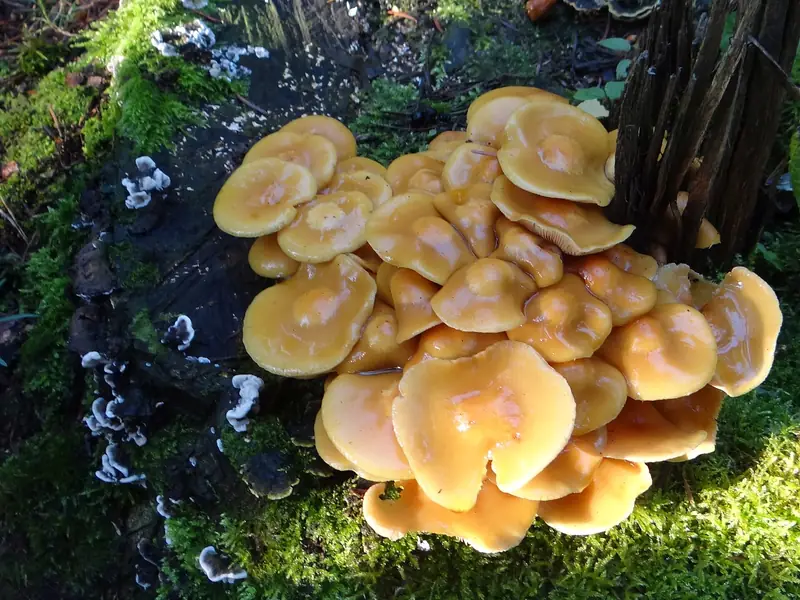
The most dangerous confusion. The sheathed woodtuft has raised dark brown scales below the ring (the funeral bell – white, flattened fibrils), its cap dries from the centre (paler centre, dark margin), it grows in larger clusters on broadleaf wood and has no mealy smell. Even experienced foragers confuse these species – sometimes only a microscope settles it.
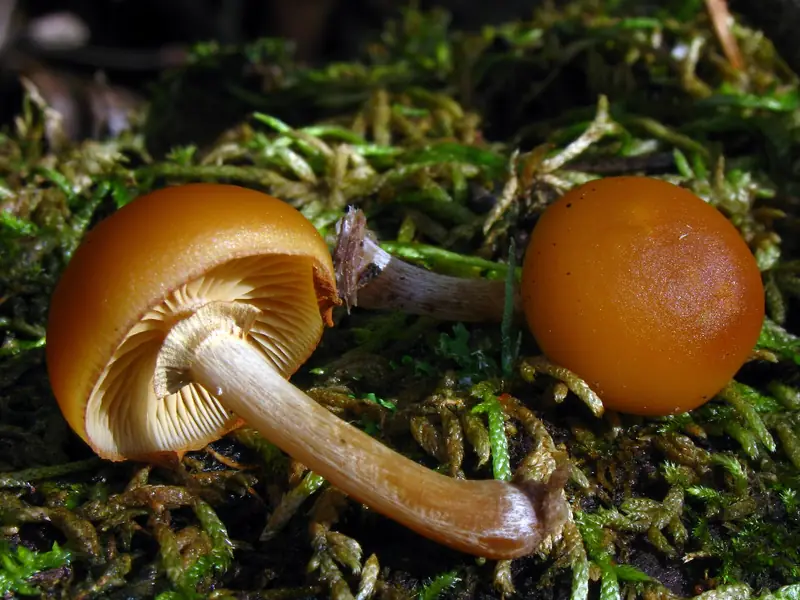
Deadly poisonous (amatoxins). The funeral bell has white, flattened fibrils below the ring instead of scales, a mealy smell, often grows on coniferous wood; its cap dries from the margin towards the centre. The differences can be subtle – if in doubt, do not pick.
Feature by feature
| Feature | Sheathed woodtuft | Funeral bell |
|---|---|---|
| Edibility | Edible | Deadly poisonous |
| Cap | 2–7 cm across, flat with a blunt umbo, hygrophanous: cinnamon-brown when moist, dries from the centre – centre pale ochre, margin darker (two-toned). | Small, 1.5–5 cm, hemispherical then flat, often with a blunt umbo; strongly hygrophanous – ochre- to reddish-brown when moist, drying paler from the centre; margin striate when moist. |
| Under the cap | Gills crowded, whitish at first, then rusty-brown (cinnamon), adnate or slightly decurrent. | Gills adnate, ochre-brown at first, then rusty-brown, edges paler. |
| Stem | 5–7 cm × 5–8 mm, fibrous, hollow; a leathery ring, smooth above, covered below the ring with raised dark brown scales. | Thin (1–6 mm), 2–8 cm, with a fragile whitish ring (often stained brown by spores); below the ring silvery-white lengthwise fibrils on a brown background, dark at the base. |
| Flesh | Thin, whitish, watery in the cap; rusty-brown in the stem; does not change colour. | Thin, pale ochre in the cap, brown in the stem; does not change colour. |
| Smell and taste | Smell pleasant, like freshly cut wood; taste mild. Spore print rusty-brown. | Smell and taste mealy (with a hint of radish). Spore print rusty-brown. Do not taste – a deadly poisonous mushroom. |
| Habitat | Common; gregarious in dense clusters on stumps and trunks of broadleaf trees (alder, birch, beech, hornbeam, willow), rarely on conifers (mainly in the mountains), in forests, parks and gardens. | On decaying wood (stumps, trunks, branches, buried wood, sawdust), singly or in groups. In the mountains mainly with spruces; sources differ regarding broadleaf wood (Wikipedia: in the lowlands mainly beech; grzyby.pl: specimens from broadleaf wood are related species, e.g. Galerina autumnalis). |
| Season | April, May, June, July, August, September, October, November, December | August, September, October, November |
How to recognise it: sheathed woodtuft
- Dense clusters on stumps of broadleaf trees
- Two-toned cap – dries from the centre
- Raised dark brown scales below the ring
- Rusty-brown spore print
- Smell of fresh wood
How to recognise it: funeral bell
- Small brown mushroom growing gregariously on wood
- Rusty-brown spore print
- Stem below the ring with silvery-white fibrils (not scales)
- Mealy smell
- Contains amatoxins – delayed symptoms
Safety rule
Never eat a mushroom identified only from a website, a photo or an app. Show any doubtful specimen to a certified mushroom inspector at the sanepid (state sanitary inspection); in season the advice points are free. Do not give wild-picked mushrooms to children.
The golden rules of foraging →Frequently asked questions
Sheathed woodtuft or funeral bell: how can you tell them apart?
The most dangerous confusion. The sheathed woodtuft has raised dark brown scales below the ring (the funeral bell – white, flattened fibrils), its cap dries from the centre (paler centre, dark margin), it grows in larger clusters on broadleaf wood and has no mealy smell. Even experienced foragers confuse these species – sometimes only a microscope settles it. Deadly poisonous (amatoxins). The funeral bell has white, flattened fibrils below the ring instead of scales, a mealy smell, often grows on coniferous wood; its cap dries from the margin towards the centre. The differences can be subtle – if in doubt, do not pick.
Funeral bell: what to do if you have eaten it?
Call 112 at once or go to A&E (SOR), and take any leftover mushrooms with you. Amatoxins (amanitins) – phalloides (cyclopeptide) syndrome, as after the death cap: gastrointestinal symptoms after several to a dozen or so hours, then an apparent improvement and damage to the liver and kidneys after 2–6 days.
Sources
- Wikipedia (pl): Łuskwiak zmienny
- grzyby.pl (atlas M. Snowarskiego): Kuehneromyces mutabilis
- First Nature: Kuehneromyces mutabilis
- Wikipedia (pl): Hełmówka jadowita
- grzyby.pl (atlas M. Snowarskiego): Galerina marginata
- First Nature: Galerina marginata
Last checked: 9 November 2026. Spotted a mistake? Write to us.