Gilled mushrooms
Sheathed woodtuft
Kuehneromyces mutabilis · also known as: Two-toned scalycap
Edible
A good edible mushroom, but NOT RECOMMENDED for beginners: the deadly poisonous funeral bell is very similar (the author of grzyby.pl and First Nature recommend treating it as “for looking at only”). Pick only when certain about every single fruit body.
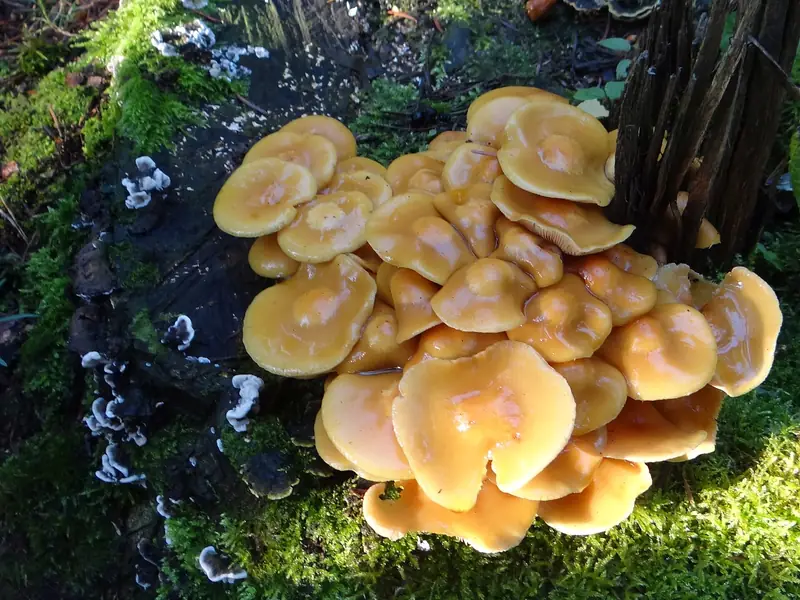
How to recognise it: sheathed woodtuft
- 1
Dense clusters on stumps of broadleaf trees
- 2
Two-toned cap – dries from the centre
- 3
Raised dark brown scales below the ring
- 4
Rusty-brown spore print
- 5
Smell of fresh wood
Description
- Cap
- 2–7 cm across, flat with a blunt umbo, hygrophanous: cinnamon-brown when moist, dries from the centre – centre pale ochre, margin darker (two-toned).
- Gills
- Gills crowded, whitish at first, then rusty-brown (cinnamon), adnate or slightly decurrent.
- Stem
- 5–7 cm × 5–8 mm, fibrous, hollow; a leathery ring, smooth above, covered below the ring with raised dark brown scales.
- Flesh
- Thin, whitish, watery in the cap; rusty-brown in the stem; does not change colour.
- Smell and taste
- Smell pleasant, like freshly cut wood; taste mild. Spore print rusty-brown.
Where and when it grows
Common; gregarious in dense clusters on stumps and trunks of broadleaf trees (alder, birch, beech, hornbeam, willow), rarely on conifers (mainly in the mountains), in forests, parks and gardens.
Most often with: birch, alder, beech, hornbeam, willow, oak, lime, hazel
Look-alikes: what it can be mistaken for
Funeral bell Deadly poisonous high risk of confusion
Deadly poisonous (amatoxins). The funeral bell has white, flattened fibrils below the ring instead of scales, a mealy smell, often grows on coniferous wood; its cap dries from the margin towards the centre. The differences can be subtle – if in doubt, do not pick.
Step-by-step comparison: Sheathed woodtuft or funeral bell →Sulphur tuft Poisonous medium risk
The sulphur tuft has a sulphur-yellow cap, greenish and purple-black gills, a dark spore print, no membranous ring and a bitter taste.
Step-by-step comparison: Sheathed woodtuft or sulphur tuft →Honey fungus Edible with care low risk
Edible, but easily confused with the funeral bell. The sheathed woodtuft has a rusty-brown spore print, cinnamon gills and a cap that dries from the centre (two-toned); the honey fungus has a white spore print.
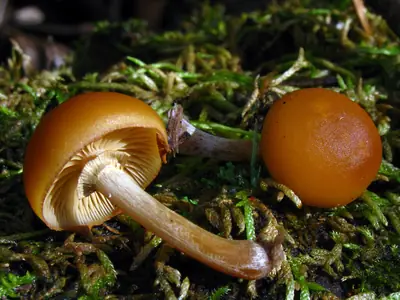
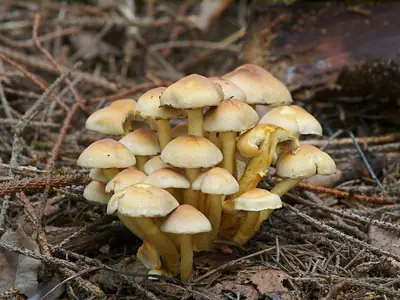
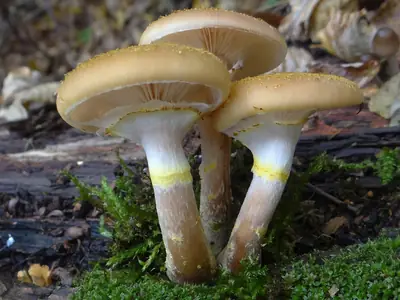
Foragers’ finds
All photosPhotos and identifications are added by users; we do not check them. Add your own find →
In the kitchen
Suitable for soups and sauces; eat only the caps (the stems are fibrous). Not suitable for pickling in vinegar; colours soup brown.
Protection and sale
- Species protection: the species is not protected.
- Sale: the species is not on the list of mushrooms approved for sale. On the list of mushrooms permitted for sale, but only “from cultivation or from outside the territory of the Republic of Poland” – specimens picked in the wild in Poland may not be sold.
Sheathed woodtuft: common questions
Is the sheathed woodtuft edible?
Edible. A good edible mushroom, but NOT RECOMMENDED for beginners: the deadly poisonous funeral bell is very similar (the author of grzyby.pl and First Nature recommend treating it as “for looking at only”). Pick only when certain about every single fruit body.
When does the sheathed woodtuft grow?
In Poland the fruiting bodies usually appear in: April, May, June, July, August, September, October, November, December. Habitat: Common; gregarious in dense clusters on stumps and trunks of broadleaf trees (alder, birch, beech, hornbeam, willow), rarely on conifers (mainly in the mountains), in forests, parks and gardens.
What can the sheathed woodtuft be mistaken for?
Funeral bell (deadly poisonous): Deadly poisonous (amatoxins). The funeral bell has white, flattened fibrils below the ring instead of scales, a mealy smell, often grows on coniferous wood; its cap dries from the margin towards the centre. The differences can be subtle – if in doubt, do not pick. Sulphur tuft (poisonous): The sulphur tuft has a sulphur-yellow cap, greenish and purple-black gills, a dark spore print, no membranous ring and a bitter taste. Honey fungus (edible with care): Edible, but easily confused with the funeral bell. The sheathed woodtuft has a rusty-brown spore print, cinnamon gills and a cap that dries from the centre (two-toned); the honey fungus has a white spore print.
Sources
- Wikipedia (pl): Łuskwiak zmienny
- grzyby.pl (atlas M. Snowarskiego): Kuehneromyces mutabilis
- First Nature: Kuehneromyces mutabilis
- Rozporządzenie Ministra Zdrowia w sprawie grzybów dopuszczonych do obrotu… – tekst jednolity Dz.U. 2026 poz. 258
Last checked: 9 November 2026. Spotted a mistake? Write to us.