Gilled mushrooms
Sulphur tuft
Hypholoma fasciculare · also known as: Clustered woodlover
Poisonous
Poisonous – causes gastrointestinal poisoning; First Nature mentions severe cases and at least one probable death. The very bitter taste usually prevents poisoning, but in a mix with other mushrooms the bitterness may go unnoticed. Confusing it with the honey fungus is a classic mistake.
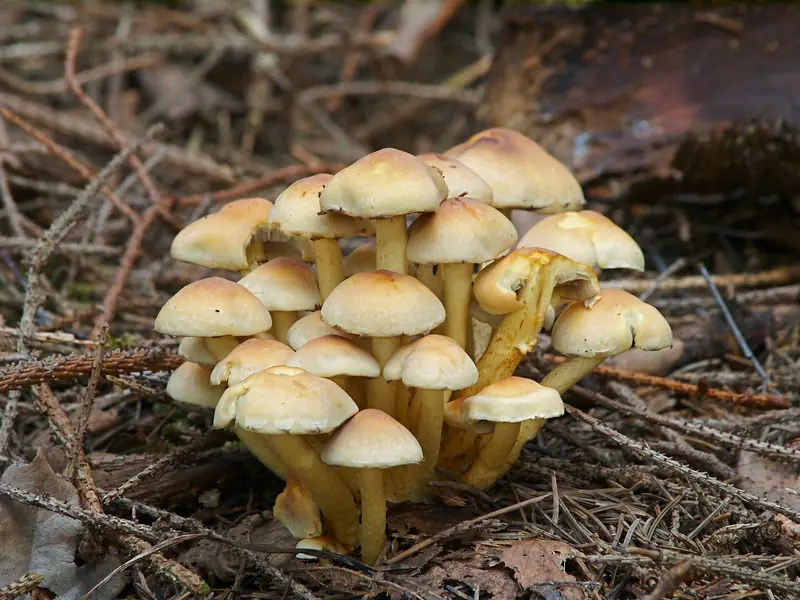
How to recognise it: sulphur tuft
- 1
Sulphur-yellow clusters on stumps
- 2
Gills yellow, then greenish and purple-black
- 3
Dark, purple-brown spore print
- 4
No membranous ring
- 5
Very bitter taste
Description
- Cap
- Up to 7 (12) cm, sulphur-yellow with a darker, orange-rusty centre, smooth, dry; margin with remnants of a yellowish, cobweb-like veil.
- Gills
- Gills crowded, sulphur-yellow in young specimens, then greenish (olive), finally purple-black from the spores.
- Stem
- Thin (up to 1 cm), curved, hollow, yellowish, brown towards the base; instead of a ring only a cobwebby zone; stems in a cluster fused at the base.
- Flesh
- Thin, sulphur-yellow, brown at the stem base; does not change colour (the stem turns brown when pressed).
- Smell and taste
- Smell indistinct; taste very bitter. Spore print purple-violet-brown.
Where and when it grows
Very common; in masses, in clusters on rotting stumps and trunks of broadleaf trees, less often conifers, also on buried wood (then it “grows from the ground”).
Most often with: broadleaf trees, conifers
Look-alikes: what it can be mistaken for
Honey fungus Edible with care high risk of confusion
The honey fungus has a white spore print, whitish/beige gills (never greenish) and a membranous ring; the cap is honey-brown with dark scales.
Step-by-step comparison: Honey fungus or sulphur tuft →Sheathed woodtuft Edible medium risk
The sheathed woodtuft has a membranous ring, a warm brown cap, rusty-brown gills and spore print, and a mild taste. Note: the edible conifer tuft (Hypholoma capnoides; grey gills, mild taste, grows on conifers) is also similar – only for the experienced.
Step-by-step comparison: Sheathed woodtuft or sulphur tuft →
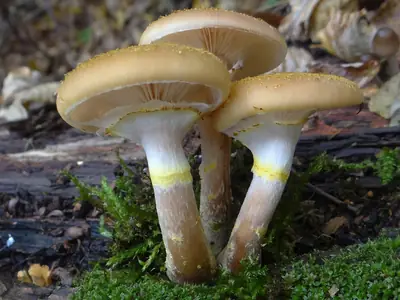
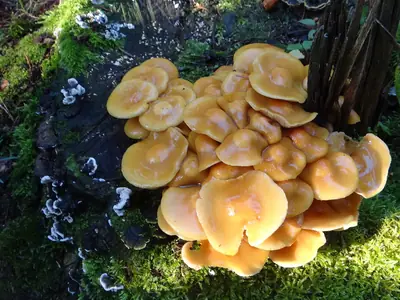
Foragers’ finds
All photosPhotos and identifications are added by users; we do not check them. Add your own find →
Protection and sale
- Species protection: the species is not protected.
- Sale: the species is not on the list of mushrooms approved for sale.
Sulphur tuft: common questions
Is the sulphur tuft edible?
Poisonous. Poisonous – causes gastrointestinal poisoning; First Nature mentions severe cases and at least one probable death. The very bitter taste usually prevents poisoning, but in a mix with other mushrooms the bitterness may go unnoticed. Confusing it with the honey fungus is a classic mistake.
When does the sulphur tuft grow?
In Poland the fruiting bodies usually appear in: April, May, June, July, August, September, October, November, December. Habitat: Very common; in masses, in clusters on rotting stumps and trunks of broadleaf trees, less often conifers, also on buried wood (then it “grows from the ground”).
What can the sulphur tuft be mistaken for?
Honey fungus (edible with care): The honey fungus has a white spore print, whitish/beige gills (never greenish) and a membranous ring; the cap is honey-brown with dark scales. Sheathed woodtuft (edible): The sheathed woodtuft has a membranous ring, a warm brown cap, rusty-brown gills and spore print, and a mild taste. Note: the edible conifer tuft (Hypholoma capnoides; grey gills, mild taste, grows on conifers) is also similar – only for the experienced.
Sources
- Wikipedia (pl): Maślanka wiązkowa
- grzyby.pl (atlas M. Snowarskiego): Hypholoma fasciculare
- First Nature: Hypholoma fasciculare
Last checked: 9 November 2026. Spotted a mistake? Write to us.