
Dangerous mistake
Honey fungus or sulphur tuft? How to tell them apart
Honey fungus is edible only with care, while the sulphur tuft is a poisonous mushroom. Compare the two mushrooms point by point.
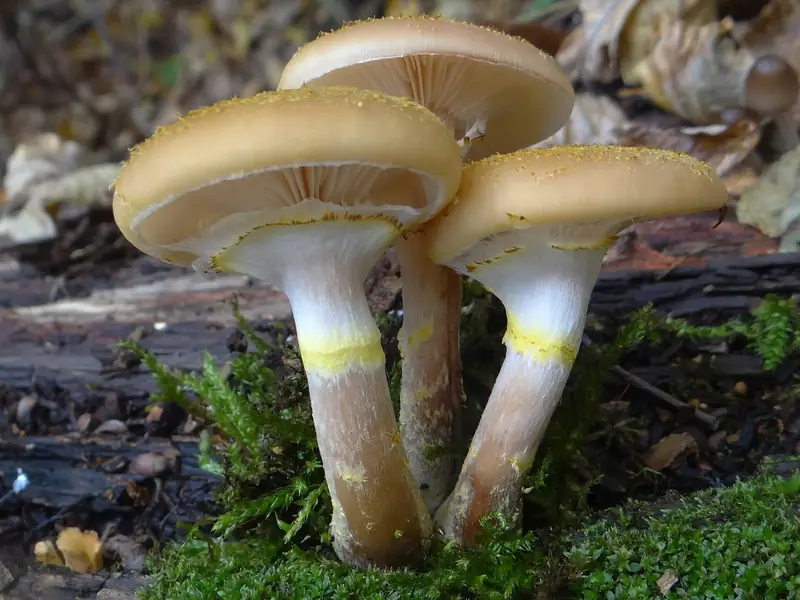
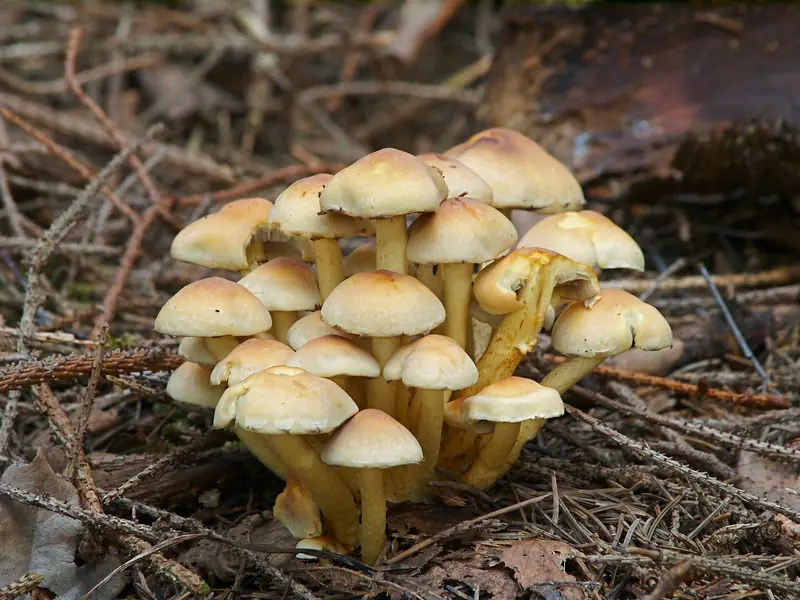
Poisonous, grows in similar clusters on stumps. The sulphur tuft has a sulphur-yellow cap, sulphur-yellow, then greenish and purple-black gills, a dark (purple-brown) spore print, no membranous ring and a very bitter taste.
The honey fungus has a white spore print, whitish/beige gills (never greenish) and a membranous ring; the cap is honey-brown with dark scales.
Feature by feature
| Feature | Honey fungus | Sulphur tuft |
|---|---|---|
| Edibility | Edible with care | Poisonous |
| Cap | 3–13 cm across, honey-yellow to olive- or reddish-brown, darker in the centre, with fine dark scales (disappearing with age); margin striate in young specimens. | Up to 7 (12) cm, sulphur-yellow with a darker, orange-rusty centre, smooth, dry; margin with remnants of a yellowish, cobweb-like veil. |
| Under the cap | Gills whitish, later beige-pinkish and yellowish with brown spots, crowded, adnate to slightly decurrent. | Gills crowded, sulphur-yellow in young specimens, then greenish (olive), finally purple-black from the spores. |
| Stem | Long (5–20 cm), slender, darker towards the base, stems in a cluster fused together; a distinct, persistent, membranous ring, whitish to yellowish. | Thin (up to 1 cm), curved, hollow, yellowish, brown towards the base; instead of a ring only a cobwebby zone; stems in a cluster fused at the base. |
| Flesh | Whitish to pale flesh-coloured, does not change colour when cut; fibrous in the stem of older specimens. | Thin, sulphur-yellow, brown at the stem base; does not change colour (the stem turns brown when pressed). |
| Smell and taste | Smell faint, pleasant; taste when raw mild, then astringent, sourish. Spore print white to cream. | Smell indistinct; taste very bitter. Spore print purple-violet-brown. |
| Habitat | Grows gregariously, in large clusters on trunks, stumps and roots of broadleaf trees (oak, hornbeam, beech, fruit trees) in forests, parks and orchards; a parasite causing root rot. Armillaria mellea in the strict sense is fairly rare in Poland; Armillaria ostoyae on conifers is more common. | Very common; in masses, in clusters on rotting stumps and trunks of broadleaf trees, less often conifers, also on buried wood (then it “grows from the ground”). |
| Season | August, September, October, November | April, May, June, July, August, September, October, November, December |
How to recognise it: honey fungus
- Large clusters on wood or tree roots
- Membranous ring on the stem
- White spore print
- Honey-brown cap with fine dark scales in the centre
- Do not eat raw – always parboil
How to recognise it: sulphur tuft
- Sulphur-yellow clusters on stumps
- Gills yellow, then greenish and purple-black
- Dark, purple-brown spore print
- No membranous ring
- Very bitter taste
Safety rule
Never eat a mushroom identified only from a website, a photo or an app. Show any doubtful specimen to a certified mushroom inspector at the sanepid (state sanitary inspection); in season the advice points are free. Do not give wild-picked mushrooms to children.
The golden rules of foraging →Frequently asked questions
Honey fungus or sulphur tuft: how can you tell them apart?
Poisonous, grows in similar clusters on stumps. The sulphur tuft has a sulphur-yellow cap, sulphur-yellow, then greenish and purple-black gills, a dark (purple-brown) spore print, no membranous ring and a very bitter taste. The honey fungus has a white spore print, whitish/beige gills (never greenish) and a membranous ring; the cap is honey-brown with dark scales.
Sulphur tuft: what to do if you have eaten it?
Call 112 at once or go to A&E (SOR), and take any leftover mushrooms with you. Fasciculols (triterpenes) – gastrointestinal syndrome (abdominal pain, nausea, vomiting, diarrhoea). Latency according to Wikipedia up to 3 hours, according to First Nature usually 5–10 hours; rarely a severe course.
Sources
- Wikipedia (pl): Opieńka miodowa
- grzyby.pl (atlas M. Snowarskiego): Armillaria mellea
- First Nature: Armillaria mellea
- Wikipedia (pl): Maślanka wiązkowa
- grzyby.pl (atlas M. Snowarskiego): Hypholoma fasciculare
- First Nature: Hypholoma fasciculare
Last checked: 9 November 2026. Spotted a mistake? Write to us.