
Tooth fungi (spines)
Shingled hedgehog
Sarcodon imbricatus · also known as: Scaly hedgehog, Scaly tooth
Edible
Young fruit bodies are edible; older ones are tough and bitterish. According to Wikipedia it can be poisonous raw – always cook it. Name: since 2003 the recommended Polish name is “sarniak świerkowy” (S. imbricatus, under spruces); the very similar Sarcodon squamosus grows under pines and is distinguished mainly by the tree – foragers call both “sarna” (“roe deer”).
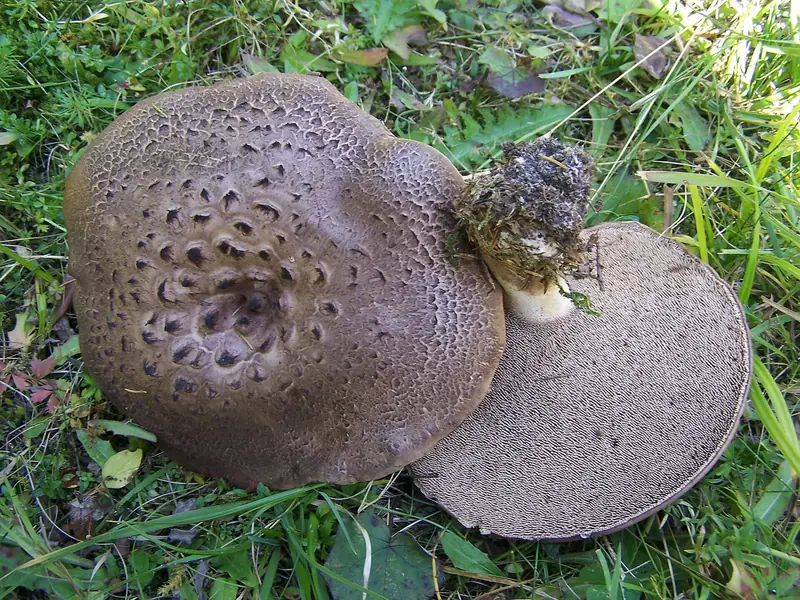
How to recognise it: shingled hedgehog
- 1
Large brown cap with coarse, raised scales like roof tiles
- 2
Spines instead of gills under the cap
- 3
Grows under spruces (Sarcodon squamosus – under pines)
- 4
Spicy smell
Description
- Cap
- Large, 6–25 cm, thick-fleshed, depressed with age; brown with a reddish tinge, covered with coarse, dark brown, raised scales arranged concentrically (like roof tiles).
- Spines
- Instead of gills, crowded, brittle spines, whitish, then grey to brown, decurrent down the stem.
- Stem
- 3–8 cm × 1–3 cm, cylindrical to club-shaped, solid, whitish when young, then grey-brown, velvety.
- Flesh
- Elastic, dry, whitish to grey-brown, brownish at the stem base.
- Smell and taste
- Smell spicy, taste pleasant (bitterish in older specimens). Spore print grey-brown.
Where and when it grows
On the ground in coniferous forests, above all in mountain spruce forests, on acidic and sandy soils; singly or in groups. Locally common, especially in the mountains; on the Polish Red List in category V (vulnerable).
Most often with: spruce, pine
Look-alikes: what it can be mistaken for
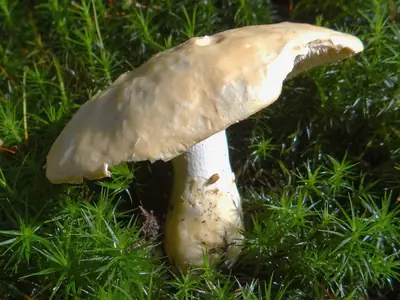
Hedgehog mushroom Edible low risk
Also has spines, but it is pale (cream to orange), with a smooth cap without scales; both species are edible.
Foragers’ finds
All photosPhotos and identifications are added by users; we do not check them. Add your own find →
In the kitchen
Pick only young specimens; rarely preserved, because it darkens; do not eat raw. Rarely maggoty.
Protection and sale
- Species protection: the species is not protected. Until 2014 the whole genus Sarcodon was protected; S. imbricatus is now not protected. Rare species remain strictly protected: S. glaucopus, S. scabrosus, S. joeides and S. underwoodii – they have finer scales and often a bluish/greenish stem base or bitter flesh; do not pick such specimens.
- Sale: the species is not on the list of mushrooms approved for sale.
Shingled hedgehog: common questions
Is the shingled hedgehog edible?
Edible. Young fruit bodies are edible; older ones are tough and bitterish. According to Wikipedia it can be poisonous raw – always cook it. Name: since 2003 the recommended Polish name is “sarniak świerkowy” (S. imbricatus, under spruces); the very similar Sarcodon squamosus grows under pines and is distinguished mainly by the tree – foragers call both “sarna” (“roe deer”).
When does the shingled hedgehog grow?
In Poland the fruiting bodies usually appear in: July, August, September, October. Habitat: On the ground in coniferous forests, above all in mountain spruce forests, on acidic and sandy soils; singly or in groups. Locally common, especially in the mountains; on the Polish Red List in category V (vulnerable).
What can the shingled hedgehog be mistaken for?
Hedgehog mushroom (edible): Also has spines, but it is pale (cream to orange), with a smooth cap without scales; both species are edible.
Sources
- Wikipedia (pl): Sarniak świerkowy
- grzyby.pl (atlas M. Snowarskiego): Sarcodon imbricatus
- First Nature: Sarcodon squamosus
- Rozporządzenie Ministra Środowiska z dnia 9 października 2014 r. w sprawie ochrony gatunkowej grzybów (Dz.U. 2014 poz. 1408)
Last checked: 9 November 2026. Spotted a mistake? Write to us.