Fruit
Guelder rose
Viburnum opulus L. · European cranberry bush, water elder, cramp bark · Polish: Kalina koralowa
Edible with care
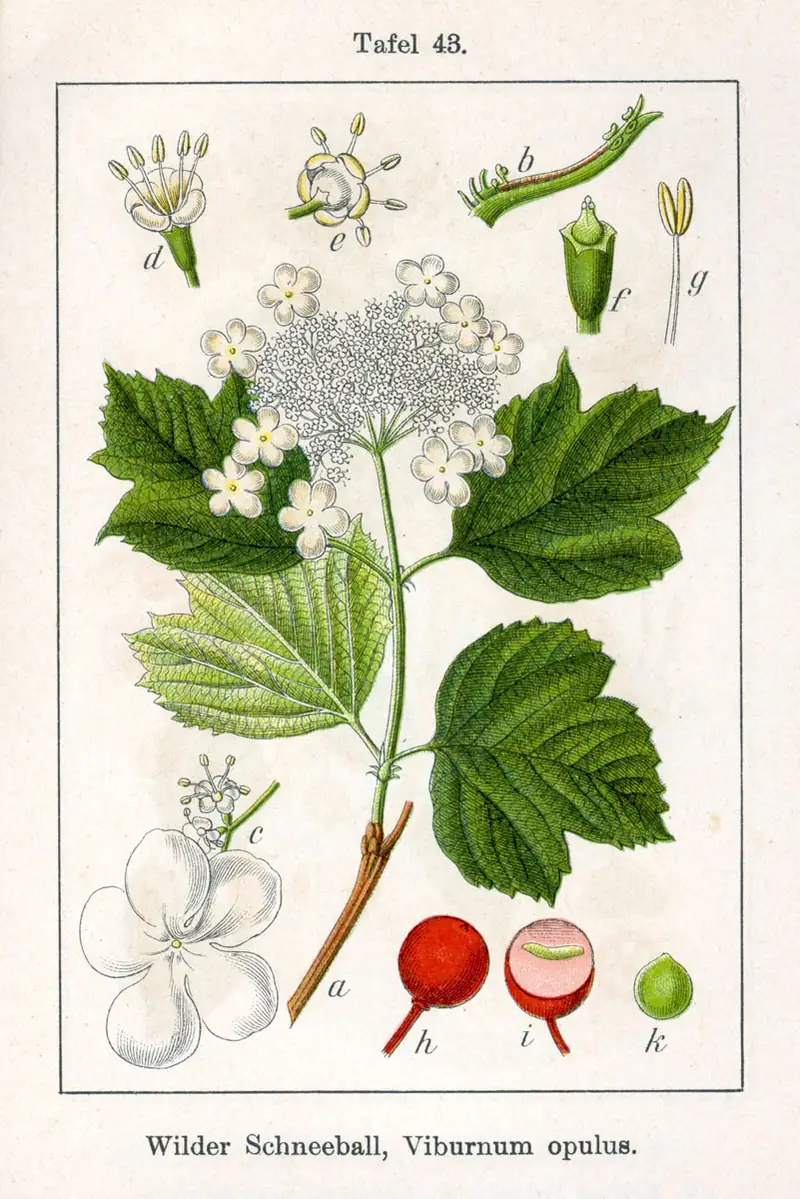
How to identify it
- Leaves bluntly lobed, with three (less often five) lobes.
- Flowers in flat-topped clusters: the outer ones large (15–25 mm) and sterile, the central ones small (May–July).
- Berries scarlet, glossy drupes 8–10 mm, in drooping clusters; they ripen in August–September and stay on the shrub for a long time.
Where it grows
Damp or at least moist woodland and scrub.
In the kitchen and the home medicine cabinet
Frozen or heat-treated berries lose their bitterness; traditionally they were picked after the frosts for syrups, and also for jellies, marmalades, nalewki and as a filling for pierogi.
Caution Raw berries (containing the glycoside viburnin) are harmful in large amounts, especially to children — they can cause, among other things, dilated pupils and acute inflammation of the digestive tract. Once processed, especially boiled, the berries are harmless. Legal status: guelder rose was partially protected under the 2012 regulation (Dz.U. 2012 poz. 81), but it is no longer in the 2014 regulation (Dz.U. 2014 poz. 1409) — it is not currently protected.
Frequently asked questions
When is Guelder rose in season?
In Poland, usually in September, October, November.
Sources
- Wikipedia: Kalina koralowa
- Rozporządzenie Ministra Środowiska z 9 października 2014 r. w sprawie ochrony gatunkowej roślin (Dz.U. 2014 poz. 1409)
- Nadleśnictwo Browsk (Lasy Państwowe): Puszcza Białowieska wczesną jesienią (05.09.2021)
Last checked: 9 November 2026. Spotted a mistake? Write to us.