Fruit
Black chokeberry
Aronia melanocarpa (Michx.) Elliott · aronia, chokeberry · Polish: Aronia czarnoowocowa
Edible
How to identify it
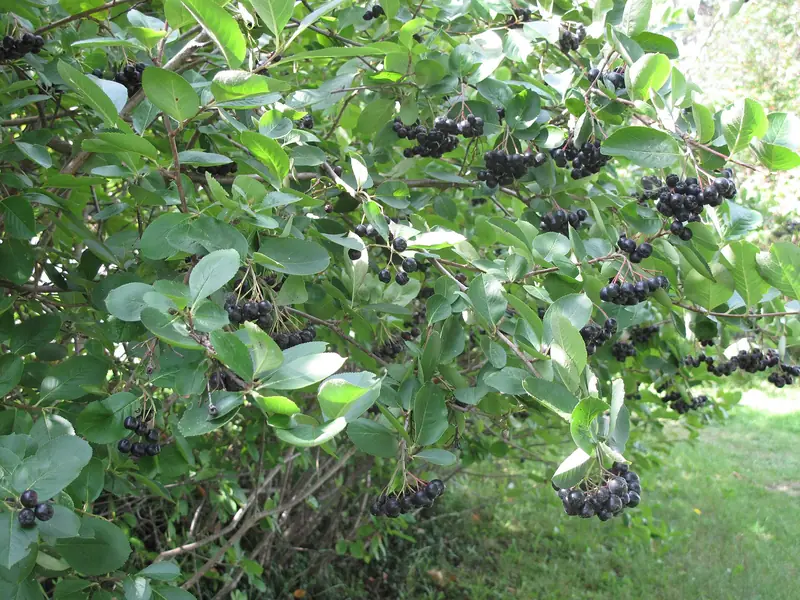
- Leaves alternate, dark green, up to 6 cm long, orange to red in autumn.
- White flowers in flat-topped clusters (May).
- Berries dark navy-blue, almost black, about 10 mm across, with a faint bloom, in clusters.
- Fresh berries taste astringent and slightly bitter (tannins).
Where it grows
A North American species, grown in Poland in plantations and gardens and occasionally planted in forests; locally naturalised in Pomerania (including on bogs).
In the kitchen and the home medicine cabinet
The berries are rarely eaten raw because of their astringency; they are made into juices, jams, powidła (fruit butter), jellies, preserves and nalewki.
Caution Only eat berries from shrubs you know. Feral shrubs on bogs may be growing in protected areas. Only pick from someone else's plantation or garden with the owner's permission.
What not to confuse it with
Deadly nightshade Deadly poisonous
The Ministry of Health warns that the fruits of some poisonous plants look very much like chokeberries or bilberries. Deadly nightshade has single glossy berries sitting on a green calyx, on a perennial herb — not clusters on a shrub.
Frequently asked questions
When is Black chokeberry in season?
In Poland, usually in August, September.
What can Black chokeberry be confused with?
Deadly nightshade: The Ministry of Health warns that the fruits of some poisonous plants look very much like chokeberries or bilberries. Deadly nightshade has single glossy berries sitting on a green calyx, on a perennial herb — not clusters on a shrub.
Sources
- Wikipedia: Aronia czarnoowocowa
- IBPRS: Aronia – ocena jakości polskich superowoców
- pacjent.gov.pl: Co robić w przypadku zatrucia (20.04.2022)
Last checked: 9 November 2026. Spotted a mistake? Write to us.