Fruit
Bilberry
Vaccinium myrtillus L. · European blueberry, whortleberry, blaeberry, wild blueberry · Polish: Borówka czarna (jagoda)
Edible
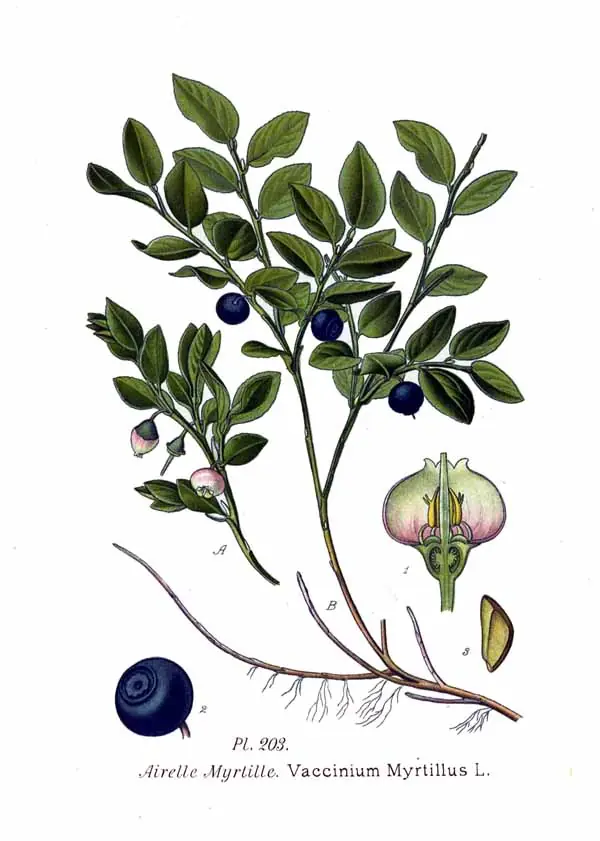
How to identify it
- Dwarf shrub 15–30 cm tall; young shoots green, angled, with sharp edges.
- Leaves light green, thin, hairless.
- Berries borne singly, black with a bluish, waxy bloom; the pigment (myrtillin) stains the tongue dark.
- In Poland the main fruiting usually runs from the second half of June to mid-July, in some places until September.
Where it grows
Common in coniferous and mixed woodland, on acidic, sandy and poor but sufficiently moist soils.
In the kitchen and the home medicine cabinet
Fresh, with sugar and cream, in pierogi and blueberry buns (jagodzianki), for preserves and juices, frozen or dried. In the forest the berries are picked by hand from the plants, without damaging them and with as few leaves as possible.
Caution The rules prohibit the use of berry ‘machines’, pickers and combs and the destruction of plants — you can be fined for this (State Forests – Lasy Państwowe). Do not gather berries that have fallen to the ground, and always wash them under running water (in a sieve) — risk of echinococcosis; tapeworm eggs die in about a minute at 100 °C. If you are not sure they are bilberries, do not pick them. Picking is prohibited in national parks and nature reserves, and also in other forests where a ban is signposted.
What not to confuse it with
Deadly nightshade Deadly poisonous
Deadly nightshade berries are easily mistaken for bilberries. Deadly nightshade is a herbaceous plant, not a low dwarf shrub; it has glossy, purple-black, cherry-sized berries borne singly and surrounded by a green calyx. Eating a few berries can be life-threatening.
Frequently asked questions
When is Bilberry in season?
In Poland, usually in June, July, August.
What can Bilberry be confused with?
Deadly nightshade: Deadly nightshade berries are easily mistaken for bilberries. Deadly nightshade is a herbaceous plant, not a low dwarf shrub; it has glossy, purple-black, cherry-sized berries borne singly and surrounded by a green calyx. Eating a few berries can be life-threatening.
Sources
- Wikipedia: Borówka czarna
- Lasy Państwowe: Idziemy na jagody! (13.07.2015)
- Nadleśnictwo Babki (Lasy Państwowe): Wyruszamy na jagody (21.07.2021)
- mp.pl (lek. Magdalena Wiercińska): Jagody i grzyby leśne – jak jeść bezpiecznie? (30.07.2025)
- mp.pl: Truciciele z naszych lasów (prof. A. Matkowski, 11.07.2025)
Last checked: 9 November 2026. Spotted a mistake? Write to us.